Planets align and Winter Triangle brightens across UAE skies this month
Residents stepping outside across Abu Dhabi and the wider UAE late at night or before dawn this November are in for a clear view of several distinct planetary alignments and historical star clusters.
Nighttime viewing routines shift to late hours and pre-dawn horizons
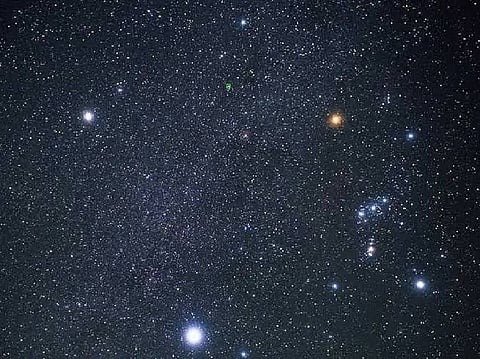
Ibrahim Al Jarwan, Chairman of the Emirates Astronomy Society and member of the Arab Union for Astronomy and Space Sciences, confirmed that celestial activity will pick up steadily throughout the month. The Winter Triangle, a primary constellation guide used historically by Arab navigators during winter sea voyages, is becoming increasingly prominent as nights progress. The formation is anchored by Sirius in Canis Major (the brightest star in the night sky) and Procyon in Canis Minor at its base, with the reddish-orange supergiant Betelgeuse in Orion marking the top point.
For residents planning late-night or early-morning observation, viewing conditions depend heavily on the target planet:
- Saturn: Visible in the evening sky as a steady yellow point of light. A standard telescope reveals its ring structure.
- Venus: Rises above the eastern horizon in the pre-dawn hours.
- Jupiter and Mars: Both planets become visible after midnight and into the early morning. Around the middle of November, Mars and Jupiter appear closely aligned, allowing observers to contrast Mars’ reddish hue directly beside Jupiter’s bright disk.
- Mercury: Stays close to the Sun, making observation difficult until the second half of November, when it becomes visible shortly before sunrise for those with an unobstructed horizon.
Clear horizons and minimal urban light pollution remain the primary requirements for viewing these astronomical alignments across the country throughout the rest of November.