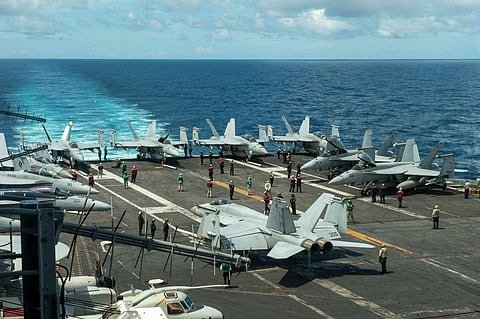
3 US Carriers Deployment Shadowed by Russian Orbital Intelligence
The deployment of a third U.S. aircraft carrier strike group to the Middle East is designed to establish absolute escalation dominance over Tehran, but space-based reconnaissance threatens to strip American forces of operational surprise. Moscow’s satellite constellation is actively tracking strategic naval and land assets across the region, potentially delivering real-time targeting and early-warning intelligence to Iranian commanders.
Dual Vectors of Escalation and Reconnaissance
The operational environment shifted significantly with the arrival of the USS Theodore Roosevelt in regional waters, joining the USS George H.W. Bush and USS George Washington. While this triple-carrier presence establishes massive strike potential, strategic deterrence is being counterbalanced by orbital surveillance capabilities capable of neutralizing tactical stealth.
+———————————————————————–+
| REGIONAL NAVAL & AIRFORCE ASSETS |
|---|
| U.S. Carrier Deployments: |
|---|
| • USS Theodore Roosevelt (Recently Arrived) |
| • USS George H.W. Bush |
| • USS George Washington |
| Key Target & Base Incidents Cited: |
| • Prince Sultan Air Base (Saudi Arabia) |
| – March 27 attack injured 12 U.S. personnel |
| – Destroyed/damaged airborne warning & control aircraft |
| – 14 Russian satellites tracked overhead 2 days prior |
| • East-West Oil Pipeline & Saudi Military Installations |
| – Tracked across 40 missile/drone strikes (July, October) |
Analysis by geospatial intelligence project AURORAH reveals that Moscow operates at least 20 spacecraft within the Kosmos-2600 series. This orbital network combines optical imagery, synthetic aperture radar, and electronic signals intelligence. Nawaf Obaid, a senior fellow at King’s College London’s Department of War Studies and founder of AURORAH, confirmed that these satellites continuously monitor changes in force posture, flight schedules, and carrier positioning, providing Tehran with critical early warning ahead of prospective strikes.
U.S. posture remains caught between active deployment and executive hesitation. On November 14, reports surfaced that U.S. President Donald Trump informed advisers he might hold off on direct offensive actions unless Iran or its allied Houthi forces execute new provocations. However, the presence of three carrier strike groups signals that retaliatory targeting packages, spanning Iranian nuclear, oil, and military infrastructure, are fully staged.
Documented Orbital Assistance and Strike Dynamics
Evidence of operational overlap between Russian space assets and proxy strikes has mounted steadily throughout the year:
- Prince Sultan Air Base Strike: On March 27, an Iranian precision strike hit Prince Sultan Air Base in Saudi Arabia, injuring 12 American personnel and damaging or destroying critical military hardware, including a U.S. airborne warning and control aircraft. Intelligence sources and U.S. officials confirmed that 14 Russian reconnaissance satellites passed directly over the base two days prior to the attack, supplying data that facilitated precise target acquisition.
- Energy and Military Infrastructure Targeting: An investigation published on October 27 tracked satellite activity tied to 40 separate missile and drone attacks launched by Houthi and Iraqi militia forces between July and October. AURORAH’s surveillance logs mapped Russian satellites hovering over sensitive targets, including Saudi Arabia’s East-West oil pipeline and key defense sites, immediately before and after strikes.
- State-Level Coordination: Saudi officials, senior Houthi figures, and defense analysts verified that Russian intelligence shared target telemetry with Iran-aligned groups, even as Moscow officially dismissed the findings as groundless.
Corporate Impact and Supply Chain Exposure
For executive leadership, multi-national operators, and logistics directors across the Gulf, this intelligence dynamic transforms regional risk exposure.
#### Maritime Logistics and Shipping Insurance The deployment of three carrier strike groups alongside active Houthi targeting capabilities elevates risk profiles across the Red Sea and Arabian Gulf. Commercial maritime entities face sudden spikes in War Risk insurance premiums. Tracking data showing satellite-assisted precision strikes means dual-use commercial ports and energy terminals remain vulnerable to collateral disruption.
#### Critical Infrastructure and Energy Operations The documented mapping of Saudi Arabia’s East-West oil pipeline demonstrates that energy infrastructure remains a primary tactical target. Facility managers and energy operators must factor high-altitude surveillance into operational security protocols, acknowledging that camouflage or routine shifts in staging will not evade radar satellite passes.
#### Defense Sector Compliance and Cyber Security Commercial contractors operating out of regional installations, such as Prince Sultan Air Base, face heightened force-protection requirements. The verification of electronic intelligence gathering via the Kosmos-2600 constellation means corporate communications, telemetry, and unencrypted logistics data face continuous interception risk.
Strategic Limits of the Orbital Intelligence Nexus
Despite documented satellite movements over strike locations, significant intelligence gaps remain. Researchers at AURORAH explicitly acknowledged that while orbital passes directly correlate with tactical strikes on the ground, intelligence analysts have not directly intercepted or verified the raw data transfer pipelines operating between Russian space command and Iranian intelligence headquarters.
Furthermore, satellite surveillance alone cannot offset raw U.S. firepower. Moscow’s space assets provide situational awareness, but they do not supply Iran with air defense interception capabilities capable of stopping a coordinated multi-carrier strike. While Russian intelligence reduces U.S. operational surprise, it does not rewrite the fundamental balance of conventional military power in the region.