Dubai Metro Blue Line Takes Shape: 30km Route, 2 Iconic Stations
The Dubai Metro Blue Line is beginning to take shape, with major construction milestones already being reached as work accelerates on one of the city’s most significant transport projects. Just two months after tunnelling works officially began, the Roads and Transport Authority (RTA) announced the completion of the first phase of excavation in July, a sign of how far construction technology has advanced since Dubai’s original Metro network was built nearly two decades ago. Local residents and commuters are set to benefit from the new line, which will connect emerging residential communities, economic centres, and key destinations, supporting the goals of the Dubai 2040 Urban Master Plan.
The Blue Line will feature two key stations: a record-sized interchange at Dubai International City 1, spanning over 44,000 square metres, and the world’s tallest metro station at Emaar Properties Station, standing at 74 metres. The latter, designed by Skidmore, Owings & Merrill, will serve Dubai Creek Harbour, a waterfront community of roughly 40,000 residents, with ridership expected to cross 70,000 a day by 2040.
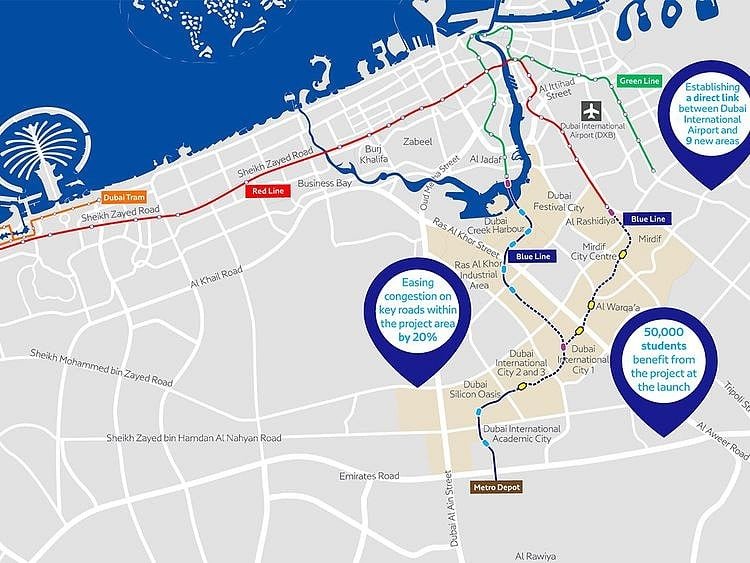
The Blue Line will span 30 kilometres across two routes, improving links between several rapidly developing districts. The first route, stretching 21 kilometres and comprising 10 stations, will begin at Creek Interchange Station on the Green Line in Al Jaddaf, passing through Dubai Festival City, Dubai Creek Harbour, Ras Al Khor Industrial Area, International City 1, International City 2 and 3, Dubai Silicon Oasis, and Dubai Academic City. The second route will extend nine kilometres from Centrepoint Interchange Station on the Red Line in Al Rashidiya, travelling through Mirdif and Al Warqa’a before connecting with the International City 1.
The construction of the Blue Line is a significant step towards achieving the goals of the Dubai 2040 Urban Master Plan, which aims to create a more sustainable and connected city. The RTA’s use of advanced tunnelling technology, including the Al Wugeisha tunnel boring machine, has enabled faster progress, with the first phase of tunnelling completed in just two months.
The Dubai Metro Blue Line is connected to the city’s previous transport developments, such as the expansion of the Red and Green Lines, which have already improved the city’s public transport network.
Dubai International City 1 will be home to the largest underground interchange station, covering over 44,000 square metres, and is expected to move an estimated 350,000 people through it daily.