7.7-Magnitude Earthquake Strikes Eastern Indonesia, Killing at Least 47
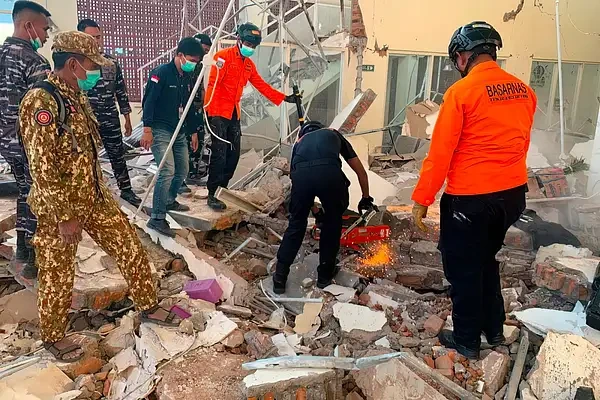
A 7.7-magnitude earthquake struck off eastern Indonesia’s Flores Island on August 15, 2026, causing widespread destruction and killing at least 47 people. The earthquake triggered tsunami waves of less than 1 meter and dozens of aftershocks, hampering rescue efforts. Rescuers are searching for survivors amidst landslides, power outages, and damaged communications.
The earthquake hit just north of Flores Island, about a thousand miles east of Jakarta, the capital. It caused several buildings to collapse on the island, and was one of the largest temblors to hit the area in more than 30 years. The national disaster mitigation agency BNPB initially reported one dead and four injured, but the death toll has since risen to at least 47.
The governor of East Nusa Tenggara Province, Emanuel Melkiades Laka Lena, told a press conference that the deaths were caused by collapsing rubble as people slept. The United States Geological Survey reported that the earthquake was one of the largest the region had experienced in decades.
This disaster is the latest in a series of natural disasters to affect Indonesia, which is located on the Pacific Ring of Fire. The country is prone to earthquakes, tsunamis, and volcanic eruptions due to its location on the intersection of several tectonic plates.
The earthquake has caused significant damage and disruption to the affected areas, with many buildings destroyed and power outages reported. The full extent of the damage is still being assessed, but it is clear that the earthquake has had a devastating impact on the region.
In recent years, Indonesia has experienced several major earthquakes, including a 7.5-magnitude earthquake that struck the island of Sulawesi in 2018, killing over 4,000 people. The country has also been affected by other natural disasters, such as tsunamis and volcanic eruptions, which have caused significant loss of life and damage to infrastructure.


USS Abraham Lincoln Returns Home
USS Abraham Lincoln Ends 266-Day Deployment
The USS Abraham Lincoln is returning home after completing a 266-day extended combat deployment in West Asia. Local residents with family members on board are eagerly awaiting the aircraft carrier's arrival. The strike group was deployed to maintain maritime security and deterrence during heightened regional tensions.
The USS Abraham Lincoln's deployment lasted 266 days, during which it played a crucial role in maintaining regional stability. The US Navy's decision to deploy the aircraft carrier to West Asia was made in response to increased tensions in the region.
The Strait of Hormuz crisis has been a significant concern for the US Navy, with the USS Abraham Lincoln being part of the efforts to ensure maritime security. Although the crisis is still ongoing, the USS Abraham Lincoln's return marks the end of its extended deployment.
The USS Abraham Lincoln's return home is a significant development, coming after a prolonged period of heightened tensions in West Asia. The aircraft carrier's deployment was part of a broader effort by the US Navy to maintain stability in the region.

Jason Arday: UK PM Andy Burnham Calls Death Tragedy
Jason Arday's Death Sparks Reflection from UK PM Andy Burnham
British Prime Minister Andy Burnham described the death of Jason Arday, the University of Cambridge's youngest ever Black professor, as a "tragedy on so many levels" after Arday was found dead at the age of 41. Arday had resigned from his position as a professor of sociology of education earlier this month following accusations of plagiarism, which he denied. Burnham's comments came a day after Arday's body was discovered in Battersea, southwest London, with the Metropolitan Police stating that the death is not believed to be suspicious.
The prime minister urged reflection, saying, "It's not a moment for any rushing to judgement. It's a moment for reflection, I would say, reflecting on how things came to this." Arday's family had stated that he was the victim of a campaign of misinformation and harassment. The death has sparked a call for reflection on the circumstances surrounding Arday's resignation and the impact of public controversy on individuals.
Jason Arday's resignation from the University of Cambridge was a result of the plagiarism allegations, which he had denied. His death has prompted responses from UK leaders, with Burnham leading the call for reflection. The Metropolitan Police have confirmed that the death is not believed to be suspicious, but the exact circumstances are still being investigated.
The death of Jason Arday has been met with an outpouring of support for his family and friends, with many calling for a greater understanding of the pressures and challenges faced by those in the public eye. As the investigation into Arday's death continues, the UK is reflecting on the tragedy and the need for greater support and understanding for those affected by public controversy.

MOHRE Skill Levels: 9 Categories
Understanding MOHRE Skill Levels: A Guide to UAE Job Classification
If you're looking for a job in the UAE, understanding the Ministry of Human Resources and Emiratisation (MOHRE) skill levels is crucial. The MOHRE categorizes UAE jobs into nine distinct skill levels based on qualifications and responsibilities, which determines job eligibility, salary expectations, and visa processing requirements.
The MOHRE skill levels range from 1 to 9, with each level representing a specific set of qualifications and responsibilities. Skill Level 1 includes senior leadership roles such as CEOs, general managers, doctors, engineers, and senior consultants, which require advanced qualifications and extensive experience with high accountability.
Skill Level 2 covers scientific, technical, and professional fields, including IT specialists, architects, accountants, pharmacists, and data analysts, who apply specialized knowledge in technical or scientific domains and require post-secondary education and industry experience.
Skill Level 3 includes technicians and skilled support specialists who support professional functions through technical or supervisory expertise, such as technicians, supervisors, and office administrators. Sales executives and customer service professionals also fall under this category.
Skill Level 4 covers clerical and administrative support roles, including receptionists, secretaries, data entry operators, and office clerks, who perform routine administrative and documentation tasks.
Skill Level 5 includes service and sales professions, such as retail staff, hospitality workers, cashiers, and sales assistants, who dominate customer-facing roles.
The remaining levels, 6 to 9, cover skilled trades, machine operators, and elementary roles. This categorization helps determine job eligibility and simplifies visa processing and salary expectations for candidates.
For example, a Health Services Manager, with an MOHRE Code of 1342031 and a required certificate, falls under Skill Level 1. Similarly, an Aluminium Fabricator, with an MOHRE Code of 7283023 and a required certificate, falls under Skill Level 3.
Understanding the MOHRE skill levels is essential for job seekers in the UAE, as it affects their job eligibility, salary expectations, and visa processing requirements. By knowing the specific skill level and requirements for their desired job, candidates can better navigate the UAE labour market and increase their chances of securing employment.
The MOHRE profession list for 2024 provides detailed information on the various professions recognized by the ministry, including their respective ENSCO and MOHRE codes, along with the required certifications. This list serves as a valuable resource for job seekers, employers, and recruitment agencies, helping them to understand the UAE labour market categories and requirements.
In summary, the MOHRE skill levels provide a framework for understanding the UAE labour market and job requirements. By familiarizing themselves with these levels, job seekers can make informed decisions about their career paths and increase their chances of success in the UAE job market.

UAE Music Fees Start Dec 1
New Music Licensing Fees for UAE Businesses Start December 1
Starting December 1, 2026, restaurants, cafes, hotels, and retail shops across the UAE must pay annual music licensing fees under a new framework issued by the Ministry of Economy and Tourism. The fees, collected by the Emirates Music Rights Association and Music Nation, will support copyright compliance and fund national music culture. Annual fees for restaurants and cafes will start at Dh1,500, while shops playing copyrighted music will pay fees starting at Dh1,700.
The fee structure varies according to the size of the establishment and the type of music used. Restaurants and cafes with up to 50 seats will pay Dh1,500 annually, rising to Dh2,700 for 51 to 100 seats, and Dh4,800 for 101 to 200 seats. Establishments with more than 201 seats will pay an additional Dh20 per extra seat, though the total annual charge is capped at Dh6,000.
The Ministry of Economy and Tourism retains full supervisory powers, including the right to conduct field inspections, review financial records, receive complaints, and impose administrative penalties or revoke permits for non-compliance. The framework covers businesses including fitness centres, airlines, floating hotels, and entertainment events.
To comply with the new regulations, businesses must obtain a music licence from the Emirates Music Rights Association or Music Nation. The licences will be valid for one year and renewable under applicable rules. The fees collected will support copyright holders and allocate a portion to a national cultural fund for musicians.
The new music licensing fees are part of the UAE's efforts to standardise commercial music licensing and protect copyright holders. Businesses that play copyrighted music without a valid licence may face administrative penalties or have their permits revoked.
| Establishment Type | Annual Fee |
|---|---|
| Restaurants and cafes (up to 50 seats) | Dh1,500 |
| Restaurants and cafes (51-100 seats) | Dh2,700 |
| Restaurants and cafes (101-200 seats) | Dh4,800 |
| Restaurants and cafes (more than 201 seats) | Dh6,000 (max) |
| Shops playing copyrighted music | Dh1,700 (starting fee) |

Dubai Driver Fined Dh25,000
Dh25,000 Fine for Dubai Driver in Drug-Fuelled Crash
A 23-year-old driver in Dubai has been fined Dh25,000 and had their driving licence suspended after being convicted of a drug-fuelled crash. The court firmly rejected the defendant's attempts to deny the possession of narcotics and driving under the influence charges. This ruling highlights the strict penalties for driving offences in the UAE, including licence suspension, heavy fines, and jail terms, as outlined in Federal Decree-Law No. 14 of 2024.
The UAE's updated traffic law aims to enhance road safety, enforce accountability, and ensure only qualified individuals are allowed to drive across the UAE. Drivers can face penalties for reckless driving, driving under the influence, causing accidents, or failing to cooperate with authorities. Fines can reach up to Dh100,000, with imprisonment for serious or repeat violations.
To comply with the UAE's traffic laws, drivers must be aware of the various infractions and their respective fines and black points. For instance, driving under the influence of alcohol or drugs carries a fine of AED 20,000, 23 black points, and 60 days of vehicle impoundment. Reckless driving can result in a fine of AED 2,000, 23 black points, and 60 days of vehicle impoundment.
Here are some key traffic violations and their penalties in the UAE:
| Violation | Fine | Black Points | Vehicle Impoundment |
|---|---|---|---|
| Driving under the influence of alcohol or drugs | AED 20,000 | 23 | 60 days |
| Reckless driving | AED 2,000 | 23 | 60 days |
| Exceeding speed limit by more than 80 km/h | AED 3,000 | 23 | 60 days |
| Using a mobile phone while driving | AED 800 | 4 | |
| Not wearing a seatbelt (driver or passenger) | AED 400 | 4 |
Drivers in the UAE must take these laws seriously to avoid severe penalties, including fines, black points, and licence suspension. It is essential to be aware of the traffic laws and regulations to ensure road safety and avoid accidents.