Automated Payments and Cheaper Transfers: Inside the UAE Digital Dirham Plan
Sovereign digital cash is coming to the UAE, but not to replace your debit card
Your bank transfers, card taps, and Aani payments already move money in seconds, so the Central Bank of the UAE is building the Digital Dirham to do something entirely different. Rather than trying to speed up retail checkout counters, this central bank digital currency targets the backend of international trade, cross-border transfers, and automated business contracts.
As part of the Central Bank of the UAE’s Financial Infrastructure Transformation programme, the currency acts as an official layer of sovereign digital money. UAE Banks Federation Director-General Jamal Saleh emphasizes that the goal isn’t to phase out existing payment channels, but to introduce sovereign-backed security and lower settlement friction across the economy.
Smart contracts for businesses, familiar apps for shoppers
Small and medium enterprises stand to gain direct operational upgrades through programmable money. Smart contracts built into the network can release funds automatically once delivery or compliance conditions are met, eliminating traditional paperwork in trade finance and supply chains. For business owners, that means instant settlement, lower transaction costs, and automated liquidity management without waiting days for correspondent banks to clear payments.
Everyday consumers won’t be forced onto a brand-new setup, as international experience shows shoppers only switch payment methods when there is a clear upgrade in value or convenience. You will still handle day-to-day transactions through licensed financial institutions and commercial banks, using peer-to-peer features, merchant payments, and digital wallets integrated into existing banking channels. Because commercial banks remain responsible for onboarding, compliance, and customer service, your daily relationship with your bank stays intact.
Banks are positioning the technology to launch new commercial services rather than watching payment revenues vanish. The Central Bank’s two-tier structure keeps licensed financial institutions in charge of credit creation, risk assessment, and customer onboarding. That allows lenders to expand into custody, settlement, and advisory roles for tokenised financial assets, automated payroll systems, and digital cash-management products.
Cheaper international trade across GCC, India, and China
The most significant impact of the Digital Dirham lies outside retail stores, specifically across international borders. The UAE has already tested multi-CBDC cross-border transactions through Project mBridge, aiming to reduce the heavy fees and delays linked to traditional correspondent banking networks.
Moving forward, sovereign digital currency will serve as a primary settlement instrument with key economic partners. The UAE sees strong potential to deepen digital payment and local-currency links with trade partners that share regulatory alignment and digital infrastructure, including the GCC, India, and China.

Meta Teen Settlement Puts Age Checks on Notice
Meta Has One Year to Verify Every Teen on Instagram and Facebook
Meta just wrapped up a federal trial in Oakland, California, agreeing to a sweeping settlement that forces the company to lock down teen accounts on Instagram and Facebook. Under the new terms, Meta has exactly one year to identify every user between the ages of 13 and 17.
Once identified, those accounts will automatically feature default curfews and strict daily time caps. Only parents will have the authority to lift these restrictions, though the mechanics of proving parental identity remain entirely unresolved.
For the framework to function, Meta has to verify the ages of all users, including adults. Any account that fails verification within two weeks will automatically fall under the same restrictive rules applied to minors.
The Verification Crunch and Privacy Pushback
To clear this hurdle, Meta plans to rely on identification documents, facial selfies, or automated analysis of user activity patterns. That reliance has already alarmed digital rights organizations. The Electronic Frontier Foundation warns that mandatory tracking and ID collection embed corporate surveillance into law, heightening risks for data breaches and government requests.
Enforcement loopholes remain a massive headache. Social media bans targeting minors in other regions have repeatedly stumbled as users bypass checks using virtual private networks. Meanwhile, third-party age-verification systems carry their own operational baggage; a notable breach last October exposed government IDs belonging to tens of thousands of users on another platform entirely.
| Requirement | Timeline / Limit |
|---|---|
| Teen Account Identification | 1 year to implement |
| Unverified Account Window | 14 days before facing restrictions |
| Daily Usage Cap | 2 hours per day by default |
With no foolproof, universally accepted method for verifying age or parental status, platforms are largely improvising. OpenAI implements restricted experiences for minors by guessing ages via usage patterns, a strategy permitted under Meta's new agreement, while European Union regulators have stalled rollouts due to strict privacy constraints.

AED 2,000 Fine: UAE Pedestrian Crossing Rules Ahead of Aug 31
AED 2,000 Fine and Impoundment: Speed Rules Tighten for UAE Back-to-School
Motorists across the UAE face mandatory complete stops at designated pedestrian crossings and speed limits capped as low as 25 km/h ahead of the nationwide Accident-Free Day on August 31.
Dubai Police and federal authorities are enforcing strict right-of-way compliance across school districts, commercial corridors, and residential neighborhoods as students return from summer break.
Federal Traffic Law Mandates Complete Stops
Under Article 5(1) of the UAE Federal Traffic Law, drivers approaching a pedestrian crossing must slow down and remain at a complete standstill until every pedestrian who began crossing has safely cleared the street. Neither drivers nor pedestrians are permitted to stop in the middle of a live lane.
Article 7 expands this obligation beyond zebra crossings. Motorists bear explicit legal responsibility for pedestrian safety across residential, commercial, and recreational zones, as well as surrounding places of worship, healthcare facilities, and educational institutions.
To enforce these protections, speed limits in high-foot-traffic areas, including school perimeter roads, residential streets, and commercial parking lots, are standardly set between 25 km/h and 40 km/h. Interactive speed radars are active in these zones to monitor vehicle approach speeds.
Executive Penalty Schedule
Penalties for violating pedestrian right-of-way are codified under Ministerial Resolution No. 178 of 2017. Drivers face direct monetary fines, black points logged against their licenses, and potential vehicle impoundment depending on the severity of the infraction.
| Violation | Legal Penalty |
|---|---|
| Blocking a pedestrian crossing | AED 500 fine |
| Stopping a vehicle in a way that endangers or blocks pedestrian movement | AED 400 fine |
| Failing to give priority to pedestrians on designated crossings | AED 500 fine, 6 black points |
| Driving in residential, educational, or hospital zones in a way that endangers lives | AED 400 fine, 4 black points |
| Driving in a distracted manner that endangers lives or safety | AED 2,000 fine, 23 black points, 60-day vehicle impoundment |
Pedestrians are equally required under traffic directives to use designated crossing points exclusively and verify that incoming lanes are clear before stepping onto the road.

UEFA FIFA Infantino criminal complaint targets $4.2B deal
$4.2B World Cup Deal Triggers Swiss Criminal Case Against Infantino
UEFA is preparing a criminal complaint in Swiss courts against FIFA President Gianni Infantino over allegations of criminal mismanagement linked to a failed $4.2 billion World Cup investment proposal. European football executives and international sports institutions face an escalating governance crisis as legal petitions advance through judicial systems in Switzerland and the United States.
U.S. Court Filings Target Investment Fund as Swiss Proceedings Loom
UEFA's 56-page legal filing seeking discovery from New York investment fund Thrive Capital Management and FIFA's Coral Gables offices aims to secure internal records concerning the aborted commercial transaction. Under the contested framework, Thrive Capital and founder Joshua Kushner were positioned as anchor investors paying $4.2 billion for a 20 percent stake in a FIFA subsidiary managing commercial events, including future World Cup tournaments. UEFA's counsel outlined potential charges under Article 158 of the Swiss Criminal Code, characterizing the deal's implied $20 billion enterprise valuation as an uncompetitive, fraudulently off-market figure promoted by Infantino for self-interest rather than the benefit of global football authorities.
This legal offensive follows Infantino's August 1 decision to drop the privatization plan after swift opposition across the global sports sector, which prompted UEFA to issue a formal warning on August 3 demanding that FIFA preserve all documents related to the transaction.
Lake Ontario rename to Lake America ordered in executive action
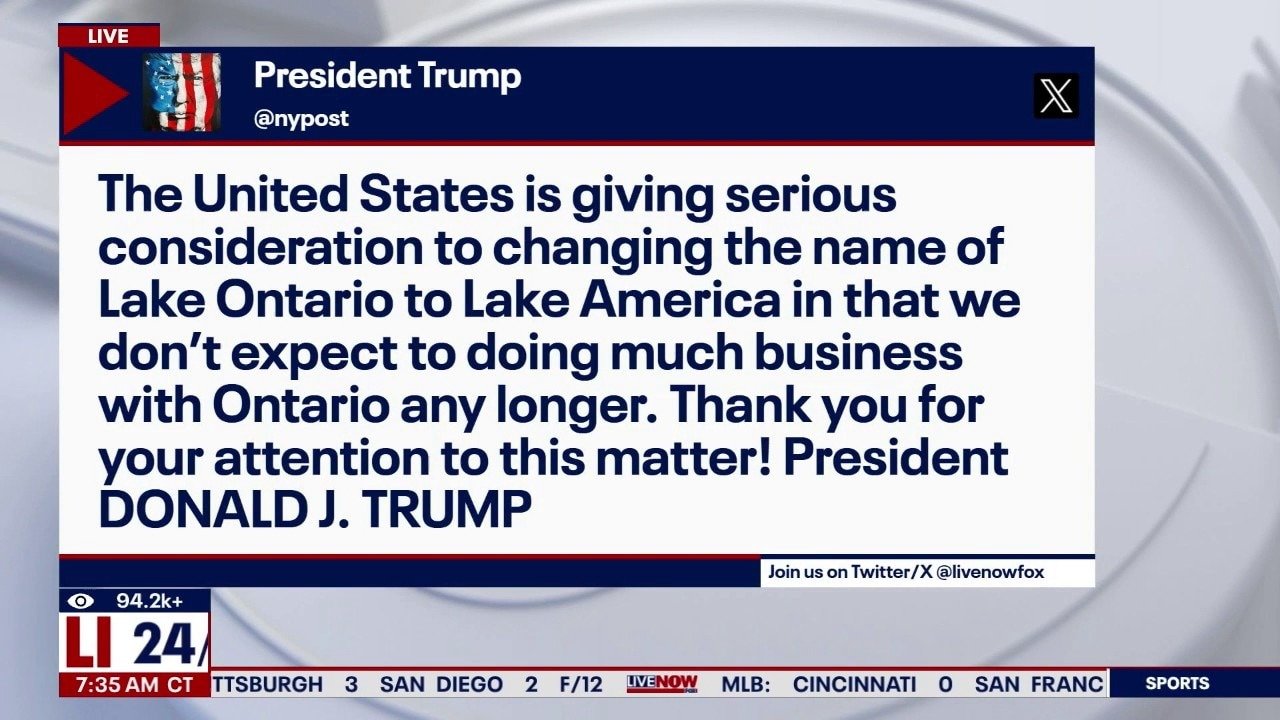
Trump Signs Executive Order Renaming Border Waterway to Lake America
US President Donald Trump signed an executive order in Washington on August 27, 2026, ordering the official renaming of Lake Ontario as Lake America with immediate effect. The directive instructs US Secretary Doug Burgum and the Department of the Interior to enforce the name change, directly impacting cross-border shipping channels, federal maritime registries, and commercial transport sectors operating along the northern US border.
Bilateral Trade Collapse Triggers Immediate Unilateral Action
Lake Ontario sits as one of the five Great Lakes of North America, sharing a direct watery boundary between the Canadian province of Ontario and the US state of New York. The sudden executive decree follows the complete breakdown of three-day intensive trade negotiations between Washington and Ottawa last week, where both administrations blamed each other for derailing the talks. Canadian Prime Minister Mark Carney's office did not immediately issue a public response to the White House directive, which arrived alongside executive threats to hit all Canadian car and truck exports with 50 percent tariffs.
The order marks an escalation in bilateral tension following the abrupt halt of cross-border economic negotiations.
Gulf of Aden earthquake: 6.0 quake hits off Somali coast
Shallow 6.0 Quake Strikes Gulf of Aden Between Somalia and Yemen
A shallow 6.0-magnitude earthquake struck the Gulf of Aden between Somalia and Yemen at 12:07 a.m. local time on Friday. Monitoring stations and maritime authorities across East Africa and the Arabian Peninsula logged the offshore tremor, which originated in regional shipping corridors.
Seismological agencies record varying magnitude readings up to 6.2 for midnight tremor
Seismologists located the epicenter approximately 145 kilometers off the Somali coast at a shallow depth, registering at 2107 GMT Thursday. While the United States Geological Survey recorded the shock at magnitude 6.0, the GFZ German Research Centre for Geosciences measured a magnitude of 6.2 in the Eastern Gulf of Aden. Authorities reported no immediate details of structural damage or casualties in surrounding coastal territories following the event.
The tremor occurred alongside other recent regional seismic activity, including a 4.9-magnitude earthquake in the Arabian Sea off Oman.