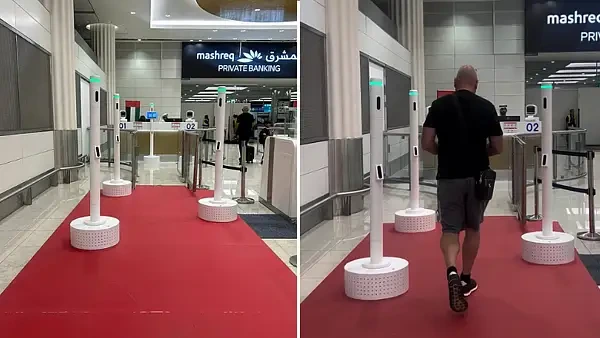
(Credit - Alkhaleej via MSN)
Dubai Airport AI Corridor Ends the Immigration Queue as You Know It
The Dubai Airport AI corridor at DXB now clears your immigration in seconds, while you keep walking, and the system can handle up to 10 passengers at the same time.
Walk Through, Done: How the New System Actually Works
Forget the stop-and-stare routine at the e-gate. Dubai International Airport‘s new AI-powered corridor scans your identity and documents as you walk through it, no pausing, no pressing your passport to a reader, no waiting for a green light before you can move. The system processes your clearance in motion, which is the core difference from every smart gate that came before it.
The corridor’s parallel processing capacity is what makes it genuinely different at scale. Because up to 10 passengers can be cleared simultaneously, a single corridor can absorb a surge of arriving travellers that would previously stack into a visible queue. During peak hours, think early-morning wide-body arrivals or the post-Eid rush, that throughput difference is felt immediately by anyone walking off the jet bridge.
What This Means for Your Next DXB Arrival or Departure
The General Directorate of Residency and Foreigners Affairs Dubai (GDRFA Dubai) oversees immigration processing at DXB, and this corridor sits within that operational framework. The upgrade targets the bottleneck that has historically built up at immigration checkpoints during peak travel windows, a pressure point that affects connection reliability, ground transport timing, and how quickly passengers reach baggage reclaim.
- Clearance speed: Seconds, while walking, no stopping at a gate or kiosk
- Simultaneous capacity: Up to 10 passengers processed at the same time
- Go-live date: June 2, 2026, at Dubai International Airport (DXB)
- Primary benefit: Reduced queue pressure during peak arrival and departure surges
| Factor | Before AI Corridor | After AI Corridor |
|---|---|---|
| Passenger action required | Stop, scan document/face at gate | Walk through without stopping |
| Passengers processed at once | One per gate lane | Up to 10 simultaneously |
| Queue risk during peak hours | High, single-file bottleneck | Significantly reduced |
| Physical interaction with equipment | Yes, press passport or look into scanner | No, scanned in motion |
Next Steps Before Your Next DXB Flight
1. Ensure your travel document is biometric-ready, the AI corridor relies on biometric matching, so your passport must carry a valid chip. Check validity via the ICP (Federal Authority for Identity, Citizenship, Customs and Port Security) smart services portal at icp.gov.ae. 2. UAE residents: confirm your Emirates ID is current, GDRFA Dubai links residency status to immigration clearance; an expired Emirates ID can interrupt automated processing even with a new corridor in place. 3. Check your DXB terminal, Dubai International Airport operates across Terminals 1, 2, and 3. Confirm which terminal your airline uses and whether the AI corridor is active there, via the Dubai Airports official app or dubaiairports.ae. 4. Allow normal arrival buffer times for now, until the corridor is fully scaled across all immigration halls, standard advice on arrival windows from your airline still applies.Dubai International Airport’s AI corridor is a structural shift in how border processing works at one of the world’s busiest hubs, replacing the stop-scan-proceed sequence with a continuous walk-through that clears up to 10 people at once. For the millions of passengers who move through DXB each month, the practical result is fewer queues and faster onward movement from the moment you land. The technology is live as of today, June 2, 2026, and its impact will be most visible during the high-volume travel periods that have historically tested DXB’s immigration capacity.

DubaiNow App Q1 2026 Hits 2.4M Users
DubaiNow App Q1 2026: 2.4 Million Users and 380 New Services Signal a Faster, Queue-Free Dubai
The DubaiNow app Q1 2026 figures are in, and they tell a clear story: Dubai residents are voting with their thumbs. The Dubai Media Office confirmed the platform added 380 services and crossed 2.4 million users between January and March 2026, a 19.4% jump year-on-year versus Q1 2025.
One App, 50+ Entities, Why the Growth Rate Is Accelerating
DubaiNow now connects users to more than 320 services from over 50 government and semi-government entities, covering everything from utility bill payments and vehicle registration to visa status checks and municipal permits. The consolidation means a resident no longer needs to toggle between separate portals for, say, DEWA, the Roads and Transport Authority (RTA), and Dubai Municipality. One login handles it all.
The 19.4% user growth in a single quarter is not incidental. It reflects a deliberate push by Dubai's digital government strategy to shift high-frequency transactions, renewals, payments, service requests, entirely online. Each new entity added to the platform reduces the operational load on physical service centres, compressing turnaround times for everyone still in the queue.
What the Numbers Mean for Your Wallet and Your Week
For Dubai residents, the practical upside is time saved and, in many cases, late-fee risk reduced. Services that previously required an in-person visit or a multi-step portal journey can now be completed, and tracked, inside a single app. With 380 services added in just one quarter, the pace of integration suggests the platform's utility will keep widening through the rest of 2026.
| Metric | Q1 2025 | Q1 2026 | Change | Resident Impact |
|---|---|---|---|---|
| Total Users | ~2.01 million (est.) | 2.4 million | +19.4% YoY | Faster load-sharing; more peer adoption means more entities prioritise the app channel |
| Services Added (quarter) | , | 380 new services | , | Broader coverage; fewer reasons to visit a service centre |
| Total Services Available | , | 320+ | , | One app replaces multiple portals for most common government needs |
| Connected Entities | , | 50+ | , | Cross-entity requests (e.g. trade licence + municipality permit) handled in one place |
Three Wallet Scenarios: Renter, Job-Seeker, Business Owner
If you're a renter: Ejari registration and DEWA connection requests are among the services accessible through Dubai's digital government ecosystem. A higher-adoption platform means entity response times tend to tighten, useful when you're trying to activate utilities before a move-in date.If you're a job-seeker: Labour-related status checks and document attestation workflows connected to government entities are increasingly routed through unified digital channels. Faster processing on the government side shortens the gap between offer acceptance and legal work commencement, a real-world difference when you're between salaries.If you're a business owner: SMEs dealing with trade licence renewals, municipal approvals, or payment of government fees across multiple entities stand to gain the most. Each entity added to DubaiNow is one fewer separate login, one fewer physical visit, and one fewer paper trail to manage, directly cutting the administrative hours billed to your operations.DubaiNow's Q1 2026 numbers confirm that Dubai's "super app" model is past the adoption tipping point, 2.4 million users across 320+ services is no longer a pilot, it's infrastructure. For residents and businesses alike, the practical question has shifted from whether to use the app to which workflows haven't been moved onto it yet. With 380 services added in a single quarter, that list is shrinking fast.

UAE Salary Payment Rule June 1: What Changes Now
UAE Salary Payment Rule June 1 Forces Employers to Pay on Day One, or Face Penalties
If you've ever waited days past payday for your salary to land, the UAE salary payment rule effective June 1, 2026 changes everything about when your employer must transfer your wages.
What Exactly Changed on June 1
Under the new requirement, private-sector companies in the UAE must process and pay monthly salaries on the first day of each month. The rule tightens what was previously a more flexible window, placing a hard deadline at the very start of the pay cycle rather than allowing employers to transfer wages at any point during the month.
The enforcement signal is already visible. Reports cited by Khaleej Times point to a 150%-plus surge in wage payments recorded on June 1 itself, a sharp behavioural shift that suggests employers moved quickly to comply rather than risk penalties. That kind of spike doesn't happen organically; it reflects payroll teams front-loading approvals, bank transfers, and Wage Protection System (WPS) submissions ahead of the month-start deadline.
Before and After: How the Rule Reshapes Payday
| Factor | Before June 1 | From June 1, 2026 |
|---|---|---|
| Salary deadline | Flexible, within the month | Fixed, first day of the month |
| Enforcement trigger | Primarily complaint-driven | Proactive monitoring expected |
| Employer risk | Lower immediate penalty pressure | Penalties apply for any delay past day one |
| Employee expectation | Unpredictable transfer date | Predictable, day-one cashflow |
| Payroll prep window | Could be processed mid-cycle | Must be funded and cleared before month starts |
What This Means Depending on Your Situation
If you're an employee on a monthly salary, your wages should now arrive on the first of every month without exception. If your employer misses that date, they are in breach of the rule and penalties apply, you are no longer in a grey zone waiting to see whether a delay is "normal" or actionable.If you're in HR or finance at a private-sector company, the compliance pressure has shifted upstream. Payroll funding, internal approvals, and bank processing must all be completed before the month begins, not on the first day. A bank processing lag is not a defence, the obligation sits with the employer to ensure the transfer clears on day one.If you're a small business owner or a firm with variable cash flow, this rule raises your compliance risk considerably. Manual payroll processes or last-minute funding arrangements that previously worked within a loose monthly window now need to be restructured around a fixed, zero-tolerance deadline.Who Enforces This and Where to Report a Violation
The Ministry of Human Resources and Emiratisation (MoHRE) oversees wage payment compliance for private-sector employers in the UAE through the Wage Protection System. MoHRE monitors WPS data, which means late transfers are visible to the authority without an employee needing to file a complaint first, consistent with the enforcement shift from reactive to proactive monitoring.
- Enforcement authority: Ministry of Human Resources and Emiratisation (MoHRE)
- Monitoring mechanism: Wage Protection System (WPS), transfers are tracked automatically
- Penalty trigger: Any salary payment processed after the first day of the month
- Who is covered: Private-sector employees receiving monthly wages
Next Steps: What to Do Right Now
1. Employees, check your June 1 transfer: Log into your bank app or review your payslip. If your salary did not arrive on June 1, you have grounds to raise a formal complaint with MoHRE via the MOHRE app or at mohre.gov.ae.2. Employers, audit your payroll cycle immediately: Map out every step from funding approval to WPS submission and identify where delays can occur. The goal is to have transfers cleared by midnight on the last day of the previous month.3. HR teams, update payroll calendars for July and beyond: June 1 is the baseline. July 1 is the next hard deadline. Build in a two-to-three business day buffer before month-end to absorb any bank processing time.4. Report a violation: Employees can file a wage complaint directly through the MOHRE app, available on iOS and Android, or by calling the MoHRE hotline at 800 60.The UAE's June 1 salary rule draws a clear line: payday is no longer whenever the employer gets around to it, it is the first of the month, every month. The 150%-plus jump in wage payments on June 1 shows the private sector heard the message. For employees, that means more predictable cashflow; for employers, it means payroll preparation must start well before the calendar flips.FAQ
Zhang Yiming Net Worth Surpasses Ambani in Asia
Zhang Yiming Net Worth Leaps Past Mukesh Ambani, Here's Why Asia's Wealth Map Just Shifted
Zhang Yiming's net worth has crossed a landmark threshold, pushing the ByteDance and TikTok founder past Mukesh Ambani to claim the title of Asia's second-richest person as of June 3, 2026, a reshuffle driven by a rising implied valuation for ByteDance and accelerating momentum around its artificial intelligence products.
How a Private Company's Valuation Can Move a Billionaire Up the Rankings
ByteDance is not publicly listed, which means there is no live share price to track Zhang Yiming's wealth in real time. Instead, wealth trackers infer ByteDance's value from secondary market share trades, investor markings, and share buyback activity, and when those signals trend upward, Zhang Yiming's estimated net worth rises with them, sometimes sharply and quickly.
The current upward move is tied specifically to ByteDance's push into AI, new products, infrastructure investment, and the broader market narrative that AI-driven tech platforms command premium valuations. That narrative, even without a public listing, is enough to shift where a founder sits on a regional wealth table.
Asia's Richest List: Who Sits Where Right Now
Gautam Adani retains the top position as Asia's wealthiest individual, a spot that has itself been contested recently, Zhong Shanshan, the Chinese beverage and pharmaceutical billionaire, briefly held the No. 1 position before Adani reclaimed it. The current top three reflects how quickly sector narratives, infrastructure and energy for Adani, consumer staples for Zhong Shanshan, and private tech for Zhang Yiming, can reorder regional rankings.
- Asia's No. 1: Gautam Adani, infrastructure, energy, and ports conglomerate
- Asia's No. 2 (new): Zhang Yiming, ByteDance / TikTok founder, boosted by AI valuation momentum
- Asia's No. 3 (displaced): Mukesh Ambani, Reliance Industries chairman, overtaken as of June 3, 2026
- Recent contender: Zhong Shanshan, briefly held Asia's No. 1 spot before the latest reshuffle
Before and After: What Changed in the Ranking
| Position | Before (Recent Prior) | After (June 3, 2026) |
|---|---|---|
| Asia No. 1 | Gautam Adani | Gautam Adani (unchanged) |
| Asia No. 2 | Mukesh Ambani | Zhang Yiming |
| Asia No. 3 | Zhang Yiming | Mukesh Ambani |
| Brief No. 1 (earlier) | Zhong Shanshan | Reverted; no longer leads |
What This Signals Beyond the Rankings
The reshuffle is a concrete signal of how much weight private tech valuations now carry in global wealth tables. When a company like ByteDance, unlisted, with no public earnings disclosure, can move its founder past the chairman of one of India's largest conglomerates, it illustrates how AI investment cycles are reshaping perceived enterprise value across Asia, independent of stock exchanges.
For anyone watching India-China wealth dynamics, the shift also reflects a broader competitive tension: Reliance Industries operates across telecoms, retail, and energy with transparent public reporting, while ByteDance's valuation is, by nature, an estimate. That estimate is currently running higher, but private-market marks can reverse just as fast as they rise.
Zhang Yiming's rise to Asia's No. 2 wealth position is a direct consequence of ByteDance's growing AI narrative lifting its implied private-market valuation. Gautam Adani holds the top spot, while Mukesh Ambani drops to third, a reminder that in today's wealth rankings, a company doesn't need a stock ticker to move markets. The ranking can shift again the moment ByteDance's valuation signals change direction.## FAQ

Dubai Smart Medical Visa: What Changes for You
Dubai's Smart Medical Visa Is Set to Reshape How International Patients Access Healthcare Here
If you're planning to travel to Dubai for medical treatment, the Dubai smart medical visa could fundamentally change how quickly, and smoothly, you get through the door. Reported by Gulf Business on June 3, 2026, Dubai authorities are moving to introduce a streamlined "smart medical visa" designed to cut friction for international patients and accelerate the emirate's push to become a leading global health tourism destination.
What's Actually Changing, And What We Know So Far
Right now, international patients navigating medical travel to Dubai face the same general visa channels as tourists or short-stay visitors, with no dedicated fast-track pathway built around clinical timelines or follow-up care needs. The smart medical visa is intended to change that by creating a purpose-built approval route specifically for people coming to Dubai for healthcare, with the stated goal of faster processing and a more joined-up patient journey from arrival to discharge.
The full operating model has not yet been published. Key details still to be confirmed include who sponsors the visa (the treating hospital or clinic versus the patient directly), eligibility criteria, permitted length of stay, extension pathways for follow-up treatment, and whether companions or caregivers travelling alongside the patient will be covered under the same streamlined process. Those details will define how useful this is in practice.
How This Plays Out for Different Readers
If you're an international patient planning elective or specialist treatment in Dubai, the most immediate benefit, once the system is live, should be a shorter wait between booking your procedure and receiving travel clearance. Currently, medical travel planning has to account for standard visa processing timelines that aren't calibrated to hospital appointment schedules. A dedicated pathway removes that mismatch.If you're a family member or caregiver travelling with a patient, the unresolved question is whether companion visas will be bundled into the same fast-track process. Until Dubai authorities publish the eligibility rules, plan conservatively and confirm with your treating facility whether they can sponsor or facilitate companion documentation.If you work in Dubai's healthcare sector, at a hospital, clinic, or medical travel facilitation company, this signals a structural shift in how patient onboarding may work. Hospitals that can act as visa sponsors will likely gain a competitive edge in attracting international referrals. It's worth engaging your patient services and compliance teams now, before the final framework drops.Before vs. After: The Patient Journey at a Glance
| Stage | Current Process | With Smart Medical Visa |
|---|---|---|
| Visa type | Standard tourist/visit visa | Dedicated medical visa category |
| Approval speed | Standard processing timelines | Faster approvals (specifics TBC) |
| Sponsor | Self-sponsored or employer | Potentially hospital/clinic-sponsored |
| Stay duration | Standard visit visa limits | To be confirmed |
| Follow-up extensions | Standard renewal process | Dedicated extension pathway (TBC) |
| Caregiver/companion | Separate standard application | Potentially bundled (TBC) |
- Announced: June 3, 2026, as reported by Gulf Business
- Scope: International patients travelling to Dubai for medical treatment
- Goal: Faster visa approvals and a smoother end-to-end healthcare travel experience
- Status: Framework announced; full eligibility rules and operational details pending
What You Should Do Right Now
1. Monitor the ICP portal (icp.gov.ae), the Identity and Citizenship Authority is the primary authority for UAE visa categories. Any new medical visa classification will be published there first. 2. Contact your Dubai hospital or clinic directly, ask whether they are registered or planning to register as a medical visa sponsor under the new framework. This affects your application route. 3. Check with DHA, the Dubai Health Authority oversees healthcare standards and licensing for facilities treating international patients. Their website (dha.gov.ae) is the right place to track any patient-facing guidance linked to the new visa. 4. If you're a caregiver or companion, do not assume you're automatically covered. Confirm companion eligibility with both your treating facility and the ICP before booking travel. 5. Healthcare providers: Begin internal reviews of patient services workflows now, particularly around visa sponsorship capacity and documentation requirements, so you're operationally ready when the rules are finalised.Dubai's smart medical visa is a meaningful step toward making the emirate a more competitive destination for international patients, but its real-world value hinges on the details still to come, particularly around stay duration, extensions for follow-up care, and caregiver inclusion. Watch the ICP portal and DHA communications closely over the coming weeks. For now, if you have a procedure booked, continue using existing visa channels and ask your hospital whether they can provide updated guidance as the framework is confirmed.

Dubai RTA Vehicle Ownership Transfer: The Complete 2026 Guide to Costs, Documents, and Online Steps
The Dubai RTA vehicle ownership transfer process is an important part of UAE law, personal finance, and daily life for many residents who buy and sell cars each year. When a vehicle changes ownership in Dubai, the law requires that the Mulkiya, the official vehicle registration card, be quickly updated with the new owner's details. If this step is not completed, both parties face legal risks: sellers remain responsible for any fines or accidents involving the vehicle, while buyers are not legally allowed to drive it.
In 2026, the Roads and Transport Authority has enhanced its digital services, allowing much of the transfer process to be initiated via the Dubai Now app, although a visit to an authorized center is still necessary to finalize the transfer.
At a Glance: Dubai Car Ownership Transfer in 2026
- The base transfer fee for a Dubai RTA vehicle ownership transfer is approximately AED 100, with additional charges for registration renewal, insurance, and any outstanding fines on the vehicle.
- Both buyer and seller must clear all traffic fines on the vehicle before the transfer can proceed; unpaid fines block the transaction at the system level.
- The Dubai Drive app allows owners to initiate the transfer request online, upload documents, and track status, but the physical handover of the Mulkiya typically requires attendance at a Tasjeel, Shamil, Tamam, or Wasel center.
- A valid Emirates ID for both parties and a current vehicle insurance certificate in the buyer's name are non-negotiable requirements before any center will process the transfer.
Before You Begin: Eligibility and Pre-Transfer Checklist
Not every car sale in Dubai moves smoothly to a transfer appointment, and the reasons are almost always the same: outstanding fines, expired insurance, or a vehicle that has not passed its technical inspection. The RTA's system is fully integrated with the Dubai traffic database, so any unpaid fine, whether a speed camera ticket or a parking violation, will halt the process the moment a clerk or the app attempts to pull up the vehicle's record.
The seller's first task is to log into the Dubai Drive app or visit the RTA's official portal and run a fines check using the vehicle's plate number. Once the record is clean, the seller needs to confirm the vehicle's registration is either current or being renewed as part of the transfer. If the car is due for a technical inspection, that appointment at a Tasjeel or affiliated inspection center must happen before the transfer date, not after.
On the buyer's side, the single most time-sensitive requirement is securing a valid motor insurance policy in their own name before walking into any RTA Customer Happiness Center or authorized service point. Insurance companies in Dubai can issue a certificate within hours, and many do so digitally, but the policy must be active and name the buyer as the registered owner of the specific vehicle being transferred.
The documents both parties need to bring together are straightforward. The seller presents their original Emirates ID and the existing Mulkiya. The buyer presents their original Emirates ID, their new insurance certificate, and, if they hold a non-UAE driving licence, a valid UAE driving licence. For corporate sellers or buyers, a trade licence and an authorisation letter from the company are required in addition to the representative's Emirates ID.
The Step-by-Step RTA Online Vehicle Transfer Process
The Dubai Drive app is the starting point for anyone who wants to reduce time spent at a service center. After logging in with UAE Pass credentials, the seller navigates to the vehicle services section and selects the ownership transfer option. The app prompts for the buyer's Emirates ID number, the agreed sale price, and confirmation that all fines are cleared. Once both parties confirm the transaction digitally, the app generates a reference number that the buyer carries to the physical center to complete the handover.
For those who prefer to handle everything in person from the start, any Tasjeel, Shamil, Tamam, or Wasel center across Dubai accepts walk-in transfer requests. The process at the counter mirrors the app flow: the clerk verifies fines, checks insurance, confirms the vehicle's inspection status, and then processes the Mulkiya transfer in the buyer's name. The new registration card is typically printed on the spot.
The fee structure at the counter covers the transfer registration charge, and if the vehicle's annual registration is due for renewal, that renewal fee is collected at the same time. Buyers should budget for the registration renewal cost on top of the base transfer fee, as the two are often processed together to ensure the Mulkiya issued is both transferred and current.
Car Ownership Transfer Dubai Cost 2026: The Full Fee Breakdown
Understanding exactly what you will pay before arriving at a center prevents the kind of last-minute scramble that delays transactions. The table below sets out the core charges associated with a standard Dubai RTA vehicle ownership transfer in 2026.
| Fee Item | Approximate Cost (AED) | Paid To |
|---|---|---|
| Ownership Transfer Registration Fee | 100 | RTA / Authorized Center |
| Vehicle Registration Renewal (if due) | 290, 420 (varies by vehicle type) | RTA / Authorized Center |
| Vehicle Technical Inspection (if required) | 150, 200 | Tasjeel / Inspection Center |
| Traffic Fines Clearance | Variable (must be zero before transfer) | Dubai Traffic / RTA |
| New Motor Insurance (buyer's policy) | Variable (market rate) | Insurance Provider |
The AED 100 transfer fee is the fixed, non-negotiable charge that goes directly to the RTA for updating the vehicle's ownership record. Every other line item depends on the specific vehicle's history and the timing of the transaction. A car with a clean record, current registration, and a recent inspection certificate will cost the buyer the least; a vehicle with lapsed registration and outstanding fines will require the seller to settle those costs before the transfer can proceed at all.
After the Transfer: What the New Owner Receives
Once the center processes the transaction, the buyer walks out with a new Mulkiya printed in their name. This document is the legal proof of ownership in Dubai and must be kept in the vehicle at all times. The RTA also updates the vehicle's digital record, which means the Dubai Drive app will reflect the new ownership within 24 hours of the transfer being processed.
The seller's record is simultaneously cleared. The vehicle no longer appears under their profile in the RTA system, and any future fines or incidents involving the car become the legal responsibility of the new registered owner. Both parties receive an SMS confirmation from the RTA once the system update is complete.
If the buyer intends to use the vehicle immediately after the transfer, they should confirm their insurance certificate is active from the transfer date, not from a future date, as driving without valid insurance in Dubai carries significant penalties under UAE traffic law.
For buyers who purchased a vehicle through a dealership, the process is largely the same, though the dealership typically handles the paperwork on the buyer's behalf and may charge an administrative fee for doing so. Private sales require both parties to be present, either physically at the center or digitally through the Dubai Drive app confirmation step, to ensure the transfer is consensual and legally binding.
The RTA Customer Happiness Centers across Dubai, including those at Deira, Al Barsha, and Umm Ramool, handle transfer requests during standard government working hours. Tasjeel centers, which operate at multiple locations including Al Quoz and Nad Al Sheba, often offer extended hours and can process transfers alongside inspection appointments, making them a practical one-stop option for buyers whose vehicles need both inspection and registration on the same day.
💡 Frequently Asked Questions
Can I complete the entire Dubai RTA vehicle ownership transfer online without visiting a center?
The Dubai Drive app allows you to initiate the transfer, upload documents, and receive a reference number online. However, the final step, collecting the new Mulkiya, currently requires a visit to an authorized center such as Tasjeel, Shamil, Tamam, or Wasel. The process is a blend of online initiation and a single physical visit.
Who is responsible for clearing traffic fines before the car ownership transfer in Dubai?
The seller is responsible for ensuring all fines linked to the vehicle are paid before the transfer date. The RTA system will not allow the transfer to proceed if any outstanding fines appear on the vehicle's record, regardless of who incurred them.
How long does the Dubai RTA vehicle ownership transfer take to complete?
Once all documents are in order, fines are cleared, and insurance is confirmed, the transfer at an authorized center typically takes between 30 minutes and one hour. The RTA system updates the digital record within 24 hours, and both parties receive SMS confirmation once the change is reflected.