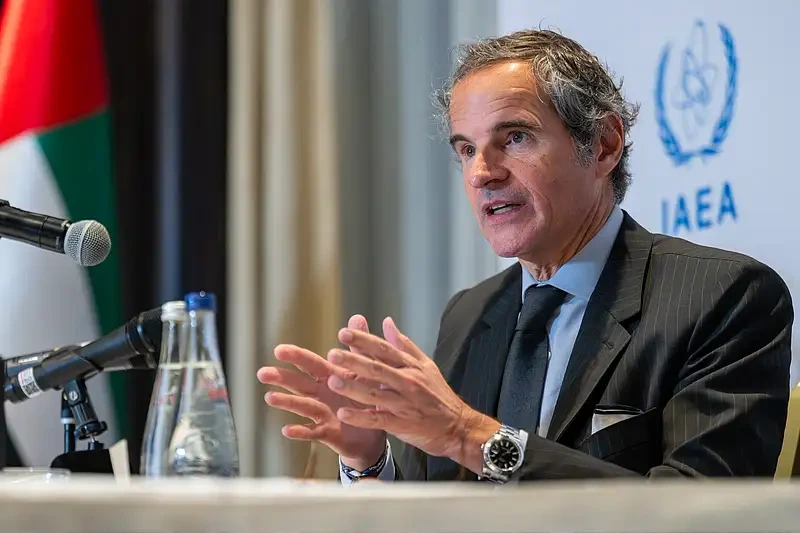
(Credit - Khaleej Times)
Barakah Nuclear Plant Put on Global Stage After IAEA Warns Attacks Are ‘Unacceptable’
If you rely on the UAE’s electricity grid, or simply live here, the Barakah nuclear plant’s reported brush with danger in May 2026 is a story that cuts far closer to home than most international security headlines.
What the IAEA and UAE Officials Actually Said
Both UAE officials and the International Atomic Energy Agency (IAEA) have issued a clear, joint position: any attack on an operating nuclear power plant is “unacceptable.” The warning is not abstract, it directly references the Barakah Nuclear Power Plant in the Al Dhafra region of Abu Dhabi, following a reported incident in May 2026 that the IAEA described as a “test by fire” for the facility. The United Nations also added its voice, calling for the protection of nuclear sites during armed conflict.
The IAEA’s role here is specific and technical. As the global body that sets nuclear safety and security standards, its public warnings carry weight beyond diplomacy, they signal to member states and non-state actors alike that strikes on nuclear infrastructure trigger a formal international response framework. The agency can deploy technical assessments, activate incident reporting protocols, and provide direct assistance to affected member states like the UAE.
Why an Attack on a Nuclear Plant Is a Different Category of Threat
Nuclear power plants are engineered with multiple redundant safety layers, but a deliberate attack does not need to hit a reactor core to cause serious harm. Disrupting off-site power supply, cooling systems, or emergency response access can be enough to elevate radiological risk, and the consequences do not stop at a country’s border. That cross-border dimension is precisely why the UN and international humanitarian law single out facilities containing dangerous forces for special protection.
For the UAE, Barakah is not a peripheral asset. It is the country’s flagship clean-energy project and a load-bearing part of the national electricity grid. Any credible security incident, confirmed or alleged, carries second-order consequences: public confidence in the plant, grid continuity planning, and the risk calculations made by insurers and infrastructure lenders all shift when a facility moves from theoretical threat to reported incident.
What This Means for UAE Residents and Stakeholders
The immediate practical reality for residents is that Barakah’s safety systems held, the IAEA’s “test by fire” framing, while unverified as a formal confirmed finding, implies the plant’s protections were stress-tested and did not fail. UAE authorities have not announced any disruption to electricity supply or any public safety advisory linked to the May incident.
- Grid impact: No reported disruption to UAE electricity supply following the May 2026 incident.
- IAEA status: The agency’s “test by fire” assessment remains unverified as an official confirmed finding; the IAEA has not published a formal incident report in the public domain as of June 3, 2026.
- International law position: The UN and humanitarian law principles classify nuclear facilities as requiring special wartime protection due to their potential for cross-border radiological consequences.
- UAE authority oversight: The Federal Authority for Nuclear Regulation (FANR) is the UAE’s independent nuclear regulator responsible for safety and security oversight at Barakah.
The Barakah plant’s reported May 2026 incident has pushed nuclear site security from a technical footnote to a front-page concern for the UAE and the wider region. The IAEA and UAE officials are drawing a hard line: operating nuclear facilities are off-limits, and the international community is watching. For UAE residents, the immediate signal is that the plant’s safety architecture was tested and held, but the episode is a reminder that critical infrastructure security is never a settled question.
UAE Skills Platform Targets 200,000 Students
UAE Skills Platform Launches to Bridge the Gap Between Classrooms and Careers
The UAE Skills Platform is now live, and if you are a student, recent graduate, or job seeker trying to figure out whether your qualifications actually match what employers want, this changes everything. Announced on June 3, 2026, the platform is a joint initiative by the Ministry of Higher Education and the Ministry of Human Resources and Emiratisation (MoHRE), built on AI and data-driven frameworks to map 1,700 future skills and reach 200,000 students across the UAE.
What Has Actually Changed, Before and After
Until now, the connection between what universities taught and what the labour market needed was largely informal, left to individual institutions, career fairs, and employer feedback cycles that moved slowly. The UAE Skills Platform changes that by creating a structured, data-backed framework that ties education planning directly to real hiring demand.
| Dimension | Before the Platform | After the Platform |
|---|---|---|
| Skills mapping | Ad-hoc, institution-led | Centralised, AI-driven, 1,700 skills catalogued |
| Labour market alignment | Indirect and slow-moving | Directly tied to MoHRE workforce data |
| Student guidance | General career advice | Structured skills-gap identification |
| Job seeker support | Separate from education system | Integrated into the same platform |
| Government coordination | Ministry of Higher Education and MoHRE operating independently | Joint cross-ministry initiative |
What This Means for You, Depending on Where You Stand
If you are a current university student in the UAE, the platform is designed to show you, with data, which skills are in demand and where your current learning path may leave gaps. Rather than graduating and discovering a mismatch, the intent is to flag those gaps while you still have time to address them through electives, certifications, or training pathways.
If you are a job seeker who has already graduated, the platform's scope extends beyond students. MoHRE's involvement signals that skills-gap identification and training matching will be available to people already in the job market, not just those still in education. Think of it as a career diagnostic tool backed by national workforce data rather than a generic job board.
If you work in HR or talent acquisition, the cross-ministry structure is the detail worth watching. When the Ministry of Higher Education and MoHRE align on a shared skills framework, it creates the conditions for a common language between what institutions certify and what employers hire for. Recruitment filters, internship criteria, and training budgets could all shift as that framework matures.
Key Facts at a Glance
- Scale: 1,700 future skills targeted across the platform's framework
- Reach: 200,000 students identified as the primary beneficiary group
- Joint ownership: Ministry of Higher Education and MoHRE are co-leads
- Technology backbone: AI and data-driven frameworks used to map skills to labour market demand
- Broader scope: Platform also designed to support job seekers, not only enrolled students
Next Steps: What to Do Right Now
1. Students enrolled in UAE universities, Check with your institution's career or academic advising office for guidance on how the UAE Skills Platform will be integrated into your programme. Universities are expected to align curricula with the platform's skills framework.2. Job seekers, Monitor the MoHRE official portal at mohre.gov.ae for announcements on how to access the platform's skills-gap tools and training pathway recommendations.3. Recent graduates, Register or update your profile on NAFIS (the federal Emiratisation programme portal), which operates under MoHRE and is likely to be a connected access point for skills assessment tools.4. HR and university administrators, Watch for official guidance from the Ministry of Higher Education on curriculum alignment requirements and employer participation frameworks as the platform rolls out further.The UAE Skills Platform represents the most structured attempt yet to close the distance between a student's degree and an employer's actual needs, using AI and national workforce data rather than guesswork. With MoHRE and the Ministry of Higher Education operating as joint architects, the framework has the institutional weight to influence both how courses are designed and how hiring decisions are made. The headline numbers, 1,700 skills, 200,000 students, are targets, and the real test will be in the rollout details: which education levels are covered, how skills are assessed, and whether employers formally recognise the outcomes.

UAE Islamic New Year Holiday Falls June 15
UAE Islamic New Year Holiday on June 15 Gives Every Worker the Day Off, Public and Private Sector Alike
The UAE Islamic New Year holiday lands on Monday, June 15, and this one covers everyone, whether you clock in at a government counter in Deira or a private-sector office in Business Bay. Authorities have declared the day a nationwide public holiday for both sectors, meaning most workplaces go dark for the occasion.
What Monday, June 15 Means for Your Work Week
The holiday marks the Hijri New Year, the start of the Islamic calendar year, and falls on a Monday, effectively extending the weekend by a day for the majority of the UAE workforce. With the standard UAE weekend running Friday, Saturday, employees on a Sunday, Thursday schedule get a three-day break heading into the week of June 15.
For employers, the clock is already ticking on roster adjustments. Shift-based operations, retail, hospitality, logistics, customer support, typically need cover plans in place well before a declared holiday. Essential services are often exempt from full closure, but individual businesses should confirm their obligations through internal HR guidance or sector-specific directives from the relevant ministry.
How the Holiday Hits Daily Routines Across the UAE
Government service centres operated under entities such as the General Directorate of Residency and Foreigners Affairs Dubai (GDRFA Dubai), the Ministry of Human Resources and Emiratisation (MoHRE), and the Roads and Transport Authority (RTA) will observe the holiday, meaning transactions, renewals, and in-person appointments scheduled for June 15 will need to be moved. If you have a visa deadline, a labour contract query, or an RTA appointment sitting on that Monday, reschedule now, the next working day is Tuesday, June 16.
- Holiday Date: Monday, June 15, 2026
- Coverage: Public and private sector employees, UAE-wide
- Occasion: Islamic New Year (Hijri New Year)
- Next Working Day: Tuesday, June 16, 2026
The UAE's approach to aligning public and private sector holidays under a single national calendar reflects the broader push within the UAE's long-term workforce and urban planning strategy, ensuring that holiday schedules support both community cohesion and economic continuity across the emirate's mixed-sector economy.
Monday, June 15 is a confirmed day off for workers across the UAE, public and private sector both, no exceptions stated. If you have government appointments or client-facing commitments on that date, move them to Tuesday, June 16. Employers in shift-heavy industries should finalise cover arrangements this week rather than waiting for the last minute.
Emirates ID Renewal: 5-Step Online Guide 2026
Last Updated: June 3, 2026, Review quarterly (next review due: September 3, 2026)Emirates ID Renewal Is Now a Single-Step Online Process, Here Is Exactly How to Do It
Emirates ID renewal in the UAE has been simplified by the Federal Authority for Identity, Citizenship, Customs and Port Security (ICP/ICA) into a streamlined online flow that eliminates most in-person visits for eligible applicants. This guide is for UAE citizens and expatriate residents who need a valid, renewed Emirates ID, the primary credential used across banking, telecom, healthcare, and government portals, and want to complete the process without unnecessary delays or rejected submissions.
Who This Guide Is For
Both UAE citizens and expatriate residents can renew their Emirates ID through ICP/ICA's digital services. Expatriate residents should note that their Emirates ID renewal is typically tied to their residency status, in most cases, you renew your ID alongside or immediately after your residency visa renewal, depending on your visa type and sponsor arrangement.If your personal data is unchanged and no biometrics update is required, you are likely eligible for the single-step online renewal. If you have a name change, nationality update, or employer/sponsor change on record, expect additional document requirements and a possible in-person step.Emirates ID Renewal Fees and Costs
> SOURCE CHECK, NO FIGURES CONFIRMED: The source text does not provide specific fee amounts for Emirates ID renewal. The table below describes the fee categories qualitatively. For exact current figures, check the ICP/ICA official smart services portal directly before submitting your application, as fees are subject to change.| Fee Category | What It Covers | Where to Confirm |
|---|---|---|
| Renewal Service Fee | Core ICP/ICA processing charge for issuing a new Emirates ID card | ICP/ICA official smart services portal |
| Card Validity Period Fee | Charged per year of validity on the renewed card (varies by ID duration) | ICP/ICA official smart services portal |
| Typing Centre Fee (if applicable) | Charged if application is submitted via an ICP-approved typing centre rather than self-service | Typing centre at point of submission |
| Courier/Delivery Fee | Applies if card is delivered to your address via Emirates Post | Confirmed at checkout during online application |
| Late Renewal Fine (if applicable) | Levied if your Emirates ID has already expired; amount depends on duration of expiry | ICP/ICA official smart services portal |
Documents Required for Emirates ID Renewal
Have these ready before you open the ICP/ICA portal. Missing any one of these is the most common reason applications stall.- Valid passport (expatriate residents; must be the passport linked to your current UAE residency visa) - Current UAE residency visa (expatriate residents; your Emirates ID renewal cannot proceed if your visa has expired) - Existing Emirates ID card (the card being renewed) - Recent personal photograph compliant with ICP/ICA specifications (only required if the system flags a photo update) - Updated contact information (mobile number and email address registered in the UAE) - Supporting documents for data changes, required only if renewing with a name change, nationality update, or new employer/sponsor; specific documents depend on the nature of the changeUAE citizens should have their family book (Khulasat Al Qaid) accessible in case the system requests verification of civil status details.Step-by-Step: How to Renew Your Emirates ID Online via ICP/ICA
Step 1, Go to the ICP/ICA Smart Services Portal Open the Federal Authority for Identity, Citizenship, Customs and Port Security (ICP/ICA) official website or the ICP UAE smart services app. Do not use third-party aggregator sites for this step, go directly to the ICP/ICA source to avoid phishing risk.Step 2, Authenticate Your Identity Log in using your Emirates ID number and registered UAE mobile number for OTP verification. If you have a UAE Pass account, use it here, UAE Pass authentication is accepted by ICP/ICA and speeds up the identity confirmation step significantly.Step 3, Confirm and Review Your Personal Details The system will display your existing registered information. Review every field carefully, name spelling, date of birth, nationality, and sponsor/employer details. If everything is accurate and unchanged, you proceed through the single-step renewal flow. If any detail needs correction, flag it at this stage; corrections require additional documentation and may extend processing time.Step 4, Upload Required Documents and Pay the Fee Upload clear, legible scans or photos of your required documents as listed above. The portal will specify which documents are needed based on your profile. Once documents are accepted, proceed to the payment screen and pay the applicable renewal fee using a UAE-issued debit or credit card. Keep your payment confirmation reference number.Step 5, Track Your Application and Receive Your Card After payment, ICP/ICA will issue a tracking reference. Your renewed Emirates ID card is typically delivered via Emirates Post to your registered address, or you can opt for collection at a designated ICP/ICA service centre. Use your tracking reference on the ICP/ICA portal or the ICP UAE app to monitor delivery status. Do not discard your old Emirates ID until the new one is in your hands and verified.When You Cannot Avoid an In-Person Visit
The single-step online renewal works cleanly when your data is static and your biometrics are already on record. You will be directed to an ICP/ICA service centre or an approved typing centre in person if:- Biometrics update required: ICP/ICA may require a fresh fingerprint scan if your existing biometric data is outdated or flagged for renewal.
- Data discrepancy detected: Any mismatch between your passport, visa, and ICP records triggers a manual review that cannot be resolved online.
- Sponsor or employer change: If your residency is now under a new sponsor or employer, the updated visa documentation must be verified in person at an ICP/ICA centre.
- Expired residency visa: You cannot renew your Emirates ID if your residency visa has lapsed. Renew your visa first through the relevant authority, GDRFA Dubai for Dubai-based residents, or ICP/ICA directly for other emirates, then return to the Emirates ID renewal process.
Why a Lapsed Emirates ID Creates Immediate Problems
The Emirates ID is not a document you can let expire and deal with later. Banks operating under Central Bank of the UAE regulations use it for KYC verification, an expired ID can freeze account transactions. Telecom providers, DHA health insurance portals, and most government e-services require a valid Emirates ID for authentication. If you are an employer or PRO managing staff renewals, an expired Emirates ID on a team member's file creates compliance exposure under MoHRE regulations. Catch renewals at least 30 days before expiry, the ICP/ICA portal sends expiry notifications to your registered mobile number, so keep that number current.The Federal Authority for Identity, Citizenship, Customs and Port Security (ICP/ICA) has made Emirates ID renewal genuinely faster for most UAE residents through its single-step online process, but the system only works smoothly when your data is clean and your residency is current. Check your Emirates ID expiry date today, confirm your ICP/ICA registered mobile number is active, and initiate the renewal at least a month before the card lapses. Letting it expire costs you time, potential fines, and disruption to services you use every day.
Frequently Asked Questions About Emirates ID Renewal

Dubai Cities Shaping the Future Report: 12th Global
Dubai Cities Shaping the Future Report Places the Emirate 12th Globally, A Direct Signal for Investment and Talent Decisions
The Dubai Cities Shaping the Future report, published by the Oliver Wyman Forum, has ranked Dubai first in the region and 12th globally among cities best positioned to drive the next era of business growth, a result released on June 3, 2026, that carries immediate weight for multinationals weighing regional headquarters decisions.
Two Independent Benchmarks, One Consistent Signal for Business Leaders
The Oliver Wyman Forum's ranking tracks cities on their capacity to attract investment, scale new industries, and sustain connectivity, the factors that drive site-selection conversations at the C-suite level. Dubai's first-place regional finish places it ahead of every other GCC and MENA city in that framework.
Separately, the 2026 IMD Smart City Index, a benchmark watched closely for digital services delivery, urban mobility, and resident experience, placed Dubai first regionally and sixth globally. The two rankings are independent in methodology, which makes the convergence of results more significant: Dubai is performing at the top of its peer group across both business-growth readiness and on-the-ground smart-city execution.
What This Means for UAE-Based Businesses and Investors
For employers and investors operating in the UAE, rankings of this profile function as a shorthand for market readiness. Multinationals use them to benchmark cities when allocating regional HQ mandates, deciding where to anchor talent pools, and assessing infrastructure reliability. A top-12 global position in the Oliver Wyman Forum report, alongside a top-6 IMD Smart City result, strengthens Dubai's negotiating position against competing hubs in Europe, Asia, and North America that are targeting the same capital and skilled workforce.
- Business Growth Ranking: Dubai, 1st regionally, 12th globally (Oliver Wyman Forum, "Cities Shaping the Future")
- Smart City Ranking: Dubai, 1st regionally, 6th globally (IMD Smart City Index 2026)
- Benchmark Focus: Oliver Wyman Forum tracks investment climate, connectivity, and industry scalability; IMD measures digital services, mobility, and urban infrastructure
- Practical Implication: Both indices are actively referenced in regional HQ site-selection, talent relocation, and capital allocation decisions
Dubai's double top-regional finish, across two methodologically distinct global indices, confirms its position as the GCC's leading city for business competitiveness and smart-city performance. For decision-makers, the actionable takeaway is that Dubai's infrastructure and digital-services trajectory continues to justify long-term footprint commitments. The next analytical step is reviewing the pillar-level breakdowns from both reports to identify where Dubai leads its global peers and where performance gaps remain.

Dubai Smart Medical Visa: What Patients Must Know
Dubai's Smart Medical Visa Is Here, and It Changes How International Patients Enter for Treatment
If you've ever tried to coordinate a hospital appointment in Dubai while simultaneously managing a visa application and a potential extended stay, the new Dubai smart medical visa is designed to fix exactly that friction, starting now.
What's Actually Changing: The Old Way vs. The New Way
Until now, an international patient travelling to Dubai for treatment had to navigate at least three separate tracks: securing an entry visa through the General Directorate of Residency and Foreigners Affairs (GDRFA Dubai), coordinating with a Dubai Health Authority (DHA)-licensed facility for appointments, and then managing any stay extensions independently if treatment ran longer than planned. Each step lived in a different system, with different timelines and different paperwork.
The smart medical visa collapses those tracks into a single integrated pathway. Dubai health authorities and GDRFA Dubai have partnered to link visa and residency processing directly with the patient's healthcare service workflow, meaning the entry permission, the care plan, and any necessary stay adjustments are handled in a coordinated loop rather than in isolation.
| Stage | Before Smart Medical Visa | After Smart Medical Visa |
|---|---|---|
| Visa application | Separate process, standard tourist/visit visa | Dedicated medical visa pathway, linked to treatment |
| Residency/stay extension | Manual application if treatment extends | Integrated with care journey, fewer separate steps |
| Hospital coordination | Patient manages independently | Connected to visa/residency workflow |
| Companion travel | Handled separately | Expected to be covered within the same framework |
| Processing touchpoints | Multiple agencies, multiple portals | Unified pathway across health and immigration |
Who This Affects, and How
If you're an international patient planning a procedure in Dubai, whether elective surgery, specialist consultation, or a multi-week treatment programme, the practical difference is fewer queues across agencies. Instead of chasing a visa extension while simultaneously managing discharge paperwork, the system is designed to anticipate those transitions. The DHA-licensed hospital or clinic you're attending is expected to feed into the same workflow.
If you're travelling with a family member or companion, the integrated framework is expected to cover accompanying visitors within the same pathway, though full implementation details on companion eligibility are still to be confirmed by GDRFA Dubai. Watch the ICP (Federal Authority for Identity, Citizenship, Customs and Port Security) portal for updates on companion visa categories.
If you're a hospital operator, medical facilitator, or insurer working with inbound patients, the operational upside is significant: fewer last-minute cancellations tied to entry paperwork, more predictable scheduling, and a cleaner handoff between the patient's travel status and their clinical timeline. The DHA's role in the partnership signals that licensed facilities will likely be part of the intake and documentation process, meaning your compliance workflows around patient records and stay authorisations may need to be updated.
- Announced: June 3, 2026, by Dubai health and immigration authorities
- Integration scope: Visa processing, residency/stay management, and healthcare service coordination
- Governing bodies: Dubai Health Authority (DHA) and General Directorate of Residency and Foreigners Affairs (GDRFA Dubai)
- Target beneficiaries: International patients and their companions travelling to Dubai for medical treatment
Your Next Steps Right Now
1. Check the ICP portal (icp.gov.ae) for the smart medical visa category once it goes live, this is where entry and residency applications are processed at the federal level. 2. Confirm with your Dubai hospital or clinic whether they are already integrated into the new DHA-linked workflow, or when they expect to be onboarded. 3. Contact GDRFA Dubai directly (gdrfad.gov.ae) if you have an existing medical visit visa and need clarity on whether your current status transitions into the new framework. 4. If you're a facilitator or insurer, review your patient intake documentation against DHA licensing requirements, the integration of residency and care records means your paperwork trail will need to align with both authorities.Dubai's smart medical visa removes one of the most persistent headaches in medical travel: the gap between getting into the country and getting into care. By connecting GDRFA Dubai's entry and residency functions with DHA-governed healthcare services, the emirate is making a clear policy bet that administrative ease converts more inquiries into actual arrivals. For patients, companions, and providers alike, the shift from parallel processes to a single coordinated pathway is the headline change, and the full implementation details, when released, will determine exactly how smooth that journey becomes.