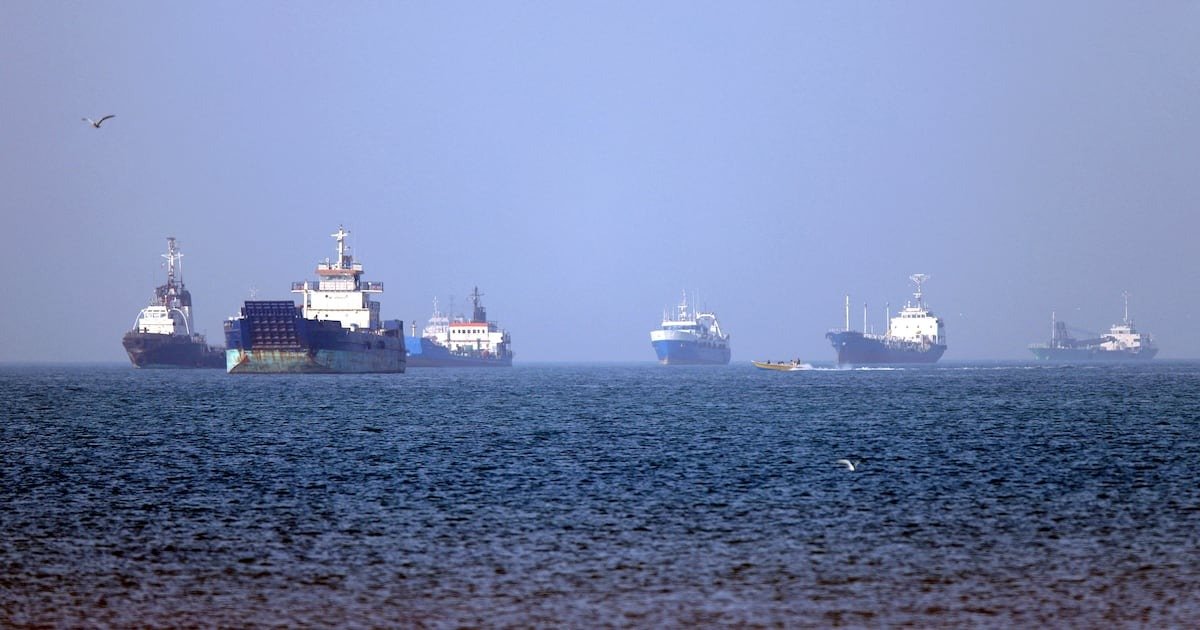
(Credit - The National)
Oil Prices Near $100: Gulf Attacks Are Repricing Global Supply Risk
Oil prices near $100 per barrel is no longer a tail risk, it is the direction markets are moving as of June 4, 2026, with fresh attacks in the Persian Gulf injecting a hard geopolitical risk premium into Brent and WTI crude and simultaneously complicating the already fragile architecture of US-Iran negotiations.
The Chess Move: This Isn’t Just a Price Spike, It’s a Structural Repricing
The global oil market isn’t just reacting to headlines. It is recalibrating the probability that Persian Gulf waterways, through which a substantial share of globally traded crude and refined products flows, could face sustained disruption. The $100 threshold is functioning as a psychological and technical marker that signals traders are no longer treating Gulf security incidents as isolated noise.When attacks occur near or within Gulf shipping corridors, the immediate market response follows a documented pattern: tanker war-risk insurance premiums rise, loading schedules at export terminals face delays, and vessels are rerouted, all of which tighten prompt physical supply even before a single barrel is actually lost. The risk premium baked into the price reflects that probability, not a confirmed outage.Driver 1, Geopolitical Risk: The Gulf Attack Premium
The Persian Gulf remains the single most consequential chokepoint in global energy logistics. Any credible security incident along its shipping lanes triggers an immediate repricing of physical delivery risk. The attacks reported as of June 4, 2026 have done precisely that, raising the perceived probability of supply outages, higher freight costs, and reduced effective export capacity from regional terminals. Traders do not wait for confirmed disruption; they price the risk of it.Driver 2, Diplomatic Deterioration: US-Iran Negotiations Under Strain
The second force amplifying price pressure is the condition of US-Iran talks. When negotiations appear stable, markets factor in the possibility of Iranian barrels returning to or remaining in global supply chains, which acts as a soft ceiling on prices. When those talks deteriorate, or when attacks in the Gulf signal that de-escalation is not holding, markets price in the reverse: stricter sanctions enforcement, reduced Iranian export flows, and the risk of retaliatory actions targeting regional energy infrastructure. That dynamic is active now, and it is compounding the physical risk premium with a diplomatic uncertainty premium.Driver 3, Shipping Economics: The Hidden Transmission Mechanism
The least visible but most immediate transmission channel from Gulf tension to global consumers runs through tanker markets. War-risk insurance surcharges on vessels transiting affected waters can rise sharply within hours of a security incident. Those costs are passed through freight rates to refiners, and ultimately to refined product prices at the pump and in airline fuel contracts. This mechanism operates independently of whether crude prices themselves sustain their move toward $100, meaning downstream cost pressure can materialise even if the headline price retreats.The Ripple Effect: Three Groups Watching Closely
Energy-intensive industries, airlines, logistics operators, and heavy manufacturers, face the most direct near-term exposure. Fuel hedging decisions made weeks ago are now being stress-tested against a price trajectory that has shifted materially. Those without forward cover are absorbing higher input costs in real time, while those with hedges are watching their coverage windows narrow.Shipping and freight operators are caught between rising war-risk insurance premiums and pressure from cargo clients to hold rates steady. Vessels transiting Gulf waters are already subject to elevated insurance costs; if the security situation persists, rerouting decisions, adding days and fuel burn to voyages, become economically rational, further tightening effective supply availability.Sovereign energy producers and OPEC+ members face a more complex calculation. Higher prices improve fiscal positions in the short term, but sustained volatility at or near $100 historically accelerates demand-side responses, efficiency investment, fuel switching, and political pressure for strategic petroleum reserve releases, that can erode the price floor over a longer horizon. The spare capacity held by key producers becomes a critical variable in whether the market views the current move as self-correcting or self-reinforcing.The Contrarian View
The strongest counter-argument is that geopolitical risk premiums in oil markets are historically short-lived when physical supply is not actually interrupted. If the Gulf attacks do not translate into confirmed, sustained disruption to export volumes, and if US-Iran negotiations stabilise rather than collapse, the current move toward $100 could prove to be sentiment-driven rather than fundamentals-driven, and vulnerable to a sharp reversal once diplomatic signals improve or inventory data shows no material tightening. Markets have priced in Gulf crises before and corrected quickly when the feared supply shock failed to materialise.- Price Direction: Brent crude moving toward $100 per barrel as of June 4, 2026
- Primary Trigger: Fresh attacks in the Persian Gulf raising supply and shipping disruption risk
- Compounding Factor: Strained US-Iran negotiations removing a soft price ceiling from Iranian supply expectations
- Key Signals to Watch: Tanker war-risk insurance rates, official shipping security statements, sanctions enforcement posture, and weekly inventory data
Oil prices near $100 reflect a market that is simultaneously pricing physical supply risk and diplomatic breakdown risk, two forces that are currently reinforcing each other. The Persian Gulf’s role as the world’s most critical energy corridor means even limited incidents carry outsized price consequences. Whether this move sustains or reverses depends on whether the security situation stabilises and whether US-Iran talks find traction, neither of which is currently signalled.

Dubai school calendar 2026-27: Key term dates
Dubai School Calendar 2026-27: Every Break Date Parents Need to Lock In Now
If you're a Dubai parent juggling annual leave, flight bookings, or childcare arrangements, the Dubai school calendar 2026-27 just gave you your planning framework, and the clock is already running.
What the 2026-27 Academic Year Looks Like, Break by Break
The 2026, 27 school year in Dubai is expected to kick off on 31 August 2026, earlier than many families may assume. From that first day, the calendar maps out three major pause points: a half-term break in October, a winter break, and a longer spring break in March 2027, each one a pressure point for flights, hotel rates, and childcare availability.
The spring break, running 16, 29 March 2027, is the longest window at 14 days, making it the most likely trigger for international travel plans. The October half-term, 19, 23 October 2026, is a shorter five-day window, but historically one of the busiest for UAE staycation bookings. Winter and additional mid-term breaks are part of the calendar but are expected to be shorter in duration; exact dates for those windows have not yet been confirmed.
Before and After: How This Changes Your Planning Routine
For most Dubai families, the shift here isn't a rule change, it's a timing advantage. Having these anchor dates in June 2026 means you have roughly 12 weeks before the school year even begins to lock in leave approvals, compare flight prices, and arrange holiday camps or tutoring cover. Waiting until August typically means paying a premium on all three.
| Break | Dates | Duration | Planning Priority |
|---|---|---|---|
| Term Start | 31 August 2026 | , | Childcare, transport setup |
| Half-Term Break | 19, 23 October 2026 | 5 days | Staycation / short-haul flights |
| Spring Break | 16, 29 March 2027 | 14 days | International travel, camps |
| Winter Break | TBC | Shorter | To be confirmed by school |
| Mid-Term Breaks | TBC | Shorter | To be confirmed by school |
Who This Affects, and How
If you're a working parent in Dubai, the October and March windows are the two dates to flag with your HR department now. Leave requests around school breaks in the UAE tend to cluster, and most Dubai-based employers process requests on a first-come basis. Getting your application in before the summer rush gives you the best shot at securing those exact days.
If you're planning international travel, the 14-day spring break (16, 29 March 2027) is long enough for a long-haul trip, and airlines typically reprice UAE-origin routes upward once school calendars are publicly confirmed. Booking now, or at least setting fare alerts, is the practical move. The five-day October half-term suits short-haul destinations: Oman, Georgia, or a Maldives resort that doesn't require a long transit.
If you rely on school transport or after-school care, contact your provider now to confirm their operating schedule around these dates. Private transport operators and nurseries in Dubai often run reduced services or close entirely during half-term and spring break, and waiting lists for holiday camps at community centres fill quickly.
One Important Caveat Every Dubai Parent Should Know
These dates reflect the expected UAE academic calendar for 2026, 27 as reported by Khaleej Times, but Dubai schools, particularly private institutions operating under British, American, IB, or Indian curricula, can and do adjust break windows within the framework set by the Knowledge and Human Development Authority (KHDA). Your school's final, confirmed calendar is the one that governs your child's actual schedule. Do not book non-refundable travel solely on the basis of these headline dates until your school issues its official term planner for 2026, 27.
- Term start: 31 August 2026, earlier than many families expect; arrange transport and childcare well in advance.
- Half-term break: 19, 23 October 2026, five days; ideal for UAE staycations or short-haul travel.
- Spring break: 16, 29 March 2027, 14 days; the primary international travel window of the year.
- Winter and mid-term breaks: Dates not yet confirmed; expect shorter durations and verify directly with your school.
Dubai's 2026-27 school calendar hands parents a rare early advantage: three months of lead time before the year even begins. Use the October and March windows to anchor your leave requests and travel bookings before prices move. Always cross-check the final dates with your school directly, since KHDA-regulated private schools can adjust break windows within the broader framework.

UAE WPS Update June 2026: New Salary Deadline
UAE WPS Update June 2026 Forces Private-Sector Employers to Pay Salaries by the First of Every Month
The UAE WPS update June 2026 draws a hard line for private-sector employers: salaries must be processed and received by employees on the first day of each calendar month, effective June 1, 2026, with escalating penalties for anyone who misses that mark.
Who Does This Rule Apply To?
If your company is registered under the Wage Protection System and employs staff in the UAE private sector, this rule applies to you, regardless of company size, industry, or the nationality of your workforce. That covers everyone from a five-person trading firm in Deira to a multinational with offices across Dubai and Abu Dhabi.
The rule has a sharper edge for larger organisations. Companies with 50 or more employees face the steepest exposure: repeated non-compliance can escalate beyond fines and work permit suspensions into potential criminal prosecution, turning a payroll admin lapse into a legal and reputational crisis. HR managers, PRO officers, and finance controllers at these firms carry direct accountability.
Employees whose wages flow through WPS-compliant channels, which covers the vast majority of private-sector workers in the UAE, are the direct beneficiaries. If your salary has historically arrived on the 5th, 7th, or 10th of the month, your employer now has a legal obligation to move that date forward.
What You Need to Do Right Now
For employers:1. Audit your payroll cycle today. Log in to the MoHRE (Ministry of Human Resources and Emiratisation) employer portal and confirm your WPS file submission schedule. If your current cycle targets mid-month or end-of-month payment, it must be restructured immediately. 2. Coordinate with your bank. WPS salary transfers require bank processing time. Speak to your corporate banking relationship manager to establish a cut-off date that guarantees funds clear employee accounts by the 1st, not just that the transfer is initiated. 3. Update your payroll calendar. Finance and HR teams should rebuild the monthly payroll timeline backwards from the 1st, accounting for data collection, approvals, WPS file generation, and bank processing windows. 4. Flag high-risk months. Months where the 1st falls on a Friday, Saturday, or public holiday require advance planning. Confirm with your bank whether transfers need to be initiated a day or two earlier to meet the deadline. 5. Document everything. Keep records of WPS file submission timestamps and bank transfer confirmations. In any enforcement review by MoHRE, timestamped evidence of timely submission is your primary defence.For employees:If your salary does not arrive by the 1st of any month from June 2026 onwards, you have grounds to raise a formal complaint through the MoHRE smart app or the MOHRE website (mohre.gov.ae). You do not need to approach your employer first, the complaint can be filed directly.Penalties for Non-Compliance
The enforcement framework under the updated WPS rules is structured to escalate with each violation. The source confirms the following consequence tiers, though specific fine amounts in dirhams were not disclosed in the available information:- First-tier consequence: Financial fines imposed on the employer for delayed salary payments.
- Second-tier consequence: Work permit suspensions, blocking the employer from hiring new staff until compliance is restored.
- Third-tier consequence (50+ employee firms): Repeated violations can trigger potential prosecution, moving the matter from an administrative penalty into the criminal enforcement domain.
- Enforcement authority: MoHRE is the named regulator overseeing WPS compliance and initiating penalty proceedings.
The June 1, 2026 WPS update compresses payroll timelines in a way that leaves no room for the informal delays that many private-sector employees have quietly absorbed for years. For employers, the first of the month is no longer a target, it is a deadline with teeth. Getting your payroll infrastructure aligned now, before MoHRE begins active enforcement, is the only sensible move.

Idris Elba Knighted by King Charles at Windsor
Idris Elba Knighted by King Charles III at Windsor Castle for Services to Young People
Idris Elba was knighted by King Charles III at Windsor Castle on June 2, 2026, formally receiving the title Sir Idris Elba. The honour recognises his sustained work in youth-focused public service, placing his contribution in a category distinct from his film career.
What the Windsor Castle Investiture Means Beyond the Title
The investiture ceremony at Windsor Castle is the moment a knighthood is formally conferred, separate from the public announcement of the honours list. King Charles III conducted the ceremony, touching a sword to Elba's shoulders in the traditional ritual. The citation "services to young people" signals that the recognition is rooted in social impact and community work rather than entertainment achievement alone.
Under the UK honours system, a knighthood grants the recipient the right to use "Sir" before their given name. For women, the equivalent title is "Dame." The honour carries no statutory powers but significantly raises a recipient's public profile and, in practice, can expand their ability to convene institutional partnerships, attract philanthropic funding, and access policy-level conversations around the causes they champion.
Recognition That Carries Real-World Weight in Youth Philanthropy
For organisations working in youth development, education, or social mobility, Elba's elevation to knighthood is likely to sharpen interest in any programmes he is publicly associated with. Charities and foundations operating in this space may find that a figure now formally recognised by the Crown carries greater leverage in fundraising and government engagement, though that influence also invites closer scrutiny of measurable outcomes.
- Recipient: Idris Elba, now Sir Idris Elba
- Conferred by: King Charles III
- Location: Windsor Castle, England, United Kingdom
- Date of investiture: June 2, 2026
- Citation: Services to young people
Idris Elba's knighthood, conferred by King Charles III at Windsor Castle on June 2, 2026, formally ties his public identity to youth service rather than screen performance. The title Sir Idris Elba places him among a cohort of public figures whose community contributions have been recognised at the highest level of the British honours system. For youth-sector organisations, the development signals a potentially more prominent advocate with enhanced institutional reach.*Source: Gulf News / Windsor Castle official investiture, June 2, 2026.*

Five Greatest FIFA World Cup Players of All Time
Five Greatest FIFA World Cup Players of All Time, and Why Each One Earned the Spot
The five greatest FIFA World Cup players of all time have been named, Maradona, Messi, Pelé, Ronaldo, and Cruyff, and the list is already splitting opinion across football fans worldwide. These are not just the biggest names in the sport; they are the figures whose performances on the World Cup stage specifically defined what tournament football can look like at its absolute peak. One of them never even lifted the trophy, which tells you everything about how complex this debate really is.
How "Greatest" Gets Decided, and Why It's Never Simple
Rankings like this typically weigh three things: tournament impact (goals, assists, match-winning moments), performance across multiple editions, and the kind of iconic individual moments that lodge permanently in football memory. No single metric settles it, a player can dominate one tournament so completely that it outweighs a longer but quieter career, while another can accumulate across four editions and still be questioned.
That subjectivity is exactly why lists like this generate heat. Depending on whether you prioritise trophies, individual awards, or tactical influence on the game itself, the five names could shift significantly, and plenty of legends sit just outside this group with legitimate claims of their own.
1. Diego Maradona, The One-Tournament Standard No One Has Matched
Maradona's case rests almost entirely on Mexico 1986, and it is still enough. He scored five goals and provided five assists across seven matches, dragging Argentina to the title with performances that remain the benchmark for individual World Cup dominance. The "Hand of God" goal and the "Goal of the Century", both scored against England in the quarter-final, happened in the same game, which captures the contradictory brilliance that made him impossible to ignore.Why it changes how you watch the tournament: When you understand that Maradona essentially carried a functional-but-not-exceptional Argentina squad to a World Cup title on individual will, every "best player at a World Cup" conversation starts and ends with 1986.2. Lionel Messi, The Long Game That Finally Paid Off
Messi's World Cup story is one of sustained elite output across five tournaments (2006, 2022), culminating in Argentina's triumph in Qatar in December 2022. He finished that tournament with seven goals and three assists, winning the Golden Ball for best player, his second such award at a World Cup, having also claimed it in 2014 despite Argentina losing the final. No other player has won the Golden Ball twice.Why it reshapes the GOAT argument: The 2022 title removed the one credible counterargument to Messi's inclusion on any all-time list. He now holds both the individual accolades and the winner's medal.3. Pelé, Three Tournaments, Two Titles, One Unbroken Record
Pelé remains the only player in history to win three FIFA World Cup titles (1958, 1962, 1970), and he scored in all three winning campaigns. He was 17 years old when he won his first, making him the youngest World Cup winner ever, a record that still stands as of June 2026. His 1970 Brazil side is routinely described as the finest national team ever assembled, and Pelé was its centrepiece.Why the numbers still hold up: Three titles across three different decades of football is a volume of success no other player has come close to replicating at international tournament level.4. Ronaldo (Brazil), A Comeback Story Built Around Goals When They Counted
Brazil's Ronaldo Nazário, not Cristiano Ronaldo, is the player referenced here, and his World Cup record is straightforward: 15 goals across three tournaments (1994, 1998, 2002), which remains the all-time record for goals scored at FIFA World Cups. His 2002 campaign in South Korea and Japan was particularly decisive: eight goals in seven matches, including a brace in the final against Germany, after a career-threatening knee injury had kept him out of the game for nearly two years.Why the comeback element is relevant: Ronaldo's 2002 performance carries extra weight precisely because it came after a period when many assumed his career was effectively over. Scoring eight goals in a winning World Cup campaign under that kind of pressure is a different kind of achievement.5. Johan Cruyff, The Greatest Player Who Never Won It
Cruyff led the Netherlands to the 1974 World Cup final in West Germany, where they lost 2, 1 to the host nation. He never played in another World Cup, he boycotted the 1978 tournament in Argentina for reasons he only publicly confirmed years later. Despite that, his influence on how the game is played, through the "Total Football" system he embodied, reshaped football tactics globally in ways that are still visible today.Why a runner-up belongs on this list: Cruyff's inclusion is the most debated of the five, but it reflects a broader point: World Cup greatness is not exclusively measured in trophies. His tactical and cultural impact on the tournament, and on football itself, is an argument that has held up for more than 50 years.The Five at a Glance
| Player | Country | World Cup Titles | Key Tournament | Notable Stat |
|---|---|---|---|---|
| Diego Maradona | Argentina | 1 (1986) | Mexico 1986 | 5 goals, 5 assists in one tournament |
| Lionel Messi | Argentina | 1 (2022) | Qatar 2022 | 2× Golden Ball winner |
| Pelé | Brazil | 3 (1958, 1962, 1970) | Mexico 1970 | Youngest-ever World Cup winner (age 17) |
| Ronaldo Nazário | Brazil | 2 (1994, 2002) | South Korea/Japan 2002 | All-time record: 15 World Cup goals |
| Johan Cruyff | Netherlands | 0 | West Germany 1974 | Finalist; never played 1978 tournament |
The Verdict
If forced to pick one name whose World Cup record is simply beyond challenge on every metric, titles, individual performance, and longevity, Pelé's three-tournament, three-title run is the hardest to argue against. Maradona's 1986 peak is the most spectacular single-tournament performance in the sport's history, and Messi's 2022 triumph finally gave him the complete résumé. But Pelé did it three times, starting at 17. That is the number that keeps coming back.Rankings of this kind are always editorial judgements, not official FIFA classifications, and reasonable cases exist for players outside this five. What makes this particular list durable is that each name on it changed something, a tournament, a tactical era, or the sport's understanding of what one player can do. The debate over who was left out is, in many ways, the point.

Saadiyat Beach Ranks 19th Best in World
Saadiyat Beach Enters the World's Top 20, and It's the Only Middle Eastern Beach to Do So
Saadiyat Beach on Abu Dhabi's Saadiyat Island has been ranked 19th on The World's 50 Best Beaches list for 2026, confirmed on June 4, 2026, making it the sole representative from the entire Middle East on this year's global ranking.
Why This Ranking Carries Real Weight for UAE Travellers
The World's 50 Best Beaches cited Saadiyat Beach's natural beauty and sustainability efforts as the basis for its placement. The beach sits within a stretch of coastline on Saadiyat Island that has long been managed with conservation in mind, nesting hawksbill turtles are a well-documented feature of the shoreline, and access protocols have historically been shaped around protecting that habitat.
A top-20 global placement on a list of 50 is not a minor footnote. It positions Abu Dhabi ahead of hundreds of widely visited coastal destinations worldwide, and it does so on criteria, environmental stewardship alongside aesthetic appeal, that are increasingly driving where discerning travellers choose to spend their money.
What This Means If You're Planning a Visit
Abu Dhabi's Department of Culture and Tourism has been building the Saadiyat Island proposition for years, and a ranking of this profile will sharpen demand during the cooler peak travel window running from October through March. Visitors planning beach stays on Saadiyat Island should expect tighter hotel inventory and earlier booking lead times as international interest follows the ranking's publication.
- Global Rank: 19th on The World's 50 Best Beaches 2026
- Regional Status: Only Middle Eastern beach included in the 2026 list
- Recognition Criteria: Natural beauty and sustainability efforts
- Location: Saadiyat Island, Abu Dhabi, UAE (24.5333°N, 54.4333°E)
Saadiyat Beach's entry at No. 19 is the strongest signal yet that Abu Dhabi's conservation-led approach to coastal tourism is being recognised at the highest global level. For UAE residents, it's a reminder that one of the world's best beaches is a short drive, or a 90-minute trip from Dubai, away. If you haven't locked in a stay on Saadiyat Island for the coming winter season, now is the time to look.