Record Construction Surges at Iran's Deeply Buried Pickaxe Mountain
Iran‘s intensive fortification at Pickaxe Mountain signals a calculated operational pivot, turning a granite-shielded site near Natanz into the focal point of an escalating nuclear standoff. Satellite analysis confirms that construction activity at the deeply buried facility has reached an all-time high, matching intensifying diplomatic pressure from international regulators and explicit military threats from Washington.
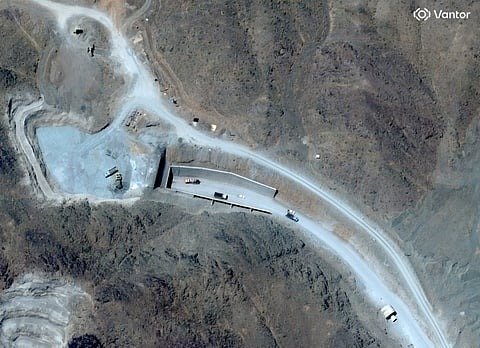
The escalation rests on a convergence of structural hardening and diplomatic rupture. A six-year review of satellite imagery by the Center for Strategic and International Studies (CSIS) reveals a surge in work across the site, including the reinforcement of underground access points, internal road expansion, entrance hardening, and the ongoing extraction of excavated material. While analysts note the facility does not currently function as an active enrichment site and cannot verify external intelligence claims regarding relocated centrifuge components, its sheer geological depth presents severe tactical hurdles. Even America’s largest conventional bunker-buster, the GBU-57 Massive Ordnance Penetrator, faces significant operational limitations against the granite-encased tunnels.
This physical expansion directly mirrors a collapse in international oversight. The International Atomic Energy Agency’s (IAEA) board voted 23-3 to report Iran to the UN Security Council, with Russia and China casting opposing votes. The referral stems from Tehran’s refusal to grant inspectors access to bombed installations or permit verification of remaining nuclear inventory. IAEA estimates indicate Iran maintains roughly 440.9 kilograms of uranium enriched to 60%, a threshold close to the roughly 90% weapons-grade standard. With inspectors locked out of affected locations, the agency cannot confirm the precise location, quantity, or condition of these declared stocks.
The standoff directly implicates three critical strategic nodes. First, Iranian leadership faces mounting external pressure, compounded by domestic political shifts and explicit warnings from US leadership. US President Donald Trump stated in a July 13 interview that Pickaxe Mountain remains firmly on the target list, warning that authorities have direct visibility on the site and demanding that Tehran prepare for potential action. Second, global regulatory bodies like the IAEA find their verification mandate neutralized, leaving international monitors unable to audit assets. Third, regional security calculations across the Middle East are shifting as military planners weigh the limits of conventional munitions against deeply subterranean nuclear infrastructure.
While intelligence assessments frame the Pickaxe Mountain expansion as an aggressive maneuver to shield nuclear capabilities, the current physical evidence offers a complex picture. Analysts emphasize that despite visible surface activity and tunnel reinforcement, the site lacks the operational indicators of an active enrichment plant. However, in the absence of verified IAEA inspections, this operational ambiguity fails to alleviate international proliferation concerns, locking both sides into an escalating cycle of threat and fortification.