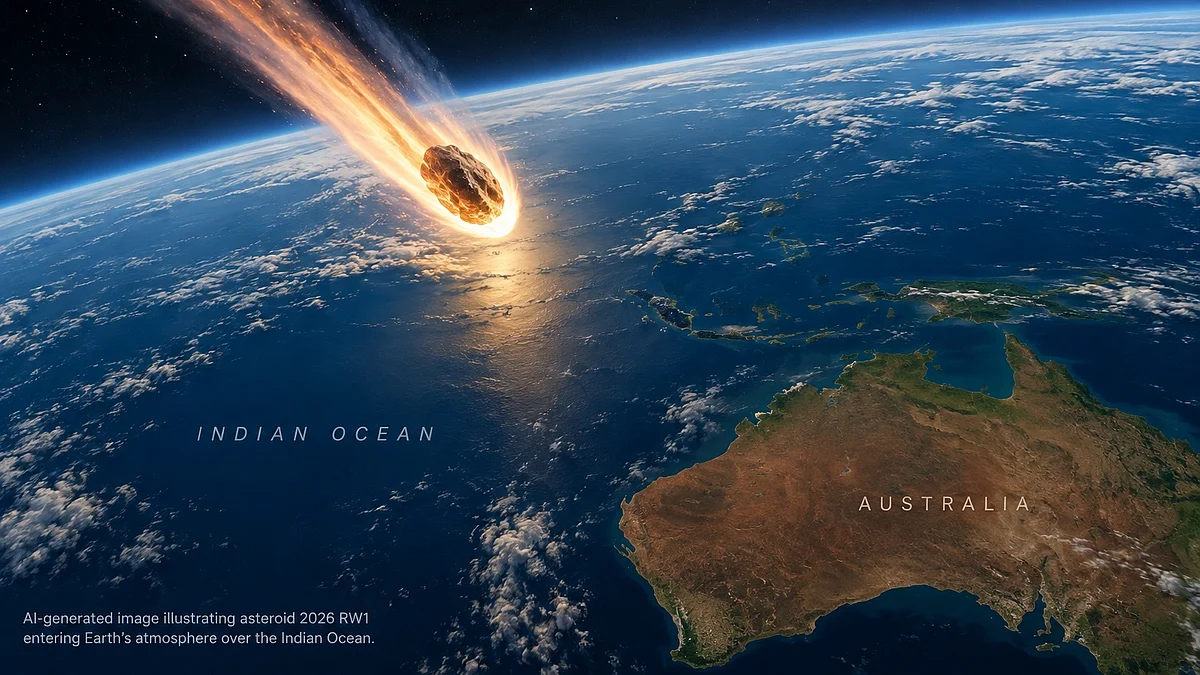
(Credit - European Space Agency)
7 Hours Before Entry, Scientists Tracked Asteroid 2026 RW1 Over Indian Ocean
How Scientists Spotted Asteroid 2026 RW1 Seven Hours Before Impact
A tiny space rock entered Earth’s atmosphere over the Indian Ocean on September 6, 2026, but the real story is that astronomers saw it coming seven hours earlier. Designated 2026 RW1, the asteroid measured between 0.6 and 1.3 metres wide and burned up completely in the upper atmosphere without posing any risk to ground safety. Its early tracking marks only the 13th time in history that an incoming asteroid was identified and calculated prior to impact.
The Mount Lemmon Survey in Arizona, operating as part of the Catalina Sky Survey, first spotted the object moving against background stars. Once astronomers logged initial observations, automated systems calculated its orbit and confirmed it was heading directly toward Earth. The European Space Agency’s (ESA) Meerkat asteroid warning system then analysed the data to pinpoint where and when the object would enter the atmosphere.
Testing Real-World Planetary Defence Systems
At around 16:07 UTC on September 6, just over seven hours after its first recorded observation, 2026 RW1 crossed into the atmosphere northwest of Australia. Because the rock was roughly a metre wide, far smaller than the larger objects planetary defence programs primarily target, no ground safety protocols or protective actions were necessary.
Detecting a one-meter space rock hours before impact provides planetary defence teams with a rare operational stress test. While massive near-Earth objects are easier to spot from long distances, small asteroids present a steep monitoring challenge due to their low visibility. The rapid trajectory calculations executed by ESA‘s Meerkat system proved that automated networks can successfully identify fast-moving, faint targets on short deadlines.
Planetary defence networks continually scan near-Earth space to track incoming objects and refine orbital projections through repeated observations. For 2026 RW1, the burn-up over the Indian Ocean ended harmlessly, but the swift detection sequence gave global tracking teams vital real-world data to sharpen future warning processes.