US Signals Abrupt Iran Pivot, Leaving Strait of Hormuz Peace Talks Stranded
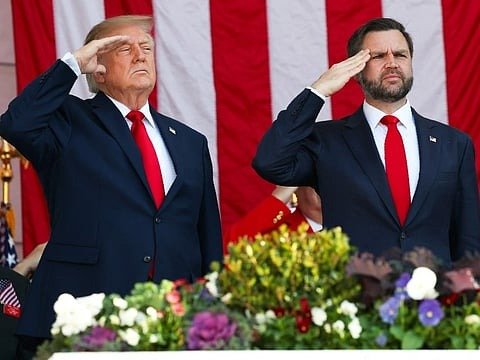
The decision by US President Donald Trump to abruptly pull Vice President JD Vance from peace negotiations with Tehran marks a deliberate shift from negotiated settlement to passive containment. By framing the eight-month-old conflict as “militarily effectively over” while simultaneously abandoning formal talks, the administration is attempting to insulate itself from domestic political fallout while forcing regional partners and global commercial markets to absorb the structural risks of an unresolved war.
This tactical pivot leaves key maritime corridors, specifically the Strait of Hormuz, in operational uncertainty. Rather than securing a structured ceasefire that restores predictable passage for energy exports from the Arabian Gulf, Washington has opted to rely on unilateral economic pressure and idle military deterrence, transferring the burden of ongoing strategic ambiguity directly onto Gulf economies and maritime logistics networks.
Domestic Politics and the Shift to Sanctions-Led Containment
The immediate catalyst for Washington’s sudden policy shift was the political fallout from last week’s midterm elections. Following substantial defeat at the polls, President Trump publicly acknowledged that the eight-month military campaign and the resulting global economic volatility contributed to voter backlash. This electoral signal forced a rapid reassessment of Washington’s strategic priorities, driving an urgent effort to exit an unpopular conflict without conceding military defeat.
To justify stepping back from active negotiations, the administration has redefined success around economic exhaustion rather than a signed accord. Speaking to the Federalist Society, Secretary of State Marco Rubio confirmed this strategy, stating that the economic pain inflicted on the Iranian regime is severe enough to eliminate the immediate requirement for further military strikes. By pointing to the crippling state of Tehran’s national economy, the administration seeks to present the conflict as functionally won, allowing it to reallocate domestic political focus toward internal governance initiatives, including directing Vice President Vance to shift his entire focus to a domestic anti-fraud campaign.
At the same time, Washington maintains a high-consequence threat baseline to deter renewed Iranian action. President Trump publicly warned that the US military remains “locked and loaded,” specifically highlighting the Pickaxe Mountain nuclear facility as a benchmark for potential intervention. In a broadcast interview with conservative host Hugh Hewitt, Trump explicitly noted he would not hesitate to act if conditions change. This posture attempts to maintain baseline deterrence through public warnings while disengaging from the operational mechanics of diplomatic resolution.
Intermediaries, Energy Routes, and Great-Power Summitry
The decision to abandon formal negotiation channels directly undermines the mediation framework established by Qatar. Qatari officials had been hosting and facilitating discussions aimed at securing an interim agreement to re-open the Strait of Hormuz, the single most critical maritime transit point for crude oil and natural gas originating in the Arabian Gulf. According to Middle East diplomats familiar with the discussions, early-week White House meetings between Trump and Qatar’s prime minister had signaled momentum toward a stabilized arrangement. The subsequent public statement by the US president declaring that Washington no longer requires a deal with Tehran immediately stalled those talks, leaving regional negotiators without clear parameters for a viable compromise.
For commercial shipping lines, energy exporters, and regional infrastructure operators, this diplomatic halt extends operational instability. Without an official agreement securing passage through the Strait of Hormuz, commercial maritime operators must continue to navigate elevated insurance premiums, altered transit routing, and persistent security risks along vital Gulf trade corridors.
The strategic implications of this policy vacuum will extend beyond the region as President Trump travels to Asia for meetings in the Philippines and the Asia-Pacific Economic Cooperation summit in Shenzhen, China. In Shenzhen, Trump is scheduled to hold a three-way summit with Chinese President Xi Jinping and Russian President Vladimir Putin. With formal US-Iran channels closed, the Iran conflict and the nuclear posture of all three powers will sit at the center of talks among the three leaders.
The Logic of Unilateral Economic Dominance
From the perspective of the administration’s policy architects, halting formal talks with Tehran is not an abandonments of policy, but the logical application of maximum leverage. Proponents of this posture argue that entering formal negotiations with a severely weakened Iranian economy would unnecessarily grant legitimacy to Tehran and require US concessions on sanctions relief.
Under this framework, maintaining strict economic sanctions while holding kinetic military power in reserve achieves US strategic objectives at zero additional deployment cost. By allowing economic damage to accumulate inside Iran without offering an immediate diplomatic exit, Washington calculates that Tehran’s capacity to resume large-scale military action or disrupt global shipping remains severely constrained. However, for regional state actors and international energy markets dependent on absolute stability through the Strait of Hormuz, this model replaces structured diplomatic guarantees with ongoing operational volatility.