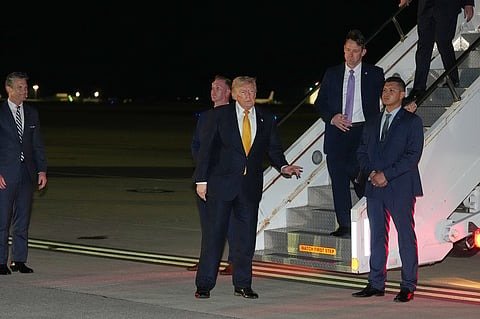
Trump's Secret Flight: A Decoy and a Catering Truck
US President Donald Trump has confirmed that he was secretly transferred to a different aircraft after the NATO summit in Turkey last month due to a potential threat linked to Iran. Trump was reportedly moved inside an airport catering truck to conceal the operation, and the original presidential aircraft was used as a decoy to ensure his safety during the return trip to Washington. The decision to switch planes was made by the Secret Service and the military, according to Trump.
The disclosure follows reporting that Trump was covertly transferred from the presidential aircraft to a smaller military jet at Ankara airport. US officials had previously told CBS News that intelligence had identified a credible Iranian threat, including a possible missile attack against the presidential aircraft. Trump stated that he did not ask for detailed information about the threat.
The incident occurred on July 8, 2026, after the NATO summit in Ankara, Turkey. The use of a catering truck as a concealment method and a decoy jet to shield the president highlights the extreme measures taken to ensure Trump’s safety.
This event is connected to the recent NATO summit in Turkey, where discussions about regional security and Iran’s role in the region were likely prominent.


Google Gemini Hits 1 Billion Users
Gemini AI Assistant Reaches 1 Billion Monthly Users
Google's Gemini AI assistant has surpassed 1 billion monthly users, as announced by CEO Sundar Pichai. This milestone makes Gemini the company's fastest-growing product ever, with it being the 14th product to reach a billion users. Local investors and tech enthusiasts are closely watching the development, as Gemini's integration across Google's ecosystem, including Search, Gmail, Maps, and YouTube, drives its growth.
The achievement comes as Google faces mounting competitive pressure in the AI sector, particularly from OpenAI and its ChatGPT app, which has also reached 1 billion users. Despite this, Google's audience remains its main asset, with the company focusing on integrating AI into its various services. The Gemini 3.5 Pro model, initially promised for June, has yet to be released, while rivals have launched more powerful models, especially for generating computer code.
The milestone is significant for Google, as it highlights the company's ability to drive user growth amidst intense competition. With OpenAI's market share for AI assistants falling below 50 percent in the first half of the year, according to research firm Sensor Tower, Google's Gemini AI assistant is well-positioned to capitalize on the growing demand for AI-powered services.
In the context of the UAE, where technology and innovation are key drivers of economic growth, the development of AI assistants like Gemini is closely watched. The UAE has been at the forefront of adopting and integrating AI technologies, with various initiatives aimed at promoting innovation and technological advancement.

UAE School Calendar 2026-27 Starts August 31
UAE Schools Reopen August 31: Key Dates for 2026-27
As the new academic year approaches, schools across the UAE are gearing up to reopen on August 31, 2026. The majority of public and private schools in the UAE follow a unified academic calendar, which sets standard dates for the start of the school year, terms, and major holidays. For parents planning ahead, here are the key dates to know for the 2026-27 academic year.
The first-term mid-term break is scheduled for October 12-18, 2026, with classes resuming on October 19, 2026. The winter break will take place from December 14, 2026, to January 3, 2027, and classes will resume on January 4, 2027. The spring break is set for April 5-11, 2027, with classes resuming on April 12, 2027. The academic year will come to a close on July 2, 2027.
It's worth noting that not all private schools follow the unified calendar. Private schools in Sharjah operate under the emirate's own regulatory framework, while schools following alternative curricula, such as Indian, Pakistani, and Bangladeshi curricula, may have different academic years and term dates. Parents should check directly with their child's school before making travel or holiday arrangements.
In addition to the term dates, parents should also factor in expected public holidays, including Eid Al Fitr from March 8-12, 2027, Eid Al Adha from May 15-18, 2027, and Hijri New Year on June 6, 2027. These dates are subject to official confirmation.
For parents in Sharjah, the private school calendar for 2026-27 has also been announced, with key dates including winter break from December 14, 2026, to January 3, 2027, and spring break from April 5-8, 2027. The academic year for Sharjah private schools will end on July 1, 2027.
As the new academic year begins, families can plan ahead with greater consistency, thanks to the unified calendar framework. With the key dates outlined, parents can make informed decisions about childcare, holidays, and other important arrangements.

UAE Public Holidays: Up to 13 Paid Days Off
UAE Public Holidays: How Ramadan Decides Your Extra Days Off
As a resident of the UAE, you're likely aware that the country's public holiday calendar is influenced by the Islamic lunar calendar, particularly the duration of Ramadan. But did you know that when Ramadan completes 30 days, you can get up to 13 days off? The UAE's public holiday resolution includes one day for the Gregorian New Year, three days for Eid Al Fitr, and additional days for other significant Islamic occasions.
The total number of public holidays in the UAE can vary between 12 and 13 days, depending on whether Ramadan lasts 29 or 30 days. If Ramadan lasts 29 days, the public holiday total is 12 days. However, if it reaches 30 days, the additional Ramadan day takes the total to 13. The exact timing of these holidays is confirmed through official moon sighting.
For instance, in 2027, Eid Al Fitr is expected to begin on Tuesday, March 9. If Ramadan lasts 29 days, residents would have three public holiday days through Thursday, March 11. If it lasts 30 days, Friday, March 12 would be added, creating a possible six-day break when combined with the weekend. Additionally, the two-day Eid Al Etihad holiday is expected to fall on Thursday, December 2 and Friday, December 3, extending into a four-day weekend.
Residents can also look forward to several long weekends throughout the year. A new law that came into effect at the beginning of 2025 allows certain public holidays to be transferred to the start or end of the week if they fall mid-week, enabling people to enjoy longer, continuous breaks. This system is expected to benefit residents further in 2026, with seven religious, national, and general occasions that offer two confirmed extended weekends, including a six-day break, and four holidays that can be transferred to create longer weekends.
If you're planning your year ahead, it's essential to keep an eye on the UAE's public holiday calendar, as the dates can change from year to year based on moon sightings. By understanding how Ramadan's duration affects the public holiday calendar, you can make the most of your time off and plan your long weekends and breaks accordingly.
Here are some key points to keep in mind:
- The UAE public holiday calendar provides up to 13 official paid days off per year when Ramadan completes a 30-day cycle.
- The total number of public holidays can vary between 12 and 13 days, depending on whether Ramadan lasts 29 or 30 days.
- Residents can experience several long weekends throughout the year, including potential six-day breaks.
- A new law allows certain public holidays to be transferred to the start or end of the week if they fall mid-week, enabling people to enjoy longer, continuous breaks.

Jaywan card use expands to 183 countries
Jaywan Card Goes Global: 183 Countries, 100M+ Points of Sale
Etihad Payments signed a Memorandum of Understanding with UnionPay International on Tuesday, August 11, to expand the use of UAE's Jaywan cards globally. The new agreement allows customers to use their Jaywan cards at more than 100 million points of sale and 1.8 million ATMs in over 183 countries. Local banks and financial institutions in the UAE will issue multi-system 'Jaywan - UnionPay' cards, enabling local payments to be processed through the Jaywan system and international payments through the UnionPay International network.
The memorandum enables UnionPay to handle the transfer of Jaywan card transactions executed outside the UAE to the Emirates Electronic Switch system operated by Etihad Payments. Settlement operations will be carried out under a separate memorandum of understanding, including the provision of settlement, liquidity, and foreign exchange services. This collaboration aims to enhance the global competitiveness and operational flexibility of the local payment card system in the UAE, raising the efficiency of payment settlement using local currencies and supporting trade relations between the two countries.
The Dubai Financial Services Authority and Central Bank of the UAE have been working to promote the use of the Jaywan card, with several UAE banks already beginning to roll out the national cards to customers. The Jaywan card offers various benefits, including travel perks and discounts, and can be used for local and international transactions.
In a similar development, the UAE has been working to expand its digital payment systems, with the Central Bank of the UAE announcing plans to launch a digital currency. The partnership between Etihad Payments and UnionPay International is expected to further enhance the UAE's digital payment infrastructure, providing customers with greater convenience and flexibility when making transactions.
100 million points of sale and 1.8 million ATMs in over 183 countries will now accept the Jaywan card, thanks to the new agreement.
This development is connected to the UAE's ongoing efforts to enhance its digital payment systems, as seen in previous initiatives such as the launch of digital wallets and online payment platforms.

Hanover Airport drone disruption: 90-minute closure
Hanover Airport Shut Down for 90 Minutes After Drone Sighting
Hanover Airport in Germany was disrupted overnight by a drone, with runways closed for 90 minutes early Tuesday morning. The drone went undetected by authorities and airport staff, flying freely for about two hours. Six flights, including departures to Turkey, Egypt, Greece, and Spain, were delayed by 15 to 50 minutes, and a cargo plane from Paris was diverted to Nuremberg Airport.
The investigation into the drone overflight at Langenhagen Airport has been taken over by the Hanover Central Criminal Investigation Department. German authorities have warned of potential "hybrid attack" scenarios, which include sabotage and espionage, following the discovery of an explosives-laden drone at Leipzig Airport last week. Interior Minister Alexander Dobrindt has cautioned that such incidents represent "a new dimension of threat."
The drone disruption at Hanover Airport occurred just a week after the Leipzig incident, but according to an internal police report, it is "currently impossible" to link the two events. The police report also mentions that the possibility of a hybrid activity cannot be excluded.
The incident has raised concerns about aviation security in Germany, which has become Ukraine's leading military backer in Europe following the 2022 Russian attack. The Hanover Central Criminal Investigation Department is currently investigating the drone overflight, and the airport has resumed normal operations.
The disruption at Hanover Airport is the latest in a series of drone-related incidents at German airports. Last week, an explosives-laden drone was discovered at Leipzig Airport, and there have been reports of drone sightings at other airports in the country.
In the wake of the Hanover Airport disruption, authorities are on high alert, and passengers are advised to check with their airlines for any updates on flight schedules. The incident highlights the need for increased security measures to prevent such disruptions in the future.
As the investigation into the drone overflight continues, the Hanover Central Criminal Investigation Department is working to determine the cause of the incident and to identify those responsible. The airport has resumed normal operations, but the incident has raised concerns about the potential for future disruptions.
The Hanover Airport drone disruption is a reminder of the importance of aviation security and the need for vigilance in the face of potential threats. As the investigation continues, authorities are working to ensure that such incidents do not happen again in the future.
Context: The incident at Hanover Airport comes just a week after an explosives-laden drone was discovered at Leipzig Airport, highlighting the need for increased security measures to prevent such disruptions.