(Credit - The National)
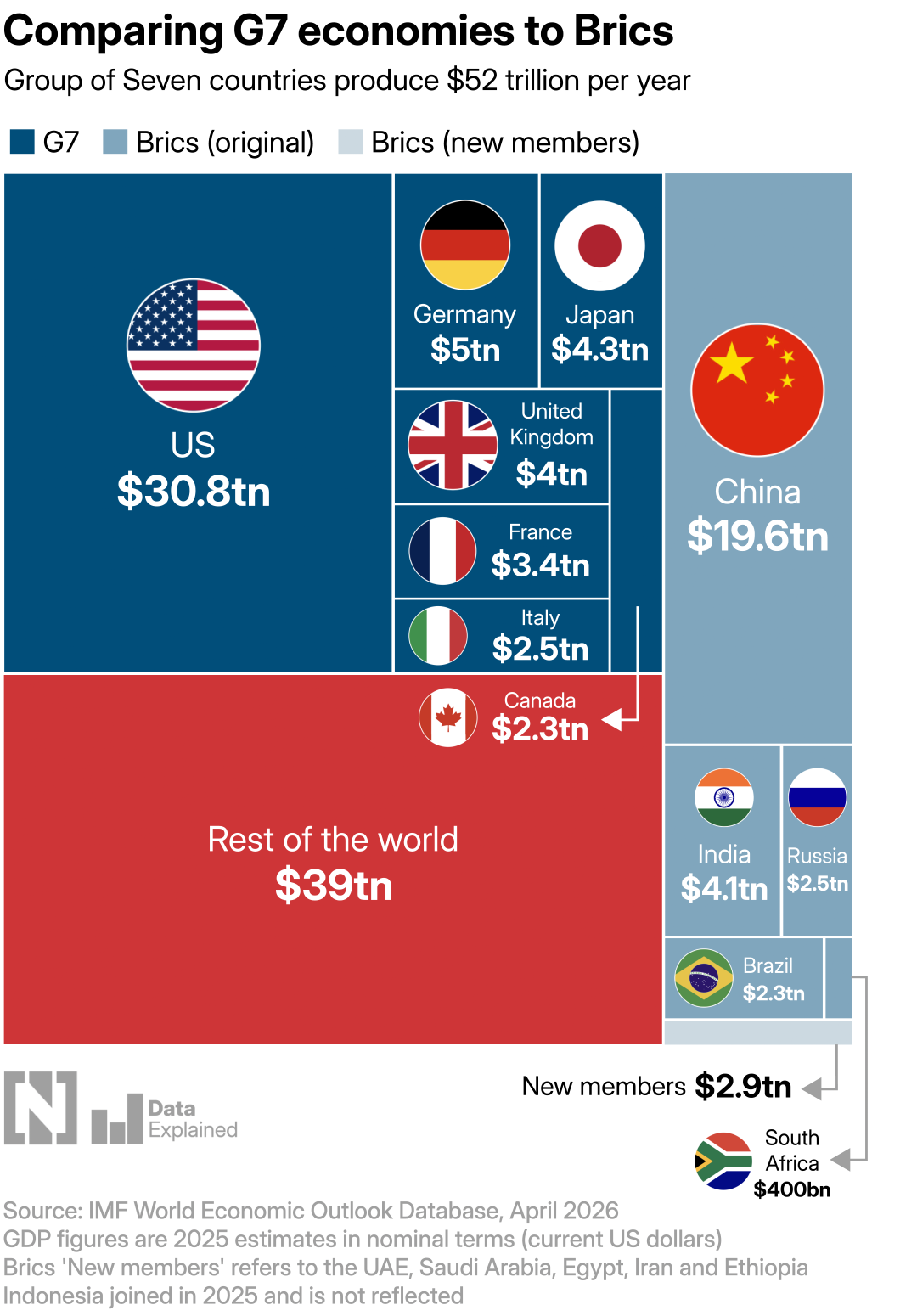
G7 Outweighs BRICS in Nominal GDP by $21 Trillion
The matchup between the G7 and BRICS economic blocs is a significant one, with each side having its own strengths and weaknesses. This comparison is for individuals and businesses looking to understand the economic environment and make informed decisions about investments, trade, and growth. The G7 is suitable for those prioritizing established markets and economic stability, while BRICS is ideal for those looking for emerging markets with high growth potential.
Cost Comparison
The cost of doing business in the G7 versus BRICS differs significantly. The G7, with its more developed economies, tends to have higher labor costs, stricter regulations, and higher taxes. In contrast, BRICS countries often offer lower labor costs, more relaxed regulations, and tax incentives to attract foreign investment. However, the G7’s higher costs are often offset by its more stable and secure business environment, which can reduce risks and costs associated with investment.Hassle Comparison
The hassle of navigating the G7 versus BRICS economies also varies. The G7 countries generally have more complex and stringent regulatory requirements, which can make it more challenging to establish and operate a business. BRICS countries, on the other hand, often have less complex regulations, but may lack the infrastructure and institutional support that investors are accustomed to in the G7. This can make it more difficult to navigate the business environment and resolve disputes.Value Comparison
The value proposition of the G7 versus BRICS economies is a critical consideration. The G7 offers a large, established market with a high level of economic stability and security. This can provide a solid foundation for businesses looking to expand their operations and reach new customers. BRICS, on the other hand, offers high growth potential, with many of its member countries experiencing rapid economic expansion. This can provide opportunities for businesses to tap into emerging markets and capitalize on the growing demand for goods and services.| Category | G7 | BRICS |
|---|---|---|
| Nominal GDP (2025 est.) | $52 trillion | $31 trillion |
| Population | 773 million | 3.2 billion |
| Per-capita GDP | $67,000 | $9,700 |
| Economic Stability | High | Medium |
The winner in this comparison depends on the individual’s or business’s priorities. If stability, security, and established markets are the primary concerns, the G7 may be the better choice. However, if high growth potential, emerging markets, and lower costs are more important, BRICS may be the more attractive option. Ultimately, the decision will depend on a careful consideration of the costs, hassles, and value proposition of each economic bloc.