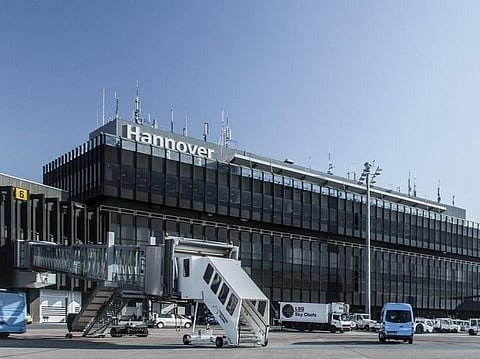
Hanover Airport Shut Down for 90 Minutes After Drone Sighting
Hanover Airport in Germany was disrupted overnight by a drone, with runways closed for 90 minutes early Tuesday morning. The drone went undetected by authorities and airport staff, flying freely for about two hours. Six flights, including departures to Turkey, Egypt, Greece, and Spain, were delayed by 15 to 50 minutes, and a cargo plane from Paris was diverted to Nuremberg Airport.
The investigation into the drone overflight at Langenhagen Airport has been taken over by the Hanover Central Criminal Investigation Department. German authorities have warned of potential “hybrid attack” scenarios, which include sabotage and espionage, following the discovery of an explosives-laden drone at Leipzig Airport last week. Interior Minister Alexander Dobrindt has cautioned that such incidents represent “a new dimension of threat.”
The drone disruption at Hanover Airport occurred just a week after the Leipzig incident, but according to an internal police report, it is “currently impossible” to link the two events. The police report also mentions that the possibility of a hybrid activity cannot be excluded.
The incident has raised concerns about aviation security in Germany, which has become Ukraine’s leading military backer in Europe following the 2022 Russian attack. The Hanover Central Criminal Investigation Department is currently investigating the drone overflight, and the airport has resumed normal operations.
The disruption at Hanover Airport is the latest in a series of drone-related incidents at German airports. Last week, an explosives-laden drone was discovered at Leipzig Airport, and there have been reports of drone sightings at other airports in the country.
In the wake of the Hanover Airport disruption, authorities are on high alert, and passengers are advised to check with their airlines for any updates on flight schedules. The incident highlights the need for increased security measures to prevent such disruptions in the future.
As the investigation into the drone overflight continues, the Hanover Central Criminal Investigation Department is working to determine the cause of the incident and to identify those responsible. The airport has resumed normal operations, but the incident has raised concerns about the potential for future disruptions.
The Hanover Airport drone disruption is a reminder of the importance of aviation security and the need for vigilance in the face of potential threats. As the investigation continues, authorities are working to ensure that such incidents do not happen again in the future.
Context: The incident at Hanover Airport comes just a week after an explosives-laden drone was discovered at Leipzig Airport, highlighting the need for increased security measures to prevent such disruptions.

Jaywan card use expands to 183 countries
Jaywan Card Goes Global: 183 Countries, 100M+ Points of Sale
Etihad Payments signed a Memorandum of Understanding with UnionPay International on Tuesday, August 11, to expand the use of UAE's Jaywan cards globally. The new agreement allows customers to use their Jaywan cards at more than 100 million points of sale and 1.8 million ATMs in over 183 countries. Local banks and financial institutions in the UAE will issue multi-system 'Jaywan - UnionPay' cards, enabling local payments to be processed through the Jaywan system and international payments through the UnionPay International network.
The memorandum enables UnionPay to handle the transfer of Jaywan card transactions executed outside the UAE to the Emirates Electronic Switch system operated by Etihad Payments. Settlement operations will be carried out under a separate memorandum of understanding, including the provision of settlement, liquidity, and foreign exchange services. This collaboration aims to enhance the global competitiveness and operational flexibility of the local payment card system in the UAE, raising the efficiency of payment settlement using local currencies and supporting trade relations between the two countries.
The Dubai Financial Services Authority and Central Bank of the UAE have been working to promote the use of the Jaywan card, with several UAE banks already beginning to roll out the national cards to customers. The Jaywan card offers various benefits, including travel perks and discounts, and can be used for local and international transactions.
In a similar development, the UAE has been working to expand its digital payment systems, with the Central Bank of the UAE announcing plans to launch a digital currency. The partnership between Etihad Payments and UnionPay International is expected to further enhance the UAE's digital payment infrastructure, providing customers with greater convenience and flexibility when making transactions.
100 million points of sale and 1.8 million ATMs in over 183 countries will now accept the Jaywan card, thanks to the new agreement.
This development is connected to the UAE's ongoing efforts to enhance its digital payment systems, as seen in previous initiatives such as the launch of digital wallets and online payment platforms.

Diesel prices surge 7.4% to $4.19
Diesel prices spike 7.4% to $4.19 a gallon
Diesel prices have surged globally following refinery attacks in Russia and Saudi Arabia, alongside lingering shipping disruptions in the Strait of Hormuz. US ultra-low-sulfur diesel futures jumped 7.4% to $4.19 a gallon, driven by distillate inventories dropping to three-decade lows. US distillate inventories, which include diesel and heating oil, stood at 107.2 million barrels as of July 31, reaching their lowest level for this time of year in three decades.
European diesel refining margins rose nearly 10%, as traders focus increasingly on shortages of refined products rather than crude itself. The disruptions come on top of the continuing fallout from the closure of the Strait of Hormuz, a critical energy shipping route whose disruption has constrained global flows of crude and refined petroleum products. Russia has also moved to protect its domestic fuel supply by extending restrictions on gasoline and diesel exports through January 2027, further reducing the amount of refined fuel available to international buyers.
The Jazan refinery in Saudi Arabia, which has been offline since July 27, is now expected to resume operations around August 30. The market is particularly sensitive to diesel because refining capacity cannot quickly switch between products. Diesel is also critical to freight transport, agriculture, construction, and industrial activity, meaning prolonged shortages can feed directly into transportation and food costs.
The squeeze illustrates why a disruption to oil infrastructure can hit consumers even when crude prices do not rise by the same magnitude. Refineries must turn crude into usable products such as diesel and jet fuel, and outages can cause the price of those products to spike rapidly when inventories are already low. For consumers, the biggest concern is that diesel could remain under pressure even if crude prices stabilize.
In a related development, Brent and US crude settled about 5% higher as uncertainty persisted over when the Strait of Hormuz might reopen and as Washington and Tehran continued to trade demands over compensation and the conflict. This comes as the global energy market is still reeling from the aftermath of the Ukrainian attack on a refinery in Russia's Tatarstan region.
This recent surge in diesel prices follows a period of heightened tensions in global energy markets, marked by supply disruptions and geopolitical instability. As the situation continues to unfold, it remains to be seen how the global economy will respond to the challenges posed by the refined-fuel squeeze.

Oman Oil Spill: 390km² Affected
Oman Battles 390km² Oil Slick
Oman is working to contain an oil spill off its southern coast after a tanker ran aground in June inside a protected marine area. The Oman Environment Authority said the ongoing spill had affected roughly 390 square kilometres, according to its most recent analysis. Environmentalists have triggered calls for action, with advocacy groups Greenpeace and PAX warning that the spill is on the verge of causing an "environmental disaster".
The tanker, Caroline Bezengi, was carrying around one million barrels of crude when it ran aground at Al Hallaniyat Islands in the Governorate of Dhofar. The vessel was rocked by explosions in early June, causing water to enter several sections. Authorities have not yet identified the cause of the spill but are in the early stages of developing a plan to transfer the vessel's oil cargo to reduce risks and protect the marine environment.
The slick is concentrated around Oman's Hallaniyat archipelago, where a marine reserve was established last year to protect sensitive ecosystems home to diverse marine life, including rare sea turtles. The country's environment authority has emphasized the need for rapid action to protect the area's biodiversity, including coral reefs, turtle nesting areas, and coastal areas of ecological importance.
This incident follows a similar environmental concern in the region, where marine life has been impacted by human activities. The Oman Environment Authority's efforts to contain the spill are crucial in preventing further damage to the marine ecosystem.

Trump Iran Compensation Demand
Trump Seeks $87 Oil Price Surge Compensation from Iran
US President Donald Trump has demanded that Iran pay compensation for the people it has allegedly killed in wars, attacks, and protests. This move is a response to Tehran's demands for compensation and an end to sanctions, which were largely in line with the terms of a preliminary peace deal signed in June. Trump's proposal complicates efforts to reopen the Strait of Hormuz, a crucial oil shipping route.
The US President stated that he would seek compensation for people who have been killed or wounded in previous conflicts, as well as payments to the families of hundreds of thousands of protesters whom he said Iran had killed. Trump also mentioned that Iran should compensate families of the 17 US sailors killed in an October 2000 attack in Yemen on the naval vessel USS Cole.
Oil prices rose after Trump's announcement, with Brent crude trading at $87, up 4.6% for the day. The increase in oil prices is likely to have significant implications for the global economy, particularly for countries that rely heavily on oil imports.
This development is a continuation of the ongoing conflict between the US and Iran, which has been escalating since February. The situation remains uncertain, with neither side likely to accept the other's terms, making it challenging to predict the outcome of the negotiations.
The US-Iran conflict has significant implications for the Middle East region, particularly for countries such as Lebanon, Syria, Yemen, and Gaza, which have been affected by the conflict. The situation is being closely monitored by the international community, with many countries calling for a peaceful resolution to the conflict.

Trump Backs FIFA's Infantino Amid Replacement Threats
Trump: Replacing Infantino 'Terrible Mistake'
US President Donald Trump on Monday backed FIFA President Gianni Infantino, who is facing allegations of a workplace affair and criticism of a failed private investment scheme. Trump stated that replacing Infantino would be a "terrible mistake" and called the FIFA president "fantastic," saying he "presided over the most successful World Cup, by four times, ever presented." FIFA's governing body has been under fire from UEFA, CONCACAF, and the AFC, with some leaders calling for Infantino's replacement ahead of the FIFA presidential election in March 2027.
Infantino has received support from the Confederation of African Football and some individual member associations, including Mexico and Qatar. However, UEFA, CONCACAF, and the AFC have expressed strong opposition to Infantino's leadership, citing a "failure of judgment" and a "shabby, opaque, backroom deal" regarding his private investment plan. The plan was later withdrawn due to widespread criticism.
The FIFA president has denied any wrongdoing and has received "full support" from senior FIFA directors in an emergency meeting. Despite this, the opposition from UEFA, CONCACAF, and the AFC remains, with some leaders viewing CONCACAF President Victor Montagliani as a potential challenger to Infantino in the upcoming election.
The controversy surrounding Infantino's leadership has sparked a heated debate within the football community, with some calling for his replacement and others defending his tenure as FIFA president. As the FIFA presidential election approaches, the situation is likely to continue to unfold, with potential consequences for the future of the organization.
The UAE has not been directly involved in the controversy, but as a member of the FIFA community, the outcome of the situation may have implications for the country's football scene.