(Credit - Dubai Roads and Transport Authority (RTA))
Dubai RTA Ridership Over Eid Al Adha Reaches 8.2 Million in Five Days
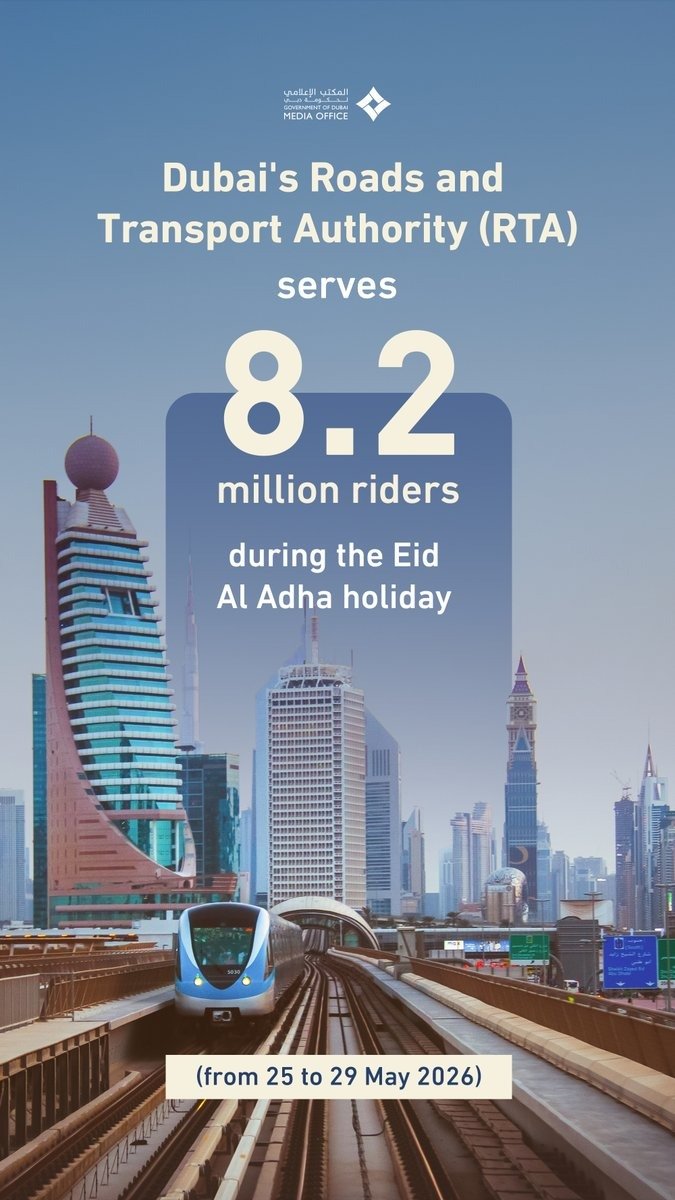
Dubai RTA ridership over Eid Al Adha hit 8.2 million across public transport and mobility services between 25 and 29 May, the Roads and Transport Authority (RTA) confirmed, averaging roughly 1.64 million trips per day across Metro, buses, marine transport, taxis, and shared mobility.
What 8.2 Million Trips in Five Days Actually Tells You
The five-day window covers one of the UAE’s highest-mobility periods of the year. Family visits, shopping runs, and leisure travel all converge simultaneously, pushing demand onto mass transit corridors and on-demand services that would otherwise see steady but predictable weekday loads.
The Dubai Metro, operating the Red and Green lines, typically absorbs the heaviest volumes on high-density corridors, while buses and marine services (abras, ferries, water buses) extend coverage to waterfront districts and residential feeders. Taxis and shared mobility pick up the late-night, last-mile, and family-group trips that fixed-route services don’t fully capture.
How the Eid Surge Fits the Bigger Picture
The RTA‘s full-year 2025 network total stood at 802 million riders across public transport, shared mobility, and taxis, a figure that frames the Eid period not as an outlier but as a concentrated expression of the city’s daily movement economy. Five days of Eid travel alone accounted for roughly 1% of that annual total, which signals how sharply demand compresses during peak holiday windows.
| Mode | Role in the Network | Holiday Demand Pattern | Resident Impact |
|---|---|---|---|
| Dubai Metro (Red & Green Lines) | High-capacity backbone corridors | Highest volume, mall, interchange & tourist routes | Expect crowding at major stations; allow extra journey time |
| Public Buses | Feeder & residential coverage | Elevated on routes linking Metro to neighbourhoods | Frequency may tighten; check RTA app for real-time loads |
| Marine Transport (Abras, Ferries, Water Buses) | Waterfront & creek connectivity | Spikes for leisure and cross-creek trips | Queues at Dubai Creek and marina stops during peak hours |
| Taxis | On-demand, door-to-door | High demand for late-night and family-group travel | Surge pricing possible; book in advance via app |
| Shared Mobility | Last-mile and flexible trips | Absorbs overflow from fixed-route services | Availability tightens near large interchanges |
Three Wallet Scenarios: Renter, Job-Seeker, Business Owner
If you’re a renter living near a Metro station, the 8.2 million Eid figure reinforces that your proximity to transit carries real financial value. Car-free living during peak periods is operationally viable in Dubai, and with annual network ridership at 802 million, service frequency is structured around sustained, high-volume demand, not occasional use.If you’re a job-seeker, roles in retail, hospitality, and facilities management near major Metro interchanges and mall corridors are directly tied to footfall patterns like these. An employer advertising shifts around Eid or other peak periods is responding to exactly this kind of ridership data, and demonstrating that transit-accessible locations drive consistent customer volumes.If you’re a business owner operating near a key station or interchange, 8.2 million riders over five days is a staffing and stock-planning signal, not just a headline. Businesses that align opening hours, delivery windows, and floor staffing to RTA peak schedules, rather than standard weekday patterns, are better positioned to convert that footfall into revenue without being caught short on capacity.Dubai’s RTA logged 8.2 million riders across all transport and mobility modes during the Eid Al Adha period from 25 to 29 May, against a full-year 2025 network total of 802 million. The numbers confirm that public transport is the practical default for millions of residents and visitors during high-demand periods, not a backup option. For anyone whose income, rent, or business depends on where people move in this city, these figures are a direct operational input.
Trump Israel Hezbollah Ceasefire: 3-Week Extension
Trump Israel Hezbollah Ceasefire: US-Mediated Halt Extended by Three Weeks, But Key Terms Remain Disputed
The Trump Israel Hezbollah ceasefire announcement landed on June 1, 2026, with Donald Trump stating that US-mediated talks produced an agreement to halt attacks between Israel and Hezbollah, and the arrangement has since been extended by three weeks.
Here's What The National Actually Reports
According to The National, Trump announced that Israel and Hezbollah agreed to halt attacks following US-mediated talks, framing it as a ceasefire arrangement. Reporting indicates Israel accepted a temporary truce while rejecting Hezbollah's demands. The ceasefire was subsequently extended by three weeks, a move that signals the initial halt was time-bound and required a deliberate renewal decision, not an automatic continuation.
A three-week extension of this kind typically means mediators are managing a fragile pause rather than a settled agreement. Both sides appear to have accepted the same broad outcome, a halt to attacks, but the public record does not confirm they accepted identical terms. Israel's framing of the arrangement as a "temporary truce" and Hezbollah's historically careful avoidance of language that implies concession means the gap between what each side says publicly and what was agreed privately may be significant. The US role as intermediary adds a layer of complexity: Washington communicates with both parties through separate channels, and the terms each side received may not be fully symmetrical.
What This Means for UAE Residents and Regional Risk
The UAE is not a party to these talks, and no UAE authority, not the Ministry of Foreign Affairs, not the General Directorate of Residency and Foreigners Affairs Dubai, not the Roads and Transport Authority, has issued specific guidance tied to this ceasefire as of June 2, 2026. However, any Israel, Lebanon de-escalation carries downstream effects that UAE residents and businesses track closely.
- Aviation routings: Flight paths over Lebanese and Israeli airspace can shift quickly on ceasefire headlines; check with your carrier before travel to or through the region.
- Shipping insurance: War-risk premiums on Eastern Mediterranean routes are sensitive to escalation signals; a sustained halt typically eases them, but short extensions keep uncertainty elevated.
- Energy market sentiment: Oil price volatility often tracks regional security headlines; a fragile truce rather than a durable settlement tends to keep risk premiums partially in place.
- Travel advisories: UAE residents planning travel to Lebanon or Israel should monitor advisories actively, short ceasefire extensions do not eliminate the possibility of rapid re-escalation.
Trump's announcement of a US-mediated halt to attacks between Israel and Hezbollah is substantiated by reporting from The National, and the three-week extension confirms the arrangement was always time-bound. What remains unverified is whether both parties accepted identical conditions, Israel's rejection of Hezbollah's demands suggests the truce is asymmetric and potentially fragile. For UAE residents, the practical watch points are aviation routes, shipping costs, and travel advisories, all of which can move faster than formal diplomatic confirmation.

Andrés Iniesta Gulf United FC: First Coaching Role
Andrés Iniesta Takes Gulf United FC Head Coach Role in Dubai on One-Year Deal
Andrés Iniesta has been appointed head coach of Gulf United FC, the Dubai-based football club confirmed on June 1, 2026, his first managerial position after a playing career that included major honours with FC Barcelona and the Spain national team. The appointment is on a one-year contract with an option to extend, and it affects Gulf United's first-team squad, coaching structure, and recruitment outlook heading into the next competitive season.
A Trophy-Winning Player Steps Into the Dugout for the First Time
The contract structure, one year with an extension clause, is standard for debut head coaches and sets a short, measurable window. Iniesta will need to establish his coaching staff, define a training methodology, and build a consistent tactical identity quickly. Squad turnover at clubs outside the UAE Pro League's top tier can be high, which adds pressure to that timeline.
Gulf United FC operates within Dubai's broader football ecosystem, which includes the UAE Pro League at the summit and a network of semi-professional and development-focused clubs competing in domestic lower divisions. Clubs at this level typically prioritise structured player pathways and coaching education alongside first-team results.
What This Means for Dubai Football and the Club's Immediate Future
A globally recognised figure in a technical role can shift a club's standing in the sponsorship market, increase academy enrolment enquiries, and strengthen the club's pull when recruiting players who want a credible development environment. Dubai's sports economy increasingly connects elite names with grassroots participation and academy pipelines, a dynamic that aligns directly with Gulf United's positioning. No UAE football governing body announcement has been issued at this stage; the appointment was confirmed at club level.
- Appointment date: June 1, 2026
- Contract length: One year, with an option to extend
- Role: Head coach, Gulf United FC first team
- Career milestone: First managerial position for Iniesta
Andrés Iniesta's move to the Gulf United FC dugout is the most prominent coaching appointment Dubai club football has seen in recent memory. The one-year deal puts immediate pressure on results, recruitment, and the club's ability to build a coherent playing identity from day one. How Gulf United performs in the coming season will determine whether the extension clause is triggered, and whether the appointment delivers beyond the headline.*Source: Khaleej Times / Gulf United FC official announcement.*

6 Months Outside UAE Residence Visa: What Happens Next
6 Months Outside UAE on a Residence Visa? Here's Exactly What Changes When You Try to Return
If you've been outside the UAE for more than six months on a residence visa, this changes everything about how you plan your return flight. Your visa may be treated as inactive by immigration systems, meaning you can't simply land at Dubai International and walk through on your existing residency status, you'll need an additional step before you board. The authority overseeing this is ICP (the Federal Authority for Identity, Citizenship, Customs and Port Security), and the mechanism available to you is a re-entry permit.
What Actually Happens to Your Residence Visa After Six Months Abroad
UAE residence visas are built on the assumption that you maintain a continuing, active connection to the country. When you remain outside the UAE beyond six months, immigration systems can flag your residency as no longer active for re-entry purposes, not necessarily cancelled outright, but effectively blocked at the border until you regularise your status. This applies whether you're on a company-sponsored employment visa or a family-sponsored dependent visa.
The re-entry permit is the bridge back. Once approved, it gives you a one-month window to physically return to the UAE. After you're back on UAE soil, you can then proceed with the standard residence visa renewal process, which typically involves medical screening, Emirates ID renewal, and sponsor confirmation through the relevant channels.
Before vs. After: How the Six-Month Rule Changes Your Return Plan
| Situation | Before 6 Months Abroad | After 6 Months Abroad |
|---|---|---|
| Re-entry method | Existing residence visa | Re-entry permit required first |
| Border clearance | Standard immigration lane | May be blocked without permit |
| Time window to return | Visa validity period | 1 month from permit approval |
| Visa renewal timing | Anytime before expiry | After physical return to UAE |
| Who is affected | All resident visa holders | Employees, dependants, family sponsors |
| Key authority | ICP / GDRFA Dubai | ICP / GDRFA Dubai |
Who Feels This Most, and What It Costs You in Real Terms
If you're an employee on company sponsorship, your HR team needs to know your travel duration before you hit the six-month mark. Missing the return window doesn't just create a visa problem, it can interrupt your employment continuity, delay onboarding back into your role, and trigger rebooking costs if you've already purchased a return flight that can't be used until the permit is in place. Employers and PRO teams should be tracking time-outside-UAE as a compliance control, not an afterthought.
If you're a dependent on a family visa, a spouse, child, or parent sponsored by a UAE resident, the same rule applies to you. An inactive visa status can cascade into disrupted school enrolment, frozen bank account access, and complications with tenancy renewals, since many landlords and utility providers verify residency status. The one-month re-entry permit window is tight, so the application should be initiated well before you intend to travel back.
If you're a UAE resident who travelled for medical treatment, a long-term family care situation, or an overseas work assignment, the six-month threshold can arrive faster than expected. GDRFA Dubai handles re-entry matters for Dubai-based residents, while ICP covers the broader federal process, knowing which authority applies to your emirate of residency is the first practical step.
Key Facts at a Glance
- Absence threshold: More than six months outside the UAE can trigger inactive residency status
- Re-entry permit validity: Typically one month from approval, you must enter within this window
- Who it affects: All UAE residence visa holders, including employment and family-sponsored dependants
- After return: Normal residence visa renewal steps apply once you're back in the UAE
- Governing authorities: ICP (federal) and GDRFA Dubai (Dubai-specific residents)
Your Next Steps Before You Book That Return Flight
1. Check your absence duration, Count the days from your last UAE departure stamp. If you're approaching or past six months, do not assume your residence visa will clear immigration automatically.2. Apply for a re-entry permit via ICP, Visit the ICP smart services portal (icp.gov.ae) to apply for the return/re-entry permit. Dubai residents can also approach GDRFA Dubai through their smart app or service centres.3. Book your return flight within the permit window, The permit is valid for one month. Confirm your travel dates align with that window before purchasing tickets.4. Prepare for visa renewal on arrival, Once back in the UAE, initiate your residence visa renewal through your sponsor (employer via MoHRE, or family sponsor via ICP/GDRFA Dubai). This will include medical fitness testing and Emirates ID renewal at a Federal Authority for Identity, Citizenship, Customs and Port Security-approved centre.5. Notify your sponsor in advance, Whether it's your employer's HR/PRO team or your family sponsor, give them lead time. Residence visa renewals require sponsor-side action and cannot be completed by the resident alone.Six months outside the UAE is the line between a straightforward return and a multi-step re-entry process, and the one-month re-entry permit window leaves little room for delays. Apply through ICP or GDRFA Dubai before you book your flight back, not after. Once you're on UAE soil, the standard renewal process picks up from there.

Strait of Hormuz: US Military Aids Ship Transits
US Military Assists Commercial Ships Through the Strait of Hormuz as Iran Tensions Raise Gulf Shipping Risk
The Strait of Hormuz became an active zone of US military assistance for commercial shipping in 2026, as heightened tensions with Iran pushed maritime security risks to levels that prompted direct intervention. U.S. Central Command (CENTCOM) publicly confirmed assistance to two commercial vessels transiting the strait, while separate reporting, including coverage by The National, described the number of ships receiving some form of help as running into the dozens.
What CENTCOM Confirmed, and What Remains Unverified
CENTCOM's public statements acknowledged assistance to two vessels. The broader claim that dozens of ships received US help has not been independently confirmed by official US sources and remains unverified. The gap between reported activity and formal disclosure is consistent with standard military practice: operational support in sensitive waterways is routinely broader than what is publicly acknowledged at any given moment.
In practical terms, US military assistance to merchant shipping in the Gulf can take several forms, from real-time radio advisories and aerial surveillance to coordinated responses when a vessel reports suspicious approaches or attempted interference. In higher-risk periods, this can extend to close accompaniment through the narrowest sections of the strait, which measures roughly 33 kilometres at its tightest navigable point between the Persian Gulf and the Gulf of Oman.
Direct Consequences for UAE Ports, Operators, and Importers
For businesses and residents in the UAE, elevated risk at Hormuz translates quickly into higher operating costs. War-risk insurance premiums rise when the strait is under threat, and those costs flow through to charter rates, freight contracts, and ultimately to the price of seaborne imports, including energy, food staples, petrochemicals, and industrial components that move through Jebel Ali Port and the Fujairah anchorage. UAE maritime authorities have not issued a specific advisory as of June 1, 2026, but operators with time-sensitive cargo are already adjusting voyage planning and building buffer inventory as standard risk management.
- US confirmation: CENTCOM publicly confirmed assistance to two commercial vessels transiting the Strait of Hormuz.
- Broader reports: The National and other outlets cited dozens of ships receiving US help, a figure CENTCOM has not officially verified.
- Nature of assistance: Can range from radio advisories and surveillance to active accompaniment; specific methods in these incidents were not disclosed.
- UAE exposure: Higher war-risk premiums and potential freight rate increases affect import costs across energy, food, and industrial supply chains.
The Strait of Hormuz remains the single most consequential chokepoint for Gulf energy and trade flows, and any sustained period of elevated tension there carries direct cost implications for UAE businesses and consumers. CENTCOM's confirmed assistance to two ships signals active US engagement, even as the full operational picture is wider than official statements reflect. Shipping operators, insurers, and procurement teams across the UAE should treat current conditions as a live risk variable, not a background concern.*Source: U.S. Central Command (CENTCOM) official statements; The National. Specific figures beyond CENTCOM's confirmed two-vessel disclosure are unverified at time of publication.*

Islamic New Year 2026 UAE Public Holiday: June 16 or 17?
Islamic New Year 2026 UAE Public Holiday Could Land on June 16 or 17, Here's How to Plan Around the Uncertainty
If you're trying to lock in leave, rosters, or a quick getaway, the Islamic New Year 2026 UAE public holiday is your next day off after Eid Al Adha, and right now, it sits on a knife-edge between June 16 and June 17, 2026.
Why the Date Is Still a Two-Day Window
Islamic New Year marks 1 Muharram 1448 AH, the first day of the new Hijri year. Because the Hijri calendar is lunar and runs roughly 10 to 11 days shorter than the Gregorian calendar each year, the exact start of Muharram can only be confirmed once the new crescent moon is officially sighted. In the UAE, that determination goes through a formal moon-sighting process, after which the UAE Cabinet or relevant federal authority issues the official confirmation.
That is why every credible projection right now gives you two possible dates. Astronomical calculations point to June 16 or June 17, 2026 as the most likely candidates, but neither is locked in until the official announcement drops, typically within 24 to 48 hours of the expected sighting window. Until then, treat both dates as live.
What This Means for Your Week, Sector by Sector
The holiday applies nationwide across both public and private sectors. Government service counters, licensing offices, and court registries will be closed on the confirmed date. For residents with pending transactions at the Dubai Land Department (DLD), the Identity and Citizenship Authority (ICP), or the Ministry of Human Resources and Emiratisation (MoHRE), factor this into any mid-June deadlines you're working toward.
If you're an employee planning annual leave, June 16 falls on a Tuesday and June 17 on a Wednesday. Neither creates an automatic long weekend on its own, but a Tuesday holiday makes Monday a natural bridge day for a four-day break if your employer approves. A Wednesday holiday splits the week differently. Submit your leave request now with a note that the exact date is pending official confirmation, so HR can adjust without a last-minute scramble.If you're an employer or HR manager, the one-day variance directly affects shift rosters, payroll attendance records, delivery cut-off windows, and any SLA commitments to clients. Sectors running continuous operations, aviation, hospitality, retail, logistics, and healthcare, should prepare two roster versions and communicate clearly with staff that the final call depends on the moon-sighting announcement. MoHRE's standard guidance on public holiday pay applies on the confirmed date.If you're a parent or school administrator, school calendars for the week of June 15, 19 should be treated as provisional until the Ministry of Education or individual school management issues a confirmed circular following the official announcement.June 2026 Holiday Snapshot
| Detail | Current Status |
|---|---|
| Holiday name | Islamic New Year (1 Muharram 1448 AH) |
| Projected date | June 16 or June 17, 2026 |
| Confirmation method | Official UAE moon-sighting announcement |
| Applies to | Public and private sector (nationwide) |
| Day of week (June 16) | Tuesday |
| Day of week (June 17) | Wednesday |
| Long-weekend potential | Yes, if June 16 (bridge to weekend via Monday leave) |
| Status as of June 1, 2026 | Unconfirmed, UAE Cabinet announcement pending |
Next Steps Before the Announcement
1. Watch for the official UAE Cabinet announcement via the UAE Government's official channels and UAE Pass notifications, this is where the confirmed date will first appear. 2. Submit provisional leave requests now through your company's HR portal, flagging June 16/17 as the target window pending confirmation. 3. Check ICP (icp.gov.ae) if you have a visa renewal, Emirates ID, or residency transaction due in mid-June, plan to complete it before June 14 or after the holiday to avoid a missed deadline. 4. Check DLD (dubailand.gov.ae) if you have a property registration or NOC deadline falling that week, DLD counters will be closed on the confirmed holiday date. 5. Check MoHRE (mohre.gov.ae) for the latest circular on public holiday compensation rules if you operate in a sector where staff work on official holidays.The UAE's next public holiday after Eid Al Adha 2026 is Islamic New Year, expected on either June 16 or June 17, the final call rests with the official moon-sighting outcome. Whether you're planning a short break or managing a business roster, prepare for both dates now rather than waiting for the announcement. Once the UAE Cabinet confirms the sighting, update your plans immediately, the window between confirmation and the holiday itself can be less than 24 hours.