(Credit - Gulf News)
FIFA World Cup Match Balls Have Gone From Laced Leather to Smart Tech, Here’s Every Major Shift Since 1930
If you’ve ever wondered why FIFA World Cup match balls look and behave so differently from one tournament to the next, the answer stretches back 96 years of materials science, broadcast demands, and on-field performance engineering.
From Stitched Panels to Sensor-Embedded Spheres: How the Ball Changed the Game
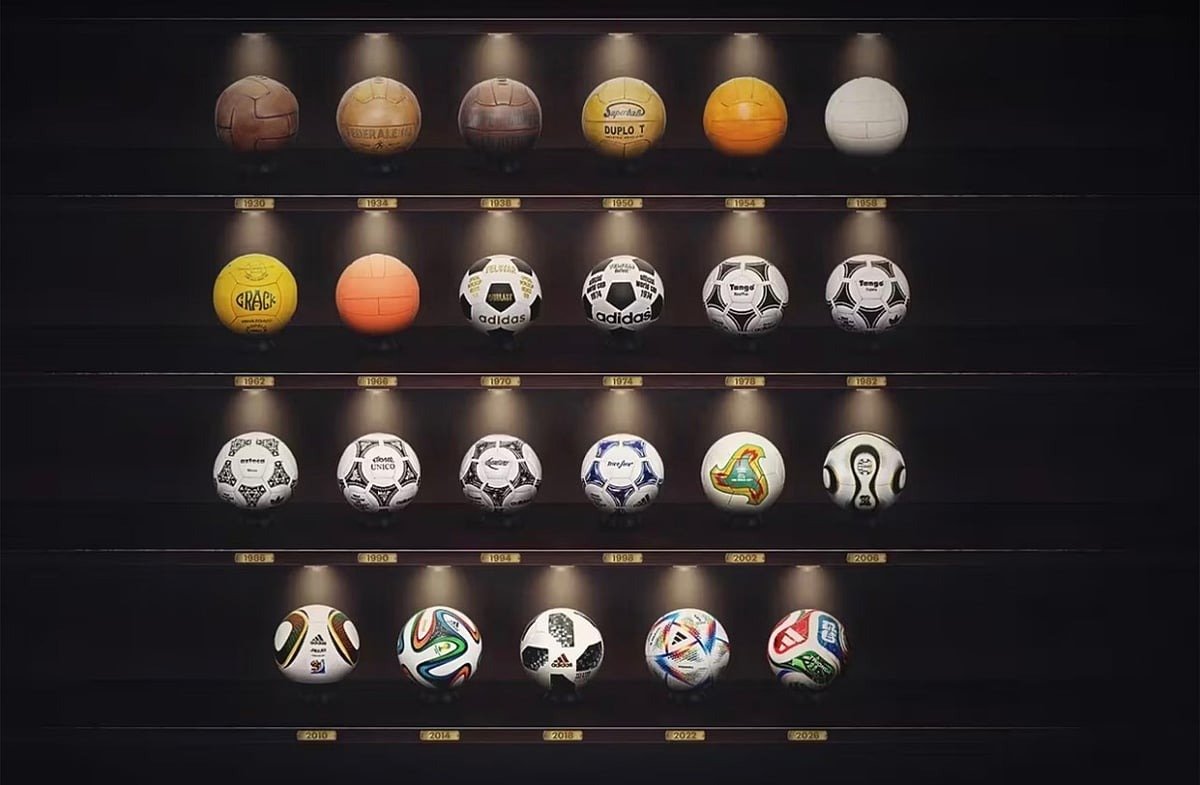
The earliest World Cup balls, used at the 1930 tournament in Uruguay, were stitched leather with a lace-up closure. That lace wasn’t decorative: it sealed the inner bladder, but it also created an unpredictable contact point that could affect a player’s strike and, in wet conditions, the ball absorbed water and grew noticeably heavier during a match. Heading one of those late in a game was a different physical experience entirely compared to what players deal with today.
The shift away from leather panels and toward synthetic materials accelerated through the mid-20th century. The most culturally iconic moment in ball design came with the black-and-white geometric Telstar era, a design built specifically for television visibility, so home audiences watching on black-and-white sets could track the ball clearly. That single design decision shows how broadcast technology, not just football physics, shaped the equipment. Later decades brought standardised panel geometry, improved water resistance, and thermally bonded (rather than stitched) seams, each change altering how the ball curves, dips, and responds to pace.
The 2026 Trionda: Three Countries, One Ball, Embedded Technology
The 2026 FIFA World Cup ball is named Trionda, and its design concept is directly tied to the tournament’s structure: three host countries are represented through three colours worked into the ball’s visual identity. Beyond aesthetics, the Trionda is described as incorporating smart technology, the continuation of a trend toward sensor-embedded match balls that support officiating systems and real-time ball-tracking data. For players and coaching staff, that means the ball is no longer just a playing surface; it’s a data point.
- 1930 ball: Stitched leather, lace-up closure, absorbed water, unpredictable flight in wet conditions
- Telstar era: Black-and-white geometric panels, designed for television visibility on monochrome broadcasts
- Modern era: Thermally bonded synthetic panels, consistent water resistance, engineered aerodynamics
- Trionda (2026): Three host-country colours, smart/sensor technology embedded for tracking and officiating support
Why Ball Design Is a Competitive Variable, Not Just a Branding Exercise
Each new World Cup ball introduces slightly different flight and touch characteristics, panel count, surface texture, and bonding method all influence how the ball moves through the air and off the boot. Goalkeepers and set-piece specialists in particular adapt their technique to each tournament ball during pre-tournament training. The shift to sensor integration in recent tournaments adds another layer: ball-tracking data now feeds directly into semi-automated offside systems used by FIFA, meaning the ball’s internal technology is part of the officiating infrastructure, not separate from it.
Ninety-six years of World Cup football have been played with equipment that kept changing underneath the players’ feet, from waterlogged leather in 1930 to a smart, three-coloured sphere in 2026. The Trionda represents the point where ball design, national branding, and match data converge in a single object. Whether you’re watching from a stadium in the United States, Canada, or Mexico this summer, the ball doing the travelling is doing more work than any previous World Cup ball in history.

India protests escalate
India's Youth-Led 'Cockroach' Movement Vows to Continue Protests
India's youth-led "Cockroach" movement said it would continue its protest demanding the resignation of Education Minister Dharmendra Pradhan on Tuesday, a day after violent protests disrupted central Delhi, injuring nearly 180 people. Thousands of protesters from Delhi and nearby cities and towns gathered to march on parliament on Monday, joining a movement that began as an online satire but has turned out to become the biggest challenge for Prime Minister Narendra Modi in his third term.
The months-old movement by the self-named Cockroach Janta Party has drawn the support of millions of young, Gen Z Indians who are demanding the resignation of Education Minister Dharmendra Pradhan over examination paper leaks that affected more than 2 million students in May. It says the leaking of the papers for a national entrance test to medical school in May - which forced students to re-test, and led to some taking their own lives - was a sign of deep-seated corruption in education.
Nearly 180 people were injured and taken to nearby state-run hospitals on Monday, with a majority of them discharged after first-aid, after clashes between the protesters and security personnel in which police used cane charges and tear gas. Delhi Police said that the injured included more than 118 security and police personnel and 60 protesters. Seventy protesters had been detained and legal action would be initiated against them, it said in a statement late on Monday.
The movement galvanized after the support of activist Sonam Wangchuk, who began a hunger strike on June 28, but was forcibly moved to a hospital by the authorities on Saturday. CJP founder Abhijeet Dipke apologized to supporters, especially girls who he said were beaten by male police officers, saying "We could have done better. I could have done better to protect you from the inhumane actions of the Delhi Police."
This ongoing unrest is reminiscent of prior protests in India, where widespread discontent among the youth population has led to significant challenges for the government. The current movement's demands for accountability and reform are likely to continue, given the depth of feeling among the affected students and their supporters.

Madonna, Justin Bieber Clash Backstage
Madonna, Bieber Reportedly Clash at World Cup Halftime
Madonna and Justin Bieber performed at the FIFA World Cup Halftime show, but according to a report, their different ideas about what makes a great performance may have caused some friction before they took the stage. Bieber wanted something "clean and controlled," while Madonna went for a dramatic and unforgettable spectacle, bringing dancers and drama to the stage.
The difference in approach allegedly became a source of tension, with a Daily Mail source claiming that neither artist wanted to feel like they played second fiddle. Bieber's mindset was focused on the music, without unnecessary risks or distractions, while Madonna believed a stage as massive as the World Cup Final's called for something people would be talking about for years.
In the end, both artists delivered their performances without overshadowing each other, and the halftime show got its big superstar moment. The actual football match was happening concurrently, but for those focused on the celebrity guest list, the real game was the sightings, including BTS's performance and interactions with fans and other celebrities.
The FIFA World Cup Halftime show's success can be attributed to the performances of various artists, including Madonna, Justin Bieber, and BTS, who all brought their unique styles to the stage. The event was a culmination of music, drama, and sports, making it an unforgettable experience for the audience.

US Imposes 50% Tariffs on Canadian Products
US Slaps 50% Tariffs on $20 Billion of Canadian Goods
The US has imposed new 50% tariffs on $20 billion worth of Canadian products, effective 30 days from the announcement on July 21, 2026. This move, taken by President Donald Trump's administration, is in response to what the US calls Canada's discriminatory treatment of American-made cars, alcohol, and dairy goods. The tariffs will apply to a wide range of goods, including dairy products, swimming pools, furniture, fishing rods, seeds, clothing, and wigs.
This decision affects Canadian exporters, particularly those in the dairy, furniture, and clothing industries, as they will now face a 50% tariff on their products entering the US market. The US Trade Representative's office estimates that the tariffs will apply to nearly $20 billion of imports from Canada, which is about 5.2% of the $382 billion worth of goods the US imported from Canada in 2025.
To comply with the new tariffs, Canadian businesses exporting to the US should review their product lines and assess the impact of the 50% tariff on their goods. They may need to adjust their pricing, explore alternative markets, or renegotiate contracts with US buyers. The tariffs are set to take effect on August 19, 2026, giving businesses a 30-day window to prepare for the changes.
The US Trade Representative, Jamieson Greer, stated that the tariffs are a response to Canada's retaliatory measures against previous US tariffs. Canadian Prime Minister Mark Carney has expressed willingness to engage in intensive talks to address outstanding trade issues with the US. The trade dispute between the two countries has been ongoing, with the US complaining about Canada's treatment of American goods and Canada responding with retaliatory measures.
| Product Category | Tariff Rate |
|---|---|
| Dairy products, swimming pools, furniture, fishing rods, seeds, clothing, and wigs | 50% |

FIFA investigation into World Cup final brawl
FIFA Probes World Cup Final Brawl
FIFA has appointed a disciplinary and ethics prosecutor to investigate the post-match brawl that erupted after Spain's 1-0 extra-time victory over Argentina in the World Cup final. The incident occurred after Spain secured their second World Cup title, courtesy of an extra-time winner from winger Ferran Torres. Argentine midfielder Leandro Paredes clashed with several Spanish players, including defender Eric Garcia and midfielder Gavi, triggering a broader brawl between the two sets of players.
The investigation will review potential breaches of the FIFA Disciplinary Code, following violent clashes between players and staff after the match. No timeframe was given for the conclusion of the investigation. The disciplinary and ethics prosecutor will examine the incidents, which included Leandro Paredes clashing with Spanish players, and other alleged violent conduct by players and staff.
The World Cup final was marred by controversy, with Argentina being reduced to 10 men in the 93rd minute of normal time when Enzo Fernandez was sent off for a second yellow card. The match ended with a 1-0 victory for Spain, but the post-match brawl overshadowed the celebrations.
This incident is reminiscent of past controversies in the World Cup, such as the infamous Zinedine Zidane headbutt in the 2006 World Cup final. The FIFA investigation will aim to determine the severity of the breaches and impose appropriate sanctions.

UAE Sets 15 as Minimum Age for Social Media Use
UAE Introduces New Social Media Regulations for Minors
The UAE has implemented new regulations that prohibit children under the age of 15 from independently creating or using social media accounts. According to Mohammed Al Zarooni, Director of Strategic Planning at the National Media Authority, this move aims to safeguard children from exploitation and encourage safer digital participation through parental supervision. The new rules, approved by the UAE Cabinet, make the UAE the first Arab country to set a minimum age for social media use.
This regulation is expected to have a positive impact on the younger generation, as it will encourage them to use social media platforms with the supervision of their parents. Teenagers aged 15 to 16 will be allowed to use social media, but they will be subject to enhanced safeguards, including age-based content controls, parental supervision, and restrictions on interacting with unknown users. Social media platforms must implement robust age verification measures using digital ID and AI, and they have 12 months to comply with the new regulations.
The National Media Authority believes that these measures will not significantly impact the creator economy in the UAE. Instead, they could encourage safer participation on digital platforms and support the long-term growth of the sector. The move is part of the UAE's efforts to protect children from inappropriate content, online risks, and excessive use.
Social media companies operating in the UAE will be required to enforce the prohibition on children under 15 creating or using personal social media accounts. They must also implement effective and reliable age verification mechanisms, such as digital identity verification and biometric tools, and parental control tools.
The UAE's decision to set a minimum age for social media use is a significant step towards ensuring the online safety of children. By introducing these regulations, the UAE aims to create a safer digital environment for its young citizens and promote responsible social media use.
| Category | Details |
|---|---|
| Minimum Age | 15 years old |
| Compliance Period | 12 months |
| Age Verification | Digital ID, AI |