(Credit - Gulf News)
FIFA World Cup Match Balls Have Gone From Laced Leather to Smart Tech, Here’s Every Major Shift Since 1930
If you’ve ever wondered why FIFA World Cup match balls look and behave so differently from one tournament to the next, the answer stretches back 96 years of materials science, broadcast demands, and on-field performance engineering.
From Stitched Panels to Sensor-Embedded Spheres: How the Ball Changed the Game
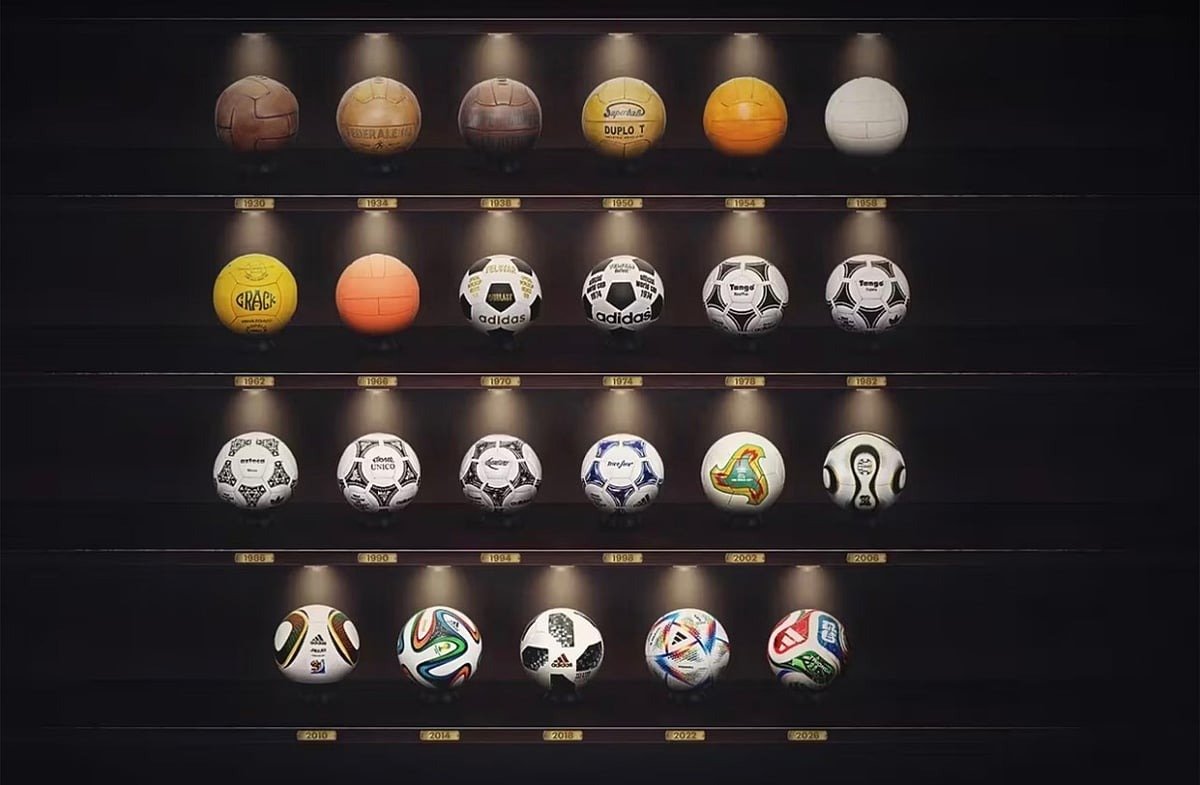
The earliest World Cup balls, used at the 1930 tournament in Uruguay, were stitched leather with a lace-up closure. That lace wasn’t decorative: it sealed the inner bladder, but it also created an unpredictable contact point that could affect a player’s strike and, in wet conditions, the ball absorbed water and grew noticeably heavier during a match. Heading one of those late in a game was a different physical experience entirely compared to what players deal with today.
The shift away from leather panels and toward synthetic materials accelerated through the mid-20th century. The most culturally iconic moment in ball design came with the black-and-white geometric Telstar era, a design built specifically for television visibility, so home audiences watching on black-and-white sets could track the ball clearly. That single design decision shows how broadcast technology, not just football physics, shaped the equipment. Later decades brought standardised panel geometry, improved water resistance, and thermally bonded (rather than stitched) seams, each change altering how the ball curves, dips, and responds to pace.
The 2026 Trionda: Three Countries, One Ball, Embedded Technology
The 2026 FIFA World Cup ball is named Trionda, and its design concept is directly tied to the tournament’s structure: three host countries are represented through three colours worked into the ball’s visual identity. Beyond aesthetics, the Trionda is described as incorporating smart technology, the continuation of a trend toward sensor-embedded match balls that support officiating systems and real-time ball-tracking data. For players and coaching staff, that means the ball is no longer just a playing surface; it’s a data point.
- 1930 ball: Stitched leather, lace-up closure, absorbed water, unpredictable flight in wet conditions
- Telstar era: Black-and-white geometric panels, designed for television visibility on monochrome broadcasts
- Modern era: Thermally bonded synthetic panels, consistent water resistance, engineered aerodynamics
- Trionda (2026): Three host-country colours, smart/sensor technology embedded for tracking and officiating support
Why Ball Design Is a Competitive Variable, Not Just a Branding Exercise
Each new World Cup ball introduces slightly different flight and touch characteristics, panel count, surface texture, and bonding method all influence how the ball moves through the air and off the boot. Goalkeepers and set-piece specialists in particular adapt their technique to each tournament ball during pre-tournament training. The shift to sensor integration in recent tournaments adds another layer: ball-tracking data now feeds directly into semi-automated offside systems used by FIFA, meaning the ball’s internal technology is part of the officiating infrastructure, not separate from it.
Ninety-six years of World Cup football have been played with equipment that kept changing underneath the players’ feet, from waterlogged leather in 1930 to a smart, three-coloured sphere in 2026. The Trionda represents the point where ball design, national branding, and match data converge in a single object. Whether you’re watching from a stadium in the United States, Canada, or Mexico this summer, the ball doing the travelling is doing more work than any previous World Cup ball in history.