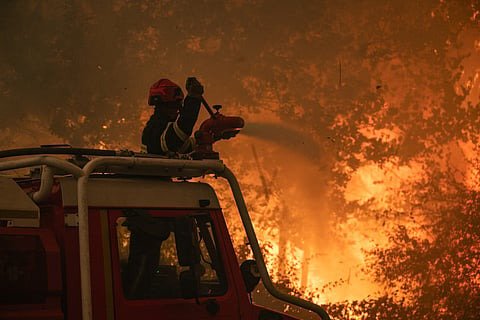
200,000 Flee Wildfires in Spain and France
Over 200,000 people have been forced to flee their homes in Spain and France due to massive wildfires that have been raging near Madrid and Bordeaux. The fires, which have been burning for two or three days, have exhausted hundreds of firefighters battling them around the clock. Residents in the affected areas have been forced to keep their windows closed due to the smell of throat-irritating smoke, with thick black ash coating roof terraces of houses in the north of Madrid.
The French Interior Minister, Laurent Nunez, has stated that the French fires have ravaged nearly 98,000 hectares, a “historic record” nearly 10 times the size of the city of Paris. So far, no deaths have been reported in the civilian population, but two French firefighters died earlier this week near Bordeaux. Spanish Prime Minister Pedro Sanchez has declared a national emergency, with the priority being to “save lives” while warning that a “complex” fight lay ahead.
Troops have been deployed to help firefighters in both countries, with French President Emmanuel Macron deploying 1,000 soldiers to assist near Bordeaux. An A400M military transport aircraft has also been ordered to join the fleet of smaller planes already dousing flames. The EU has also provided assistance, with aircraft sent from other European countries to help combat the fires. Emergency shelters have been set up in schools and gymnasiums in southwestern France for tourists and residents left wondering what they would return to.
The fires have advanced quickly due to tinderbox conditions worsened by successive heatwaves since May. Scientists say global warming is increasing droughts and causing weather emergencies to become more extreme and more frequent. Europe is the fastest-warming continent due to climate change. The blazes west of Madrid have burned up to 25,000 hectares, according to Spain’s interior ministry, with two of the three major wildfires merging into one and threatening to join up to form a massive inferno just kilometers from the capital.
In France, at least 167,000 people have been evacuated, with more than 45,000 people evacuated in Spain and another 20,000 told to hole up in their homes. The situation remains critical, with erratic gusts making the fight difficult, but a dip in temperatures has offered a “real opportunity” to combat the fires.
The village of El Escorial, northwest of Madrid, has been shrouded in smoke, with a historic monastery in the town affected. Residents who have fled the area have been forced to seek shelter in emergency centers, with many left wondering what they would return to. The situation remains dire, with the military and firefighters working to contain the blazes and prevent further damage.
In relation to prior events, the current wildfires in Spain and France follow a pattern of extreme weather events in Europe, which have been exacerbated by climate change. The region’s fastest-warming continent status has led to increased droughts and weather emergencies, making the current situation a continuation of a larger trend.


Dubai traffic: 5-minute drive with new bridges, tunnels
Dubai Traffic to Slash 75% with New Bridges, Tunnels
The Roads and Transport Authority (RTA) is upgrading four major intersections in Dubai with new bridges, tunnels, lanes, and service roads as part of the Oud Metha and Al Asayel Streets Development Project. This project aims to improve traffic flow across some of the city's busiest routes, including roads linking Oud Metha Street, Sheikh Rashid Road, Al Asayel Street, Al Wasl Club Street, Al Khail Road, and Dubai-Al Ain Road. The upgrades will serve key areas such as Zabeel, Al Jaddaf, Oud Metha, and Umm Hurair.
The project is expected to cut travel time from 20 minutes to just five minutes, a reduction of up to 75%. This significant improvement in travel time will be achieved through the addition of new bridges, tunnels, and lanes, which will increase the capacity of the roads and reduce traffic overlaps. For instance, a new three-lane bridge has already opened, and two tunnels and another bridge are due to follow by the end of August.
At the intersection of Oud Metha Street and Sheikh Rashid Road, an additional lane will be added to the left-turn ramp, increasing its capacity to 1,800 vehicles per hour. The service road on Sheikh Rashid Road will also be upgraded to reduce traffic overlaps and improve road safety. Additionally, right-turn lanes from Sheikh Rashid Road onto Oud Metha Street will increase from two to three, with a capacity of 4,000 vehicles per hour.
The upgrades at the intersection of Oud Metha Street, Al Asayel Street, and Al Wasl Club Street will include three bridges, improving links between Al Asayel Street, Al Wasl Club Street, and Al Khail Road. A two-lane bridge will serve traffic traveling from Al Asayel Street towards Al Wasl Club Street, while a three-lane bridge will serve motorists traveling from Al Khail Road towards Al Asayel Street. A separate two-lane bridge will serve left-turn traffic from Al Asayel Street towards Oud Metha Street, with a capacity of 2,400 vehicles per hour.
The works at the intersection of Al Wasl Club Street and Al Khail Road will improve traffic heading towards Al Khail Road and Business Bay Crossing. A two-lane bridge will serve motorists traveling from Al Asayel Street towards Al Khail Road, with a capacity of 3,000 vehicles per hour. The exit from Al Wasl Club Street towards Al Khail Road will be expanded to two lanes, and a service road will be constructed on Al Wasl Club Street in both directions.
The fourth intersection upgrade, at Zabeel Palace Street, Al Khail Road, and Oud Metha Street, will improve traffic movement between Al Khail Road, Dubai-Al Ain Road, Oud Metha Street, and Al Wasl Club Street. An additional lane will be added to the left-turn ramp from Al Khail Road towards Dubai-Al Ain Road, doubling its capacity from 900 to 1,800 vehicles per hour. A one-lane tunnel will serve traffic traveling from Dubai-Al Ain Road towards Al Wasl Club Street, accommodating 1,200 vehicles per hour and helping to reduce traffic congestion.
This project is part of Dubai's efforts to improve its traffic infrastructure and reduce congestion, which is essential for the city's urban expansion and population growth. The RTA's initiatives aim to provide a smooth and efficient traffic flow, making it easier for residents and visitors to navigate the city.
The expected completion of the project by the end of August 2026 will bring significant relief to commuters who currently face long travel times on these routes. With the reduced travel time, residents can expect to save up to 15 minutes per trip, which can greatly impact their daily routines and productivity.
In conclusion, the Oud Metha and Al Asayel Streets Development Project is a significant step towards improving Dubai's traffic infrastructure. The addition of new bridges, tunnels, and lanes will not only reduce travel times but also improve the overall traffic flow, making it easier for residents and visitors to navigate the city.

US Iran Conflict: Airstrikes Paused Amid Stockpile Concerns
US Holds Fire as Iran Warns of Wider War
The US has paused its airstrikes against Iran, marking a lull in the nearly five-month-long conflict, as reports suggest concerns over dwindling munitions stockpiles are influencing the decision. Local residents and international observers are closely watching the situation, as the pause revives hopes for negotiations between the two nations. Iran's army has warned that if the US chooses to press ahead with attacks, the war would widen even further, geographically expanding beyond its current scope.
Iran's army spokesman, Mohammad Akraminia, stated that if the Americans fall for the Zionists' deception and continue the war, particularly through airstrikes, the conflict will expand further. Meanwhile, US operations against Iran are currently "on a hold," according to CNN, quoting an unidentified Pentagon source. Plans to escalate the campaign have been shelved in part due to shrinking supplies of Patriot interceptors and other defensive weapons.
The Strait of Hormuz remains a central flashpoint in the conflict, with Iran's effective blockade of the waterway opposed by Washington. Iran has made progress in talks with neighboring Oman on "common principles and operational mechanisms" for shipping in the Strait. The situation is complex, with multiple parties involved, including Israeli Prime Minister Benjamin Netanyahu, who is set to visit Washington on Tuesday.

Trump Faces Midterm Reckoning
Trump's Presidency on the Line in Midterms
President Donald Trump's presidency is at a critical juncture, with the US midterm elections just 100 days away. Although Trump will not be on the ballot on November 3, the stakes for his presidency could hardly be higher. A Democratic House would give the party control of powerful committees and subpoena authority, likely subjecting Trump's administration to two years of investigations and potentially exposing him to a third impeachment drive.
The Republican Party is staring down polling that points to the loss of the House of Representatives and a ferocious battle to retain the Senate. According to US elections website Decision Desk HQ, the Democratic Party has a 59-percent chance of winning the House, forecasting a 224-211 majority. The president's party usually loses ground in midterm elections, and only a handful of seats need to change hands. Gasoline prices have climbed above $4 a gallon as the Iran war disrupts energy markets, inflation remains elevated, and interest rates are high.
Polling cited by Democrats suggests voters now trust them more than Republicans on inflation, health care, and even immigration, long considered a Republican strength. House Democratic leader Hakeem Jeffries has announced an affordability campaign built around groceries, gasoline, housing, and health care. Republicans, on the other hand, plan to highlight border enforcement and tax cuts while portraying Democratic candidates as aligned with the socialist left.
Trump is pressing every available advantage, waging a prolonged campaign for congressional Republicans to pass the SAVE America Act, which he portrays as essential to preventing election fraud but Democrats condemn as an attempt to suppress legitimate votes. Republicans have been considerably more successful in another effort to shape the electorate: redrawing congressional maps. They look likely to emerge with a net advantage of between five and 12 seats, which could offset the national political environment in a House contest expected to be decided by a similarly narrow margin.
The Senate presents a different but equally dramatic contest. Republicans hold a 53-47 majority, meaning Democrats need a net gain of four seats. Decision Desk HQ narrowly favors Republicans to retain control through a 50-50 split, with Vice President JD Vance casting tie-breaking votes. For Trump, even a divided Washington - with Democrats controlling the House and Republicans holding the Senate - would transform the remainder of his term. His legislative agenda would stall in the House, his officials would face inquiries and public hearings, and Democrats would gain a national platform from which to scrutinize the Iran war, administration ethics, and the president's attempts to reshape elections.
The strongest counter-argument to the notion that the midterm elections will be a reckoning for Trump's presidency is that Republicans have been successful in redrawing congressional maps, which could give them an advantage in the House. Additionally, Republicans hold a substantial financial advantage, with party campaign committees and allied groups entering the final months with tens of millions of dollars more than their Democratic counterparts. However, this argument is weakened by the fact that polling suggests voters are increasingly unhappy with the Republican Party's handling of key issues, including inflation, health care, and immigration.

Oil Prices Drop 6% on US-Iran Diplomacy Hopes
Oil Prices Plummet 6% as US-Iran Tensions Ease
The numbers are telling, a nearly 6% drop in oil prices is a significant shift in the global energy market. This decline comes on the heels of renewed hopes for a diplomatic deal between the US and Iran, with both countries pausing their military strikes. The immediate concern of a broader regional conflict, which could disrupt crude exports, has been reduced, leading to a decrease in oil prices. As of Monday, international benchmark Brent fell more than 8% to $88.36 per barrel, while WTI shed 5.8% to $84.
This development is a result of Washington signaling its willingness to hold back on additional military action, allowing room for diplomacy. In response, Iran has halted its own strikes, creating a reciprocal, conditional de-escalation rather than a full, formal ceasefire. This move has reassured traders and analysts, who were previously worried about the potential disruptions to crude exports through the Strait of Hormuz and the Red Sea.
The impact of this drop in oil prices could be significant, potentially easing inflation concerns if sustained. However, analysts caution that any renewed attacks on energy infrastructure or shipping routes could quickly reverse the decline. The energy market remains highly sensitive to developments in the Middle East, and the situation is being closely watched by investors and traders alike.
Qatar and Oman have been central to shuttle diplomacy and indirect talks between the US and Iran, with US envoys engaging Qatari officials and Omani proposals on the Strait of Hormuz. The ongoing technical-level exchanges and recent activity in the region have contributed to the improved investor sentiment.
The decline in oil prices has also had a positive impact on the stock market, with most markets climbing at the start of the week. The FTSE 100, CAC 40, DAX, Nikkei 225, Hang Seng Index, and Shanghai Composite all saw increases, ranging from 0.4% to 1.2%.
As the situation continues to unfold, it remains to be seen whether this relief to global inflationary pressure will hold or is just temporary. The world has seen temporary halts in US-Iran attacks before, only to see the two sides resuming military strikes. The next steps in this inflection point will be crucial in determining the direction of the global energy market.

Pentagon Updates Iran War Casualty Count
US Iran War Toll Surges: 18 Killed, 624 Wounded
The Pentagon's official Iran war death toll has been revised, with 18 service members killed and 624 wounded since the conflict began on February 28, according to the Defense Casualty Analysis System (DCAS). This update includes the restoration of four deaths and the addition of over 140 wounded personnel that had previously been reclassified or disappeared from public records.
The revised total marks a significant increase from the 482 wounded listed just days earlier, after lawmakers and journalists questioned why official casualty figures had inexplicably declined despite intensified Iranian missile and drone attacks. The Pentagon has attributed the discrepancies to technical problems, with acting press secretary Joel Valdez stating that the lower figures reflected "temporary data disruptions" affecting the DCAS website.
The introduction of a new category labeled "Overseas Operations" has also raised questions about how casualties are reported. This category tracks personnel killed or wounded beginning July 7, but the Pentagon has not publicly explained why it was added during an active conflict or how it affects reporting procedures.
The revisions have drawn bipartisan attention on Capitol Hill, with lawmakers demanding greater transparency and seeking explanations for the fluctuating casualty totals. Twelve Democratic members of the Senate Armed Services Committee sent a letter to Defense Secretary Pete Hegseth, emphasizing that accurate casualty reporting is essential for congressional oversight and maintaining public confidence during military operations.
The updated casualty count highlights the scale of the conflict, which has included Iranian ballistic missile attacks on US installations, drone strikes, naval confrontations in the Gulf, and sustained American air operations targeting Iranian military infrastructure. As US forces remain on heightened alert despite a fragile pause in direct hostilities, the revised Pentagon figures suggest the war's human toll was significantly greater than previously understood.
| Category | Amount |
|---|---|
| US Service Members Killed | 18 |
| US Service Members Wounded | 624 |
The revised casualty count has significant implications for US service members and their families, as well as for congressional oversight and public confidence in military operations. As the conflict continues, accurate and transparent reporting of casualties is crucial for understanding the human toll of the war.