Dubai Adds 800 Daily Residents While RAK Hits Dh2.89B in Real Estate
Dubai’s population hitting 4.81 million by September 2026, spurred by an influx of more than 800 residents daily, is cementing a structural shift across the UAE property market. ValuStrat data shows this sustained demographic expansion is underpinning long-term housing demand even as the market recalibrates. Rather than moving in lockstep, Dubai and Ras Al Khaimah are charting distinct, complementary trajectories that offer investors starkly different risk-reward profiles.
The freehold residential ValuStrat Price Index stood at 218.6 points in the third quarter of 2026, with roughly 33,000 homes completed by the end of September. Development activity remains relentless across the emirate. An estimated 108,134 units are planned for delivery during 2026, and more than 376,000 homes are currently under construction through 2030.
Within this massive pipeline, specific growth corridors are capturing disproportionate capital. Dubai Islands, spanning approximately 18.6 square kilometers across five islands, is emerging as a premier waterfront destination. The masterplan is designed to accommodate more than 230,000 residents across roughly 62,000 homes, alongside more than 11,000 hotel keys, over 4,000 branded residences, and 57 kilometers of coastline connected to the mainland via three bridges.
According to Dubai Land Department data analyzed by Dubai Real Estate Data, Dubai Islands registered approximately Dh18.8 billion in residential sales across 5,035 transactions in the 12 months leading to September 28. AXD Immobilien’s analysis of Dubai Land Department records indicates median residential transaction prices reached Dh30,571 per square meter (approximately Dh2,840 per square foot) in 2026 year-to-date through July, marking a 17.7 percent increase against the 2025 full-year median. Developers are moving fast to capture this demand; Grovy Developers broke ground on Ramada Residences in August 2026 with Jaseera Building Contracting as the main contractor, targeting a Q3 2027 handover.
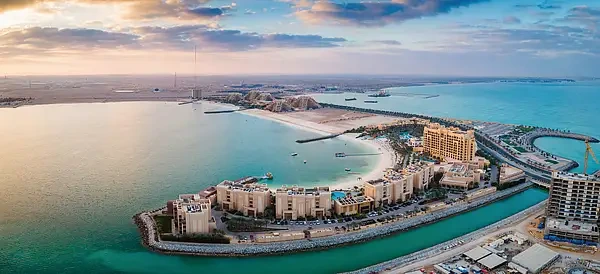
Meanwhile, Ras Al Khaimah is carving out a parallel economic narrative driven by tourism and mixed-use expansion. RAK Municipality data shows total transactions reached Dh2.89 billion between January and June 2026. That total breaks down into Dh1.353 billion in property sales, Dh1.16 billion in mortgages, and approximately Dh380 million in waivers. This northern emirate momentum has attracted major hospitality partnerships, including Sugee Group and Wyndham Hotels & Resorts teaming up to bring the world’s first Vienna House Residences by Wyndham to Al Marjan Island.
For LLC operators and C-suite executives, the evolving market requires a nuanced operational approach. Dubai offers unmatched market depth and institutional liquidity anchored by relentless population growth, while Ras Al Khaimah provides early-mover access to an emerging transformation centered on branded lifestyle hospitality. Both markets rely heavily on aligning local development expertise with global hospitality brands to capture high-net-worth capital.
Rather than signaling overheating, market observers view these dual trajectories as evidence of a maturing UAE real estate sector. Capital is flowing simultaneously into established urban density in Dubai and high-growth tourism corridors in Ras Al Khaimah, creating a diversified ecosystem where regional and international players can deploy capital across distinct risk horizons without direct friction.