(Credit - Gulf News)
FIFA World Cup Mascots Span 60 Years, Here’s What Every Character Said About Its Host Nation
The FIFA World Cup mascots have been football’s most visible branding tool since 1966, when England introduced “World Cup Willie” and set a tradition that now ends, for this cycle, with a trio of characters representing three host nations in 2026.
Why the Mascot Timeline Runs From a Lion to Three Friends
FIFA introduced official mascots as a way to wrap each tournament’s identity into a single, marketable character that could anchor licensing programmes, fan merchandise, and host-country storytelling for a global audience. The concept started simply: one host, one character, one cultural reference point. England’s World Cup Willie was a Union Jack-wearing lion, unmistakably British, instantly reproducible on a badge or a pennant.
Over the following six decades, the design philosophy shifted from hand-drawn, locally themed figures toward more stylised, globally merchandisable characters. By the 1990s and 2000s, mascots were being built with animation pipelines and international licensing deals in mind, less folk art, more franchise asset. The shift tracks almost perfectly with the broader commercialisation of the tournament itself.
The Full Roster: Every Mascot, Every Year
- 1966, World Cup Willie (England): A lion in a Union Jack kit. The first official FIFA mascot and the template for everything that followed.
- 1970, Juanito (Mexico): A young Mexican boy in the national kit, reflecting the host nation’s footballing passion.
- 1974, Tip and Tap (West Germany): Two boys in German colours, the first time FIFA used a pair rather than a single character.
- 1978, Gauchito (Argentina): A young gaucho figure, drawing directly on Argentine rural and cultural identity.
- 1982, Naranjito (Spain): An orange wearing a Spanish kit, one of the most recognisable and commercially successful mascots of the era.
- 1986, Pique (Mexico): A jalapeño pepper in a sombrero, leaning into Mexican iconography for the country’s second hosting.
- 1990, Ciao (Italy): A stylised figure made of coloured blocks in the Italian tricolore, a sharp design departure toward abstraction.
- 1994, Striker (United States): A cartoon dog in a US kit, designed with American pop-culture sensibilities and broad family appeal.
- 1998, Footix (France): A rooster, France’s national symbol, in blue, holding a football. Clean, confident, very French.
- 2002, Ato, Kaz, and Nik (South Korea/Japan): Three futuristic creatures called “The Spheriks,” reflecting the co-hosted tournament’s dual identity and the era’s digital design trends.
- 2006, Goleo VI and Pille (Germany): A lion in a German shirt paired with a talking football, an attempt at a duo that drew mixed public reaction.
- 2010, Zakumi (South Africa): A leopard with green dreadlocks, widely praised for capturing South African wildlife and colour.
- 2014, Fuleco (Brazil): An armadillo in Brazilian colours, chosen partly to raise awareness of the three-banded armadillo’s endangered status.
- 2018, Zabivaka (Russia): A wolf in sports gear, selected through a public vote, one of the more popular modern mascots among fans.
- 2022, La’eeb (Qatar): An abstract, ghost-like figure inspired by the traditional Arab keffiyeh headwear, culturally specific and visually distinct.
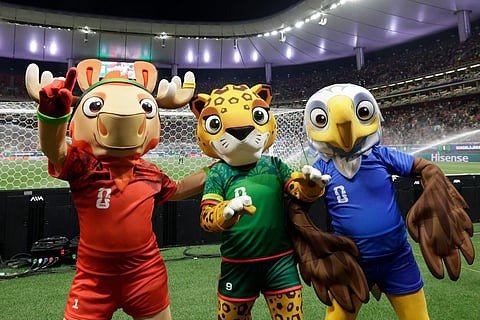
- 2026, Maple, Zayu, and Clutch (Canada, Mexico, United States): A trio, one per host nation, marking the first time three countries share a single tournament and, by extension, three mascots share a single stage.
What the 2026 Trio Signals for the Tournament
The 2026 edition, hosted across Canada, Mexico, and the United States, is structurally unlike most prior tournaments, and the mascot concept reflects that. Maple represents Canada, Zayu represents Mexico, and Clutch represents the United States. Running three characters simultaneously is a direct response to the multi-host format: a single mascot would implicitly favour one nation’s identity over the others.
For licensing and merchandising teams, the trio approach opens three separate product lines tied to distinct national symbols, but it also raises a question the industry will watch closely: whether a divided mascot identity can generate the same singular cultural resonance as a Zakumi or a Naranjito. A single iconic image tends to travel further on merchandise than a committee of three.
Sixty years of World Cup mascots form a surprisingly accurate record of how host nations chose to present themselves to the world, and how FIFA’s commercial ambitions grew alongside that story. The jump from World Cup Willie’s hand-drawn simplicity to 2026’s three-character franchise reflects both design evolution and the tournament’s transformation into a multi-billion-dollar global property. Whether Maple, Zayu, and Clutch become as fondly remembered as Zakumi or Footix will depend on how well three characters can share one moment.

Dubai property transactions hit AED419.9 billion
Dubai Property Transactions Surge to AED419.9 Billion
Dubai\'s real estate market recorded AED419.9 billion in transactions during the first half of 2026, with 112,850 transactions taking place. Local investors and property buyers were involved in 86,000 deals worth more than AED286.44 billion in real estate sales. Completed property sales accounted for the largest share of total real estate sales, reaching AED146.69 billion across 27,160 transactions, while off-plan property sales totalled AED139.75 billion through 58,840 transactions.
The Dubai Land Department\'s data revealed a significant surge in Dubai\'s off-plan office market, with sales reaching AED13.1 billion across 1,668 deals. This surpasses the sector\'s combined sales over the previous seven years, from 2019 to 2025, which totalled AED5.48 billion across 1,821 deals. The record off-plan office sales indicate strong investor confidence and robust growth in Dubai\'s property market.
The Dubai Land Department\'s report on the first half of 2026 comes after a period of steady growth in the emirate\'s real estate sector. In 2025, Dubai witnessed a significant increase in property transactions, with the total value of real estate transactions reaching a record high.
112,850 transactions were recorded in the first half of 2026, with the majority being off-plan property sales. The Dubai Land Department\'s data provides insight into the emirate\'s real estate market, highlighting the growth and demand for property in Dubai.
This surge in Dubai\'s property market can be attributed to the emirate\'s business-friendly environment and attractive investment opportunities. The record off-plan office sales are a reflection of the confidence of investors in Dubai\'s real estate sector.

Dubai Traffic Violations
14 Traffic Violations in Dubai
If you\'re driving in Dubai, you need to know about the 14 traffic violations that can get your car impounded for 14 or 30 days. In 2024, Dubai Police issued Administrative Resolution No. 1 of 2024, listing out these serious traffic offences. Using your mobile phone while driving, failing to maintain a safe distance, and sudden swerving are just a few examples of the violations that can lead to vehicle impoundment.
Here are the 14 traffic violations that can get your car impounded in Dubai:
- Sudden swerving of the vehicle in a manner that endangers lives, property, or traffic safety - 30 days. This means that if you\'re caught swerving suddenly, you could lose your car for a month.
- Failure to maintain sufficient safe distance from the vehicle in front - 30 days. Tailgating is a serious offence in Dubai, and can result in a 30-day impoundment period.
- Entering the road without first ensuring that the lane is clear - 14 days. If you\'re not careful when merging onto a busy road, you could face a 14-day impoundment period.
- Driving while distracted by using a mobile phone or any other object - 30 days. Distracted driving is a major concern in Dubai, and can result in a 30-day impoundment period.
- Reversing the vehicle in a manner that endangers lives, property, or traffic safety - 14 days. Reversing your car without checking your surroundings can be dangerous, and may result in a 14-day impoundment period.
- Non-compliance with mandatory lane discipline while driving a light vehicle - 14 days. If you\'re not following the rules of the road, you could face a 14-day impoundment period.
- Stopping in the middle of the road without a valid reason - 14 days. If you\'re caught stopping in the middle of the road without a good reason, you could lose your car for 14 days.
- Performing dangerous overtaking manoeuvres - 14 days. Overtaking other cars can be dangerous, and may result in a 14-day impoundment period.
- Driving a vehicle that does not comply with the necessary safety and security requirements - 14 days. If your car is not roadworthy, you could face a 14-day impoundment period.
- Non-compliance with mandatory routes while driving a heavy vehicle - 30 days. If you\'re driving a heavy vehicle and not following the rules, you could lose your car for 30 days.
- Stopping or overtaking on the hard shoulder of a road in other than emergency situations - 14 days. Using the hard shoulder for anything other than an emergency can result in a 14-day impoundment period.
- Driving a vehicle without number plates or with only one plate affixed - 14 days. If you\'re caught driving without a number plate, you could face a 14-day impoundment period.
- Driving the vehicle in a manner that obstructs the flow of traffic - 14 days. If you\'re driving in a way that\'s causing traffic congestion, you could lose your car for 14 days.
- Changing the vehicle colour without authorisation - 14 days. If you\'ve changed the colour of your car without getting permission, you could face a 14-day impoundment period.

Trump Addresses US Troop Deaths in Iran Attack
Trump Responds to Fatal Attack on US Troops in Jordan
President Trump addressed the deaths of US troops in an Iranian attack on Jordan. The incident occurred on July 20, 2026, and has resulted in US troop casualties, escalating regional tensions. US troops were killed in the attack, which has been attributed to Iran.
The US-Iran conflict has been escalating, with both countries trading strikes. This incident marks a significant development in the ongoing tensions in the Middle East. The attack on US troops in Jordan has raised concerns about the growing conflict in the region.
The conflict between the US and Iran has been worsening, with both sides engaging in military actions. The situation in the Middle East remains volatile, with various countries involved in the conflict. The deaths of US troops in Jordan have added to the tensions, and the international community is watching the situation closely.
This incident is the latest in a series of events that have increased tensions in the Middle East. The US and Iran have been involved in a conflict that has been escalating over time. The attack on US troops in Jordan is a significant development in this conflict, and its implications are being closely watched by the international community. The situation in the region remains unstable, with the potential for further escalation.
In related news, Yemen's Houthis have threatened a "maritime embargo" against Saudi Arabia, which could worsen the economic impact of the regional conflict. The Middle East conflict has been escalating, with various countries involved, and the situation remains volatile.

Zohran Mamdani Weighs Netanyahu Arrest
Mamdani Considers Arresting Netanyahu at UN Summit
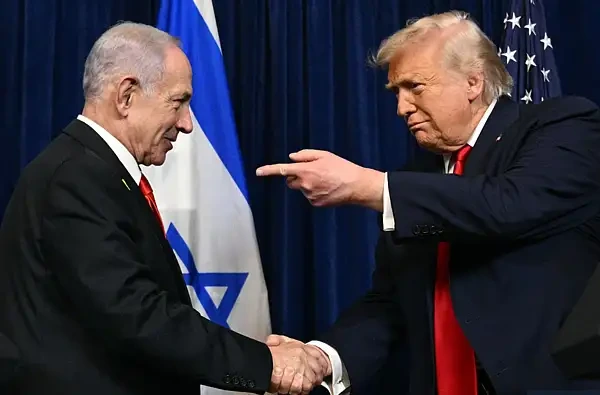
New York Mayor Zohran Mamdani is consulting legal experts over whether to try to arrest Israeli Prime Minister Benjamin Netanyahu during an upcoming UN summit. Mamdani believes Netanyahu belongs in The Hague, calling him a "war criminal" who has been charged by the International Criminal Court. The mayor's comments have prompted a sharp rebuke from Netanyahu's camp.
Mamdani, who has called Israel an "apartheid regime," stated that his opinion is shared by many due to Netanyahu's actions over the years. He admitted uncertainty about his power to order the New York Police Department to detain a foreign leader but is discussing the matter with the city's legal team. Mamdani emphasized that he will take whatever action the law allows him to do in New York City.
The potential arrest of Netanyahu would be a significant development, with implications for international relations and the United Nations. As the situation unfolds, it remains to be seen what actions Mamdani will take and how the international community will respond.
This development comes as the UN summit approaches, scheduled for September 2026. The summit will bring together world leaders, including Netanyahu, to discuss various global issues. Mamdani's consideration of arresting Netanyahu adds a new layer of complexity to the upcoming summit.

US Troops Killed in Iran Attack
Iranian Attack in Jordan Kills Two US Troops, One Missing
Two US troops were killed and one is missing following an Iranian attack in Jordan. The incident occurred on July 19, 2026, and marks a significant escalation in regional tensions between the US and Iran. US military personnel are among those affected by the attack, which is part of the ongoing geopolitical conflict and proxy warfare between the US and Iran in the Middle East.
The attack has heightened concerns about the safety of US troops in the region and the potential for further escalation. Analysts warn that any attacks near the Red Sea could worsen the economic impact of the regional conflict. The incident is the latest in a series of strikes between Iran and the US, with the two countries trading blows for the ninth night.
The US-Iran war is increasingly escaping the control of those waging it, with Yemen\'s Houthis threatening a \"maritime embargo\" against Saudi Arabia. The situation is complex, with multiple parties involved and various interests at play. The US has announced the start of Israel\'s withdrawal from \"pilot zones\" in south Lebanon, which may have implications for the regional conflict.
This incident is connected to the broader Middle East conflict, which has seen various countries and factions involved in proxy warfare and geopolitical tensions. The US and Iran have been on opposite sides of the conflict, with each seeking to exert its influence in the region. The attack on US troops in Jordan is a significant development in this ongoing conflict.