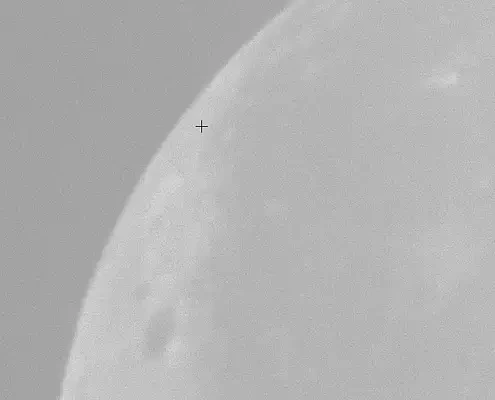
(Credit - Astronomy Centre)
Abu Dhabi Observatory Tracks SpaceX Moon Crash
On August 5, 2026, a SpaceX rocket piece crashed into the moon, and the UAE’s Al Khatm Astronomical Observatory in Abu Dhabi attempted to observe the impact. The object, a school-bus-size second stage of a Falcon 9 rocket, had been floating in space since January 2025. Astronomical calculations indicated that the rocket would collide with the lunar surface at 06:34:31 UTC on August 5, 2026.
The impact was expected to eject approximately 450 cubic meters of lunar soil and rock, equivalent to about 1,100 metric tons of material. However, due to the daylight conditions and the moon’s low altitude, the observation was particularly challenging. The Al Khatm Observatory directed its main telescope toward the moon and continuously imaged the impact site from one minute before the predicted collision until five minutes afterward. Unfortunately, no impact flash or visible emission of lunar material was detected.
The event was considered worth monitoring, despite the uncertainty surrounding the visibility of the impact effects. Scientists had predicted that the effects could range from a brief impact flash to a cloud of dust and rocks ejected by the collision, or possibly no visible effects at all. The Al Khatm Observatory’s efforts were part of a global observation effort, with researchers around the world awaiting the results of the monitoring.
The crash occurred on the left-hand limb of the moon, just to the left of the plus (+) marker in an image provided by the Astronomy Centre. The impact site was located near the lunar limb, making it difficult to detect any ejecta that might have been thrown into space. The maximum angular separation from the lunar disk was estimated to be only about 1.5 arcseconds, an extremely small distance that would make detection difficult even with large telescopes.
The UAE’s observation of the SpaceX rocket moon crash highlights the country’s growing interest in space science and astronomy. The Al Khatm Astronomical Observatory’s efforts demonstrate the importance of monitoring and studying celestial events, even if the effects are not immediately visible.
In the context of the UAE’s growing space program, this event is a significant milestone. The country has been actively involved in various space-related initiatives, including the launch of its own satellites and participation in international space missions. The observation of the SpaceX rocket moon crash reflects the UAE’s commitment to advancing its space capabilities and contributing to the global understanding of space science.


Air India Turbulence: 300-Foot Drop Injures Passengers
Turbulence Horror: Air India Flight Drops 300 Feet, Injuring Passengers
An Air India flight from Phuket to Delhi encountered severe turbulence, causing the aircraft to drop 300 feet and injuring multiple passengers and crew members. Passengers were thrown into the air as the plane was rocked by violent jolts, with some hitting the cabin ceiling before falling back into their seats or onto the aisle. The flight landed safely in Delhi, but the incident has raised questions about what causes such turbulence and how it can be avoided.
Aviation experts say the aircraft most likely encountered severe atmospheric instability linked to monsoon weather, including powerful updrafts, downdrafts, or wind shear associated with thunderstorm activity. Turbulence occurs when an aircraft flies through unstable air, and it can be triggered by thunderstorms, powerful vertical air currents, jet streams, or sudden changes in wind speed and direction. At this time of year, flights between Phuket and Delhi often pass through active monsoon weather over the Andaman Sea and Bay of Bengal, where towering cumulonimbus clouds can generate intense updrafts and downdrafts.
The US Federal Aviation Administration (FAA) advises passengers to keep their seat belts fastened whenever they are seated, even when the seat belt sign is switched off, because severe turbulence can occur without warning. This is because the seat belt sign indicates that conditions are considered safe enough for passengers to move around the cabin if necessary, but it does not mean turbulence cannot occur unexpectedly. Keeping the belt loosely fastened while seated allows passengers to remain comfortable while providing immediate protection in case of unexpected turbulence.
The Air India turbulence incident is a reminder of the importance of aviation safety and the need for passengers to follow safety guidelines, including keeping their seat belts fastened at all times when seated. As the investigation into the incident continues, passengers and crew members who were on the flight are still trying to come to terms with the terrifying ordeal they experienced.
This incident is similar to previous cases of severe turbulence that have occurred in the region, highlighting the need for continued vigilance and safety measures to mitigate the risks associated with flying through unstable air.

UAE highest temperature 51.2C recorded
UAE Sizzles at 51.2C: Highest Temperature Recorded
The UAE witnessed a scorching high temperature of 51.2°C on Wednesday, August 5, in Al Dhafra's Budu Dafs, according to the National Centre of Meteorology (NCM). This extreme heat is part of the country's peak summer season, which is expected to continue until August 10. The NCM reported that the mercury rose to 50°C in Abu Dhabi's Al Shawamekh on August 1, indicating the intense summer heat gripping the nation.
As the UAE experiences unstable weather conditions, convective clouds are forming, leading to rainfall and thunderstorms in eastern regions. The NCM expects this weather pattern to continue until Friday, August 7. Cloud-seeding flights have been conducted to enhance rainfall, and the centre has explained that intense summer heat encourages convective cloud development through surface heating. However, moisture, humid air masses, atmospheric instability, upper-air troughs, and favourable winds must also be present for thunderstorms and rainfall to develop.
The extreme weather has already caused heavy rains and stormwaters in Fujairah, with videos shared by Storm Centre showing the intense weather conditions. The NCM's announcement comes as astronomy experts say that the rise of the Al Mirzam star, traditionally marking the peak of summer heat, in UAE skies signals the beginning of a transitional weather period.
The UAE's peak summer season, also known as 'Jamrat Al Qayth' (the embers of summer), is currently drawing to an end. The NCM's forecast indicates that the country can expect more rainfall in the coming days, bringing some relief from the extreme heat.

UAE Ranking 2026: 14th Best Place to Move
UAE Ranked 14th Best Country to Move to in 2026
The United Arab Emirates has been crowned one of the best places to move to in 2026, according to a global study conducted by Remitly. This ranking comes as no surprise to those who have been living in the UAE, as the country has always been known for exceeding expectations and offering a high level of comfort. From its immeasurable safety to its diverse culinary options, rewarding employment opportunities, stellar education, and world-class entertainment, the UAE has cemented its position as a top destination for relocation.
The UAE ranked 14 out of 82 countries in the latest global study, marking the second consecutive year that the country has secured a position in the top 15 globally for relocation. The study highlights the UAE's melting pot of cultures, with expats making up 88% of the population, and its continuous efforts to reform laws and investment opportunities for those looking to build a legacy, home, or life in the region.
For those considering moving to the UAE, the country's recent initiatives, such as the Dubai Invite initiative, which grants residents perks worth over Dhs3,000 to bring their loved ones for an exclusive Dubai holiday, may be a significant draw. With its high safety standards, diverse culinary options, strong employment market, quality education, and expanding expat incentives, the UAE is an attractive destination for those looking to relocate.
The UAE's ranking is backed by expert research conducted by Remitly, which considered various factors that make a country an ideal place to move to. The country's position in the top 15 globally for relocation reflects its commitment to providing a high quality of life for its residents.
In terms of its global ranking, the UAE is among the top 15 countries that made it to the list, which includes Switzerland, Iceland, Luxembourg, Australia, Germany, Ireland, United States, Denmark, Norway, Spain, Netherlands, France, Sweden, and the United Kingdom. The UAE's ranking is a significant achievement, considering the country's relatively small size and population compared to other countries on the list.
Overall, the UAE's ranking as the 14th best country to move to in 2026 is a reflection of its efforts to provide a high quality of life for its residents, and its commitment to becoming a top destination for relocation.

UAE Telemarketing Fines Hit Dh19 Million
Dh19 Million in Fines for Telemarketing Violations in UAE
The Telecommunications and Digital Government Regulatory Authority (TDRA) has issued Dh19.19 million in fines and disconnected 9,433 mobile numbers for telemarketing violations as of June 2026. This crackdown is part of the TDRA's efforts to combat unwanted marketing calls and protect the privacy of individuals. The authority has reported that 92,748 numbers have been flagged by the public, resulting in the disconnection of numbers associated with violating telemarketers.
The TDRA's campaign targets individuals who use personal mobile numbers for telemarketing or business promotional activities, which is against the regulations. Using a personal number for such purposes may result in regulatory action and applicable penalties. The initial fine for making marketing calls from personal numbers is Dh5,000, along with the suspension of all phone numbers registered under the individual's name until the penalty is paid. Repeat offenders can face fines escalating up to Dh50,000 and a 12-month ban from receiving services from UAE telecommunication companies.
To empower residents and enhance their calling experience, the TDRA is urging the public to utilize the 'Do Not Call Registry' (DNCR). Residents who wish to opt out of authorized telemarketing campaigns can easily register their numbers by sending an SMS with the letters 'DNCR' to 2211. Furthermore, if residents receive an unwanted telemarketing call, they are encouraged to report the violator by sending the caller's number via SMS to 2211.
The regulations, which came into full effect in August 2024, were designed to shield consumers from aggressive cold-calling tactics. Licensed telemarketing firms must follow strict operational guidelines, including restricting call timings to between 9am and 6pm, prohibiting follow-up calls if a consumer rejects a product during the initial contact, and banning the use of pressure tactics. Companies violating these rules face severe administrative penalties, with fines ranging from Dh10,000 up to Dh150,000.
| Violation Type | Fine Amount |
|---|---|
| Initial fine for making marketing calls from personal numbers | Dh5,000 |
| Repeat offenders | Up to Dh50,000 |
| Companies violating telemarketing rules | Dh10,000 to Dh150,000 |

UAE Grocery Price Platform: Compare Over 8,343 Essential Goods Before You Buy
8,343 UAE Essential Goods Now Price-Comparable Across 525 Outlets
UAE shoppers can now compare prices for 8,343 essential products across 525 outlets operated by 13 major retailers, thanks to the Ministry of Economy and Tourism's Essential Goods Prices Platform. This platform, launched in April 2026, has already attracted approximately 143,720 visitors, averaging over 1,451 visits each day. The platform allows consumers to use pricing information to compare products across participating retailers before deciding where to shop.
The Ministry of Economy and Tourism plans to expand the platform by adding more products and participating retail outlets, giving shoppers a broader range of prices to compare. Pricing data collected through the system is used to produce periodic analyses of price fluctuations across UAE retailers and assess the factors influencing market movements. The platform connects digital monitoring with field inspections, allowing authorities to review market developments using current pricing data and indicators.
For consumers, the platform's data and statistics are being used to strengthen consumer protection measures and provide shoppers with more accurate information when making purchasing decisions. Regular analysis of pricing patterns also supports policy decisions related to markets, retail pricing, and consumer protection. Retailers across the UAE continue to maintain sufficient supplies of goods and provide consumers with a range of products and alternatives, according to the ministry.
The Essential Goods Prices Platform is a significant step towards market transparency, enabling consumers to make informed decisions about their purchases. By comparing prices across different retailers, consumers can save money and make the most of their shopping budget. The platform's success, with over 143,720 visitors since its launch, demonstrates the demand for such a service and the ministry's commitment to consumer protection.
As the platform continues to expand and add more products and retailers, it is likely to become an essential tool for UAE shoppers. With its user-friendly interface and comprehensive pricing data, the platform is poised to revolutionize the way consumers shop in the UAE. Whether you are a budget-conscious shopper or just looking for the best deals, the Essential Goods Prices Platform is definitely worth checking out.