New UAE AI Firefighting Tools Send Drones Inside Burning Buildings
In Dubai, emergency response operations are undergoing a massive technological pivot as the Federal Authority for Ambulance and Civil Defence integrates autonomous systems into daily readiness.
Smarter Tools Keep First Responders Out of Toxic Fumes
The push relies heavily on agentic AI, systems capable of independent action, to map high-risk zones and forecast incidents before they strike. Major General Dr Jassim Mohammed Al Marzooqi, Director General of the authority, highlighted that every civil defence directorate across the UAE will now appoint a dedicated AI ambassador. These ambassadors are tasked with tracking, testing, and sharing best practices for agentic AI applications to directly cut down response times and safeguard human lives.
Operations on the ground are already reflecting this shift, following a recent specialised forum in Dubai attended by Ahmed bin Ali Al Sayegh, Minister of Health and Prevention and Chairman of the authority. Three standout projects debuted at the event to tackle distinct emergency scenarios: Kashif, Najda, and Athar.
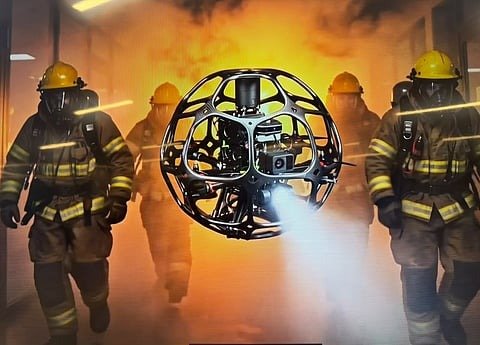
Kashif is a high-tech indoor drone developed alongside Dubai Civil Defence and Dubai AI Campus. Designed to enter burning structures before human crews, it navigates without GPS using multiple sensors to build real-time 3D maps, pinpoint fire sources, and track carbon monoxide and oxygen levels. Millimetre-wave radar lets the drone detect trapped occupants and monitor their vital signs through thermal protection and a carbon-fibre frame, transmitting critical route data straight to headquarters.
For personnel safety, the wrist-worn Najda device continuously monitors firefighters for heat stress and cardiac episodes. Utilizing AI to map a personalised baseline for each wearer, the gadget fires off an SOS alert to team leaders when it catches abnormal vitals, functioning seamlessly even without an internet connection. Meanwhile, Athar deploys small drones and hand-sized rovers during the critical first 72 hours following an earthquake or building collapse to locate survivors and gather site data safely.
These tiered integrations aim to support firefighters with advanced tactical equipment, ensuring high-risk environments like chemical spills with toxic fumes can be scouted by machines rather than risking human lives.