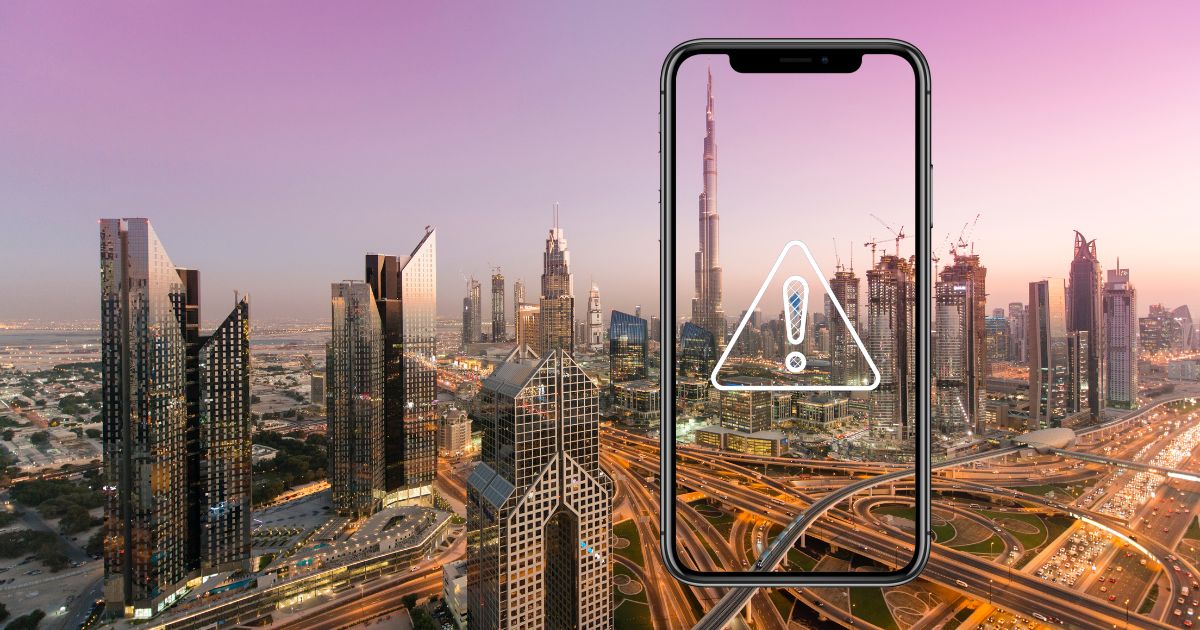
You’re in Dubai or wider UAE, your phone blares an emergency notification, and within seconds your WhatsApp group chat is chaos. Half the group swears they got nothing. It feels random, even unfair, and the first thought is usually the same: why didn’t I get the emergency alert, or why did I get it when others didn’t?
Here’s the real-world explanation from National Emergency Crisis and Disaster Management Authority (NCEMA): UAE emergency alerts are built to be targeted. They are sent based on location, so only people in the affected area, or an area considered at risk, may receive the message. That is the point of the UAE public warning system. It aims to protect people who need to act, without alarming everyone else across the country.
This is important now because the UAE often uses official public safety messages for quickly changing situations, like severe weather, major traffic jams, industrial accidents, and regional security issues, including missile warnings that residents have talked about a lot. In crowded cities where people frequently travel between neighborhoods, highways, metro lines, and even across emirate borders, the difference between receiving or missing a message can be just a few minutes and one cell tower.
The Short Version, in plain English
- UAE emergency alerts are location-based, so only phones in the affected or at-risk zone may receive them.
- Your phone’s connection to a specific tower matters. Two people a few kilometres apart can be on different cells and see different results.
- Even in the same area, Mobile notifications can be blocked or hidden by settings like Focus or Do Not Disturb, disabled alert categories, or outdated software.
- Temporary carrier congestion or delayed handoffs between towers can make an alert arrive late, or look like it never arrived.
How the system works
Think of NCEMA alerts UAE as a targeted broadcast, not a mass text to the whole country. The goal is speed and precision. When authorities identify a risk area, they can push instructions to phones in that geographic zone using carrier-level alerting, commonly described as Cell broadcast style messaging or similar technology.
This is also why these alerts can still come through when app-based channels are struggling. If WhatsApp is slow, or social feeds are flooded with rumours, the official alert is designed to cut through because it is delivered through the mobile network layer, not as a normal app message.
Why your neighbour got it and you didn’t
The most common reason is simple proximity. UAE location-based alerts depend on where your device is registered at that moment. If your phone is connected to a tower serving the affected zone, you may get the alert. If your friend is connected to a different tower outside the defined area, they may not, even if they feel “nearby” in everyday terms.
Movement makes this more noticeable. People traveling on Sheikh Zayed Road, drivers using interchanges, metro passengers, and those living near emirate borders can switch between network cells quickly. This can affect whether your phone receives the alert right when it is sent.
The settings and tech stuff that quietly blocks alerts
Sometimes people are in the same building and still have different experiences. That is where device behaviour comes in. Emergency notification settings iPhone Android UAE can vary widely depending on what you have enabled, how your phone handles alerts, and whether your software is up to date.
- Alert categories disabled: Some phones let you switch off certain emergency alert types. If those are off, you might never see the notification.
- Focus or Do Not Disturb: Depending on your device and configuration, the alert may be silenced, hidden, or easy to miss.
- Language and region settings: Misaligned settings can affect how alerts display, or whether they show as expected.
- Outdated operating system: Older software can mishandle Mobile notifications, especially system-level alerts.
- Network congestion or tower handoff delays: In busy moments, an alert can arrive late. People often interpret “late” as “never.”
Put another way, if you are searching “cell broadcast alerts UAE” after an incident, you are not alone. Many “missed” alerts are actually a mix of location rules and phone settings.
Why targeted alerts are a public safety feature, not a glitch
It is tempting to assume every alert should go to everyone. NCEMA’s approach is the opposite. Targeting reduces panic, limits misinformation, and keeps attention on the people who need to take action. In a country with high smartphone use and dense urban living, that precision is part of how UAE public safety messaging stays effective.
It also helps emergency services. When the right people get the right instructions quickly, resources can be focused where they are needed most, instead of managing unnecessary calls and confusion from unaffected areas.
What to do next if you think you missed an alert
If you are worried you are not receiving UAE emergency alerts, treat it like a quick safety check, the same way you would check your smoke alarm at home.
- Open your phone settings and review emergency alert toggles. Make sure emergency alerts are enabled and not filtered by category.
- Review Focus or Do Not Disturb settings and how they handle time-sensitive or emergency notifications.
- Update your operating system to the latest version available for your device.
- If you are near an emirate border or commuting, remember that location-based public safety alerts can vary by the tower your phone is connected to at that moment.
And when an alert does come in, rely on the official instruction in the notification itself. Group chats can help you check who received what, but they can also spread half-true screenshots fast, especially on WhatsApp.
Bottom line
NCEMA guidance is clear: the system is designed so that not everyone receives the same warning. If you are asking “why didn’t I get the emergency alert,” the answer is usually that you were outside the defined risk area when it was sent, or your phone settings and network conditions affected delivery. The practical takeaway is simple. Keep your emergency alert settings enabled, keep your phone updated, and treat location-based alerts as a sign that authorities want people in a specific area to act quickly.
Ebola DR Congo 2026: Death Toll Hits 1,887
Ebola Death Toll Reaches 1,887 in DR Congo
The Democratic Republic of Congo has reported 1,887 Ebola deaths and 4,120 confirmed cases in its ongoing outbreak. The latest government figures represent a significant increase from the 4,053 confirmed cases and 1,850 deaths reported as of August 5-6. The outbreak, caused by the Bundibugyo strain of Ebola virus, was declared in northeastern Congo in May and has since spread across multiple provinces.
The World Health Organisation's July 30 update had recorded 3,605 confirmed cases and 1,587 deaths, meaning the outbreak has continued to accelerate rapidly in just days. The fatality rate is currently 45.8%, according to the Congolese Ministry of Communication. Cases have been reported across five provinces, Ituri, North Kivu, South Kivu, Haut-Uélé, and Tshopo, involving dozens of health zones.
The outbreak involves the Bundibugyo virus, a relatively rare Ebola species for which there is currently no approved vaccine or specific treatment. Researchers and health authorities are testing potential vaccines and treatments, but they are not yet established tools for controlling this outbreak. The outbreak is also occurring in a region affected by armed conflict, population displacement, weak health infrastructure, and extensive population movement, all of which complicate surveillance, contact tracing, and treatment.
The World Health Organisation has described the situation as a rapidly evolving public-health emergency. The CDC said this outbreak passed 1,000 confirmed cases within about 40 days of response activation, compared with roughly 235 days during Congo's 2018 outbreak. WHO Director-General Tedros Adhanom Ghebreyesus has warned that the outbreak is outpacing the response, while aid organizations have reported shortages of personnel and other resources.
This outbreak is the second-largest Ebola outbreak ever recorded, behind the 2014-16 West Africa epidemic. Health authorities are racing to improve early detection, contact tracing, isolation, and treatment, while researchers work to evaluate medical countermeasures against Bundibugyo Ebola.
The situation is connected to the previous Ebola outbreak in West Africa, which was declared a Public Health Emergency of International Concern in 2014. The current outbreak has been declared a Public Health Emergency of International Concern by the WHO since May 17, 2026.

Typhoon Dolphin Hits Zhejiang
Typhoon Dolphin Batters Zhejiang, 388 Flights Canceled
Typhoon 'Dolphin' made its second landfall in China's Zhejiang Province at Yueqing City at around 6:40 p.m. on Sunday, according to the National Meteorological Center. The maximum sustained wind near the typhoon center hit Force 13, or 38 meters per second. Local residents and travelers are affected as the Hangzhou Xiaoshan International Airport in Hangzhou City, capital of Zhejiang, has canceled 388 inbound and outbound flights for the day due to the typhoon.
The typhoon first landed at Yuhuan in Taizhou City, Zhejiang, at around 5:30 p.m., with the maximum sustained wind near the typhoon center hitting Force 14. The National Meteorological Center warned local authorities in the affected areas to guard against extreme downpours.
The severe weather system has also impacted flight schedules, with Emirates delaying Dubai-China flights due to the typhoon. Over 1,000 flights have been canceled as Typhoon Dolphin looms.
This typhoon is one of several severe weather systems currently active, including Tropical Storm Chan-hom heading towards mainland Japan, and three more systems spinning around the Mariana Islands.

Oil prices rise as Hormuz deal hopes clash
Oil Nears $85 as Hormuz Deal Hopes Stall
Oil prices were higher in early Asian trading on August 10, 2026, as uncertainty over a possible agreement to reopen the Strait of Hormuz continued to outweigh hopes for a quick return to normal shipping. Traders and investors are closely watching the developments, as the situation affects the global energy market. The prices of West Texas Intermediate crude and Brent crude rose, with WTI at $78.71 a barrel, up 53 cents, or 0.68%, and Brent crude at $84.28, up 73 cents, or 0.87%, at 8:33 am Tokyo time.
The gains came despite renewed diplomatic efforts to reopen the strategic waterway, reflecting traders' concern that an emerging Iran-Oman arrangement may not immediately restore unrestricted global shipping. Iran has tied a full reopening to additional concessions from Washington, which has led to a stalemate in the negotiations. The central problem is that Tehran and Washington appear to have different ideas about what “reopening” means, with Iran seeking concessions linked to the conflict and sanctions before unrestricted passage can resume.
The situation in the region remains volatile, with Iran stepping up attacks on ships in the Middle East Gulf, including vessels from South Korea and the UAE. The UAE accused Iran of attacking an empty crude oil tanker belonging to Abu Dhabi state oil firm ADNOC with drones as it attempted to transit the Strait. The UK Maritime Trade Operations reported incidents involving cargo vessels in the region, adding to the tensions.
The ongoing tensions and uncertainty have led to a rise in oil prices, with Brent futures climbing toward $85 per barrel and WTI hovering near $79. The global oil market remains highly volatile, with traders and investors closely watching the developments in the region. The situation is being monitored by the UAE, which has left OPEC, and the US, which has stepped up its naval blockade of Iran.
The UAE's energy minister stated that the country owes it to its people to ensure the stability of the energy market, as the situation continues to unfold. The US has redirected eight commercial vessels and disabled another ship as its military campaign entered an 11th consecutive night. The ongoing tensions and uncertainty in the region are likely to continue to affect the global energy market, with oil prices remaining volatile.
As the situation in the Strait of Hormuz continues to evolve, it is connected to the prior story of the US-Iran ceasefire that came into force in early April, which had initially led to hopes of a reduction in tensions in the region. However, the recent escalation of attacks and the stalemate in the negotiations have led to a rise in oil prices and increased uncertainty in the global energy market.

Dubai Shared Housing Law Takes Effect Late August
New Dubai Law: Shared Housing Now Open to Families, Bachelors
The new Dubai shared housing law, set to take effect in late August, allows families and bachelors to legally occupy shared properties. According to Dr. Hasan Elhais, Legal Consultant at Amal Al Rashedi Lawyers and Legal Consultants, the law identifies six categories for which shared housing may be designated, including workers of private companies and establishments. This law is significant because it expands the concept of shared accommodation beyond the traditional idea of unrelated workers or individuals sharing a property.
The law applies to various types of properties, including residential apartments, standalone houses, residential complexes, mixed-use buildings, townhouses, and multi-storey buildings. Each property must meet the applicable permit, occupancy, planning, and safety requirements. Dubai Municipality can set specific standards for each category depending on the type of property and can add, amend, or remove categories through subsequent decisions.
Under the new law, rent will be paid monthly and in advance by default, although landlords and occupants can agree to a different payment arrangement in the tenancy contract. Electricity and water consumption charges will be included in the rent by default, unless the landlord and occupant agree otherwise. The landlord remains responsible for paying the electricity and water bills to the relevant service provider.
The law also prohibits occupants from allowing another person to reside in and benefit from their allocated space, and subletting the allocated space is also prohibited. However, the legislation does not expressly ban others from staying over. Tenancy contracts and any amendments to them must be registered in the Shared Accommodation Registry.
The new law aims to protect the rights of owners and residents, ensure healthy living conditions, curb overcrowding, and promote fair rental practices. With the law taking effect in late August, families and bachelors can now explore shared housing options in Dubai.
| Category | Eligibility |
|---|---|
| Families | Eligible for shared housing |
| Bachelors | Eligible for shared housing |
| Workers of private companies and establishments | Eligible for shared housing |

Dubai-it Award Nominations Open August 10
Dubai-it Award Launches with Nominations Open Until September 10
Nominations for the first edition of the Dubai-it Award open on August 10, recognising individuals, projects and organisations that have turned ambitious ideas into tangible results in Dubai. Local individuals, projects, and companies are eligible to nominate themselves or others for the award, which has three main recognition segments covering individuals, projects, and institutions and companies.
The award is launched under the directives of His Highness Sheikh Hamdan bin Mohammed bin Rashid Al Maktoum, Crown Prince of Dubai, Deputy Prime Minister and Minister of Defence, and is based on the Dubai-it initiative launched by His Highness Sheikh Mohammed bin Rashid Al Maktoum, Vice President and Prime Minister of the UAE and Ruler of Dubai. Nominations can be submitted across 10 fields: Government, Real Estate, Economy, Business, Technology, Sports, Society, Education, Services and Health.
The Dubai-it Award's digital platform will accept nominations until September 10, and eligible achievements can include projects, initiatives and transformations delivered during the past four years. Applicants are required to provide details of the achievement, the challenge or opportunity behind it, how it was implemented and the results and impact it produced, with supporting evidence such as performance data, reports, images, media material and certificates.
This launch is connected to the broader initiative of promoting innovation and excellence in Dubai, as seen in recent efforts such as Dubai Municipality's AI-powered project to automate the issuing of building permits, reducing wait times from days to minutes.