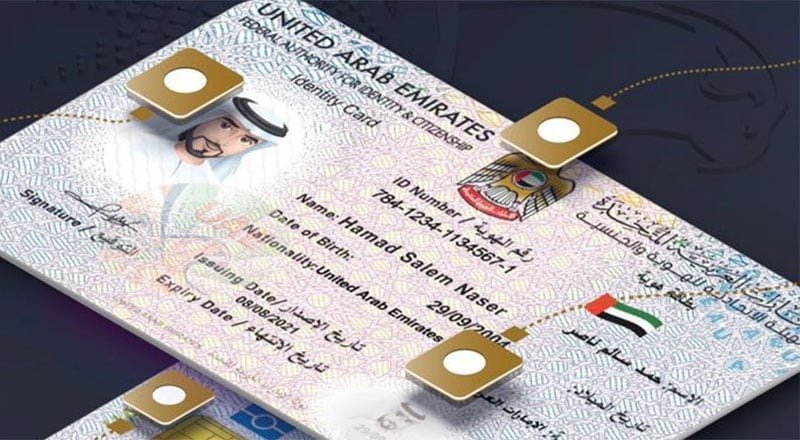
The Emirates ID chip embedded in the back of every UAE resident’s card is not a passive strip of plastic. It functions as a compact, encrypted data store that feeds into some of the most consequential identity checks a person faces in the UAE, from opening a bank account to passing through an airport gate. Most residents carry the card daily without knowing the depth of what it holds or how widely it is read.
At a Glance: Emirates ID Chip Facts
- The Emirates ID chip reportedly stores up to 20 distinct pieces of personal information.
- The card is issued by the Federal Authority for Identity, Citizenship, Customs and Port Security (ICP), the sole authority governing UAE national ID credentials.
- The chip supports identity verification across telecom, banking, healthcare, and government portals, making it the central KYC anchor for regulated services in the UAE.
- Airport-related use cases exist, but the exact access level depends on the specific smart-gate system, airline, and terminal in operation.
Inside the Emirates ID Smart Card Chip
Think of the chip as a secure vault that only authorised readers can open. Smart-card chips of this type store identity attributes and cryptographic security certificates, allowing a connected system to confirm who you are, verify the card has not been tampered with, and flag any mismatch in real time. That is why a bank teller swipes your Emirates ID rather than simply reading the printed name on the front.
The ICP-issued card is the UAE’s primary identity document for both citizens and residents. Its chip is built to serve government and regulated private-sector touchpoints, which is why the same card you use to register at a clinic in Dubai can also verify your identity on a government portal in Abu Dhabi. The data stored on it reportedly spans 20 separate personal data points, covering the kind of biographical and biometric information that underpins identity verification at scale.
Exactly which 20 fields are encoded has not been officially itemised in a public ICP disclosure, so residents should treat any specific list circulating online as indicative rather than definitive. The authoritative breakdown sits with ICP, and the agency’s official channels remain the correct place to verify what your chip holds.
Emirates ID Airport Access and What It Actually Means
References to “airport access” attached to the Emirates ID card tend to travel faster than the nuance that accompanies them. The card does play a role at UAE airports, but that role is not uniform across every terminal or every airline.
In practice, Emirates ID is used at e-gates and smart-gate systems where the chip is read to confirm identity against travel records. Whether that constitutes “access” in a given context depends on the airport’s infrastructure, the specific gate system deployed, and the airline’s own boarding process. A resident using the card at Dubai International Airport may have a different experience from one using it at a smaller terminal, simply because the smart-gate integration varies.
ICP and the relevant airport authority remain the correct sources for confirming exactly what the card unlocks at any specific checkpoint. Residents planning to rely on the card for airport-related identity checks should verify the current setup directly with the airport or airline before travel.
Personal Data on the Chip: Treat It Accordingly
Because the Emirates ID chip carries this volume of personal data, the card warrants the same care as a passport. Sharing your ID number unnecessarily, handing the card to an unverified third party, or allowing it to be scanned by an unofficial reader all carry real risk.
ICP’s guidance is clear on the practical steps: use official channels for any identity verification request, report a lost or stolen card immediately through ICP’s official portals or service centres, and flag any suspected misuse without delay. The card is not simply a photo ID. It is a live credential tied to your legal identity in the UAE, and the chip is what makes it readable by the systems that govern access to services, benefits, and facilities across the country.
Steps Every UAE Resident Should Take Now
- Verify your Emirates ID details are current through the ICP smart services portal at icp.gov.ae or the ICP UAE app.
- Report a lost or damaged card immediately via ICP’s official service channels to prevent unauthorised use of your chip data.
- Avoid handing your card to unverified parties for scanning; insist on knowing why a chip read is required before consenting.
- For airport-specific queries about e-gate eligibility and smart-gate access, contact the relevant airport authority or airline directly rather than relying on third-party summaries.
The ICP UAE app, available on iOS and Android, also allows residents to view their registered identity details and track card status without needing to visit a service centre in person.
💡 Frequently Asked Questions
What personal information is stored on the Emirates ID chip?
The Emirates ID chip reportedly stores up to 20 pieces of personal information, including biographical and biometric data used for identity verification. The exact list of fields has not been publicly itemised by ICP, so residents should consult icp.gov.ae for authoritative details on what their chip contains.
Can the Emirates ID be used for airport access in the UAE?
Emirates ID is used at e-gates and smart-gate systems at UAE airports for identity verification, but the specific access it enables depends on the airport, terminal, and gate system in use. Residents should confirm the current setup with their airline or the relevant airport authority before relying on the card at a specific checkpoint.
What should I do if my Emirates ID is lost or the chip is compromised?
Report the loss immediately through ICP’s official portal at icp.gov.ae or visit an ICP service centre. Prompt reporting limits the risk of unauthorised use of the chip data and allows ICP to flag the credential in its systems.