What is Your UAE UID Number?
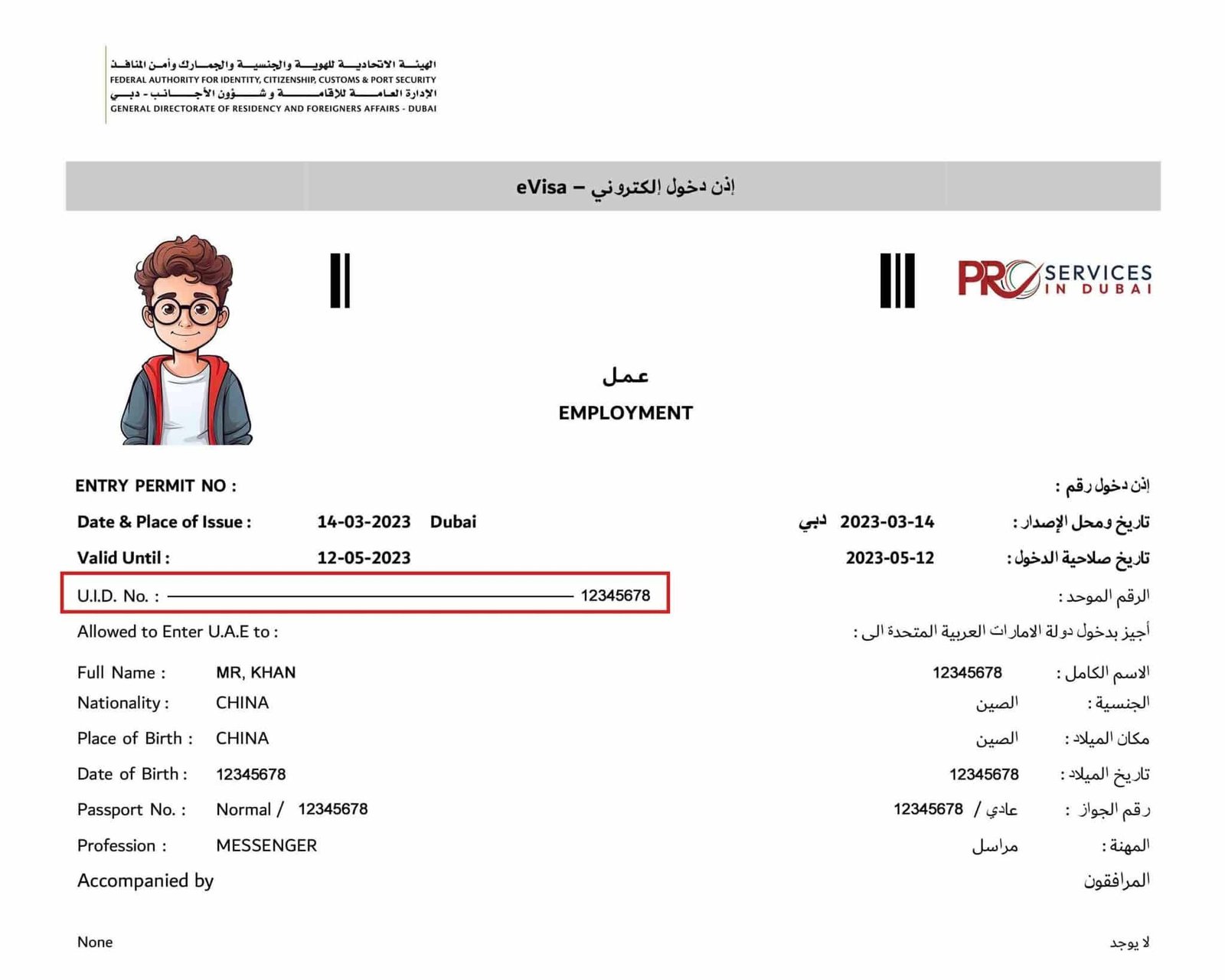
If you’re an expat resident in the UAE, you’ve likely been asked to provide your Unified Number (UID) at some point. But what is this number, and why is it important? The UID is a unique 9-to-15-digit number assigned by the Federal Authority for Identity, Citizenship, Customs and Port Security (ICP) to every resident issued a visa in the UAE. It’s a permanent identifier that never changes, even if you renew your passport, change your visa type, or switch sponsors.
The UID is different from your Emirates ID number, although they are interconnected and required for completing administrative processes in the UAE. Your UID Number is usually required by the UAE Ministry of Human Resources & Emiratisation (MOHRE), General Directorate of Identity and Foreigners Affairs, Dubai (GDRFA), and ICP to access identity records and for related transactions. In contrast, the Emirates ID is usually used for physical verification and as a supplementary verification tool.
To find your UID, you can check the back of your Emirates ID card, under the barcode. You can also access it through the ICP Smart Services website (smartservices.icp.gov.ae). According to Imran Khan, managing director at I K Lawyers, “The UID is issued by UAE immigration the first time a person enters the UAE, even as a visitor. It becomes their permanent UAE identity and never changes.”
The UID is crucial for various government services, including visa applications, Emirates ID renewals, and MOHRE transactions. It’s a reference code that’s unique to you and is used by the authorities to identify you within the UAE’s identity infrastructure. Whether you’re a free zone company employee or a dependent on a family visa, your UID is linked to your Emirates ID and becomes your personal identity record.
If you’re a resident in the UAE, it’s essential to know your UID and understand its significance. The UID is a permanent identifier that reflects your entire immigration history, and it can be activated even after you have left the UAE and returned. By understanding the purpose and importance of the UID, you can navigate the UAE’s administrative processes more efficiently and avoid any potential issues or delays.
For residents who are unsure about their UID or need to access it, the ICP Smart Services website provides a convenient and secure way to retrieve this information. By logging in to the website, you can access your UID and other important details related to your residency and visa status.
In summary, the UAE Unified Number (UID) is a unique and permanent identifier assigned to every resident in the UAE. It’s essential for various government services and is used to access identity records and related transactions. By understanding the purpose and significance of the UID, residents can navigate the UAE’s administrative processes more efficiently and avoid any potential issues or delays.

Caught in the Crossfire: Why Gulf States Bear the Brunt of US-Iran Escalation
Gulf Security at Risk as US-Iran Conflict Escalates
The collapse of a fragile 60-day ceasefire between the United States and Iran has led to a renewed escalation of military confrontations, leaving Gulf states exposed to the conflict. The Strait of Hormuz, a critical shipping route, has become a flashpoint, with both sides targeting assets in the region. This development has significant implications for the security and economies of Gulf countries, including Bahrain, Kuwait, Qatar, and Oman.
The breakdown of the ceasefire, which was signed in mid-June, followed a series of events that began with the US accusing Iran of striking three ships in the Strait of Hormuz. In response, the Islamic Revolutionary Guard Corps Navy announced the closure of the strait and struck a Cyprus-flagged vessel, prompting the United States to attack dozens of Iranian military targets. The escalation has resulted in drone strikes against US military sites in Bahrain, Kuwait, and Qatar, with Iran presenting these strikes as attacks on American assets rather than on the countries hosting them.
The pattern of escalation is familiar, with previous confrontations following a similar sequence: Iran attacks commercial shipping, the United States responds with limited strikes, and Tehran then targets American assets in Gulf countries. The GCC economies are feeling the effects of every confrontation, with the conflict impacting the security and stability of the region. The closure of the Strait of Hormuz, in particular, has significant implications for the global economy, as it is a critical route for oil exports.
For Gulf governments, the situation is precarious, with the conflict posing a significant threat to their security and economies. The distinction between attacks on American assets and attacks on the countries hosting them offers little reassurance, as the explosions still take place in their airspace and near their cities. The GCC countries are taking necessary measures to respond to developments and ensure the safety of their citizens, but the situation remains volatile.
The strongest counter-argument to the notion that Gulf states are exposed to the US-Iran conflict is that the region has experienced periods of relative calm in the past, and that diplomatic efforts can still yield a peaceful resolution. However, this perspective overlooks the fundamental disagreement between the United States and Iran over control of the Strait of Hormuz, which has been a persistent source of tension. The conflict is unlikely to be resolved through diplomacy alone, and the GCC countries must be prepared to take necessary measures to protect their security and economies.
In conclusion, the US-Iran conflict has reignited, and Gulf states are facing renewed exposure to military confrontations and economic instability. The conflict poses a significant threat to the security and economies of the region, and the GCC countries must be prepared to take necessary measures to protect their interests.

Global Oil Threat: Saudi Exports Slashed by 36% Amid Escalating Chokepoint Risks
Saudi Oil Loadings Plunge 36% Amid Houthi Threats
36% is the significant drop in Saudi oil loadings, according to reports from the National, due to ongoing Houthi threats disrupting maritime traffic through the critical Bab Al Mandeb passage. This disruption has forced tankers carrying Saudi oil to U-turn in the Red Sea, highlighting the escalating risks to global energy supply chains in the region.
The impact of this disruption on the global oil market is substantial, with the 36% decrease in Saudi oil loadings likely to affect oil prices and availability worldwide. For businesses and individuals relying on oil, this disruption could lead to increased costs and potential shortages.
| Category | Impact |
|---|---|
| Saudi Oil Loadings | 36% decrease |
| Global Oil Market | Potential price increases and shortages |
The Houthi threats and subsequent disruption to the Bab Al Mandeb passage have significant implications for global energy security. As a result, businesses and individuals should be prepared for potential price fluctuations and supply chain disruptions. The situation highlights the importance of diversifying energy sources and developing strategies to mitigate the risks associated with geopolitical tensions in the region.
FAQ_INTEL[/FAQ_INTEL]

Chile Floods: State of Emergency Declared After Fatal Storms Destroy Homes
Chile Declares State of Emergency Amid Deadly Floods
Chile has declared a state of emergency due to heavy rainfall that has killed at least 10 people and destroyed or severely damaged over 1,100 homes. The affected areas, specifically the northern regions of Coquimbo and Atacama, have been experiencing unusually intense rainfall since last week, with the situation worsening on Sunday. Local residents, including those in Coquimbo and Atacama, are struggling with blocked roads, isolated communities, and disrupted drinking water supplies.
The state of emergency, declared by President Jose Antonio Kast on Monday, allows the government to deploy the military, restrict freedom of movement, and quickly mobilize aid to the affected areas. Deputy Interior Minister Maximo Pavez described the rainfall as \"abnormal and extreme,\" stating that \"what normally rains in a month fell in an hour\" on Sunday.
The extreme weather has left 17 people injured and four missing, according to Alicia Cebrian, director of Chile\'s SENAPRED national emergency service. Arnaldo Zuniga of the national meteorological service noted that Chile has not witnessed this much rainfall in two decades.
Rising rivers have blocked roads and isolated communities, while mud and power cuts have disrupted drinking water supplies in Coquimbo. The situation is being closely monitored by the government, with aid being mobilized to support those affected.
This declaration of a state of emergency follows similar situations in the past, such as the wildfires that affected Chile in recent years, highlighting the country\'s vulnerability to natural disasters.

India protests escalate
India's Youth-Led 'Cockroach' Movement Vows to Continue Protests
India\'s youth-led \"Cockroach\" movement said it would continue its protest demanding the resignation of Education Minister Dharmendra Pradhan on Tuesday, a day after violent protests disrupted central Delhi, injuring nearly 180 people. Thousands of protesters from Delhi and nearby cities and towns gathered to march on parliament on Monday, joining a movement that began as an online satire but has turned out to become the biggest challenge for Prime Minister Narendra Modi in his third term.
The months-old movement by the self-named Cockroach Janta Party has drawn the support of millions of young, Gen Z Indians who are demanding the resignation of Education Minister Dharmendra Pradhan over examination paper leaks that affected more than 2 million students in May. It says the leaking of the papers for a national entrance test to medical school in May - which forced students to re-test, and led to some taking their own lives - was a sign of deep-seated corruption in education.
Nearly 180 people were injured and taken to nearby state-run hospitals on Monday, with a majority of them discharged after first-aid, after clashes between the protesters and security personnel in which police used cane charges and tear gas. Delhi Police said that the injured included more than 118 security and police personnel and 60 protesters. Seventy protesters had been detained and legal action would be initiated against them, it said in a statement late on Monday.
The movement galvanized after the support of activist Sonam Wangchuk, who began a hunger strike on June 28, but was forcibly moved to a hospital by the authorities on Saturday. CJP founder Abhijeet Dipke apologized to supporters, especially girls who he said were beaten by male police officers, saying \"We could have done better. I could have done better to protect you from the inhumane actions of the Delhi Police.\"
This ongoing unrest is reminiscent of prior protests in India, where widespread discontent among the youth population has led to significant challenges for the government. The current movement\'s demands for accountability and reform are likely to continue, given the depth of feeling among the affected students and their supporters.

Madonna, Justin Bieber Clash Backstage
Madonna, Bieber Reportedly Clash at World Cup Halftime
Madonna and Justin Bieber performed at the FIFA World Cup Halftime show, but according to a report, their different ideas about what makes a great performance may have caused some friction before they took the stage. Bieber wanted something "clean and controlled," while Madonna went for a dramatic and unforgettable spectacle, bringing dancers and drama to the stage.
The difference in approach allegedly became a source of tension, with a Daily Mail source claiming that neither artist wanted to feel like they played second fiddle. Bieber's mindset was focused on the music, without unnecessary risks or distractions, while Madonna believed a stage as massive as the World Cup Final's called for something people would be talking about for years.
In the end, both artists delivered their performances without overshadowing each other, and the halftime show got its big superstar moment. The actual football match was happening concurrently, but for those focused on the celebrity guest list, the real game was the sightings, including BTS's performance and interactions with fans and other celebrities.
The FIFA World Cup Halftime show's success can be attributed to the performances of various artists, including Madonna, Justin Bieber, and BTS, who all brought their unique styles to the stage. The event was a culmination of music, drama, and sports, making it an unforgettable experience for the audience.