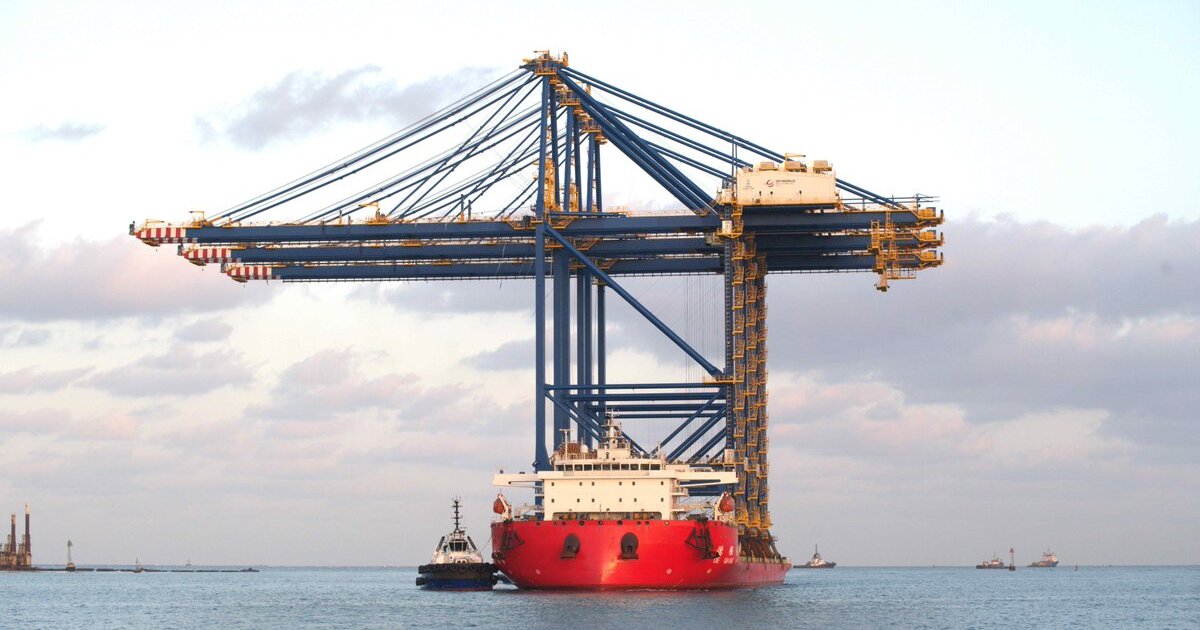
If you live in the UAE, you might not think a crane in Jeddah has anything to do with your weekly grocery run, your next online order, or your company’s restocking schedule. But the DP World Jeddah terminal sits on one of the busiest East to West trade corridors, and what happens at Jeddah Islamic Port can ripple across Red Sea shipping routes that feed into Gulf feeder networks and regional hubs.
The three new semi-automated quay cranes are part of a larger $800 million modernization program at DP World’s Jeddah Islamic Port terminal
Quick Overview
- DP World installed three semi-automated quay cranes at its container terminal at Jeddah Islamic Port, Jeddah, Saudi Arabia.
- Each crane is a 65-tonne quay crane, built to handle the world’s largest container ships with faster, more precise ship-to-shore moves.
- The cranes are expected to boost berth productivity and help the terminal serve multiple vessels simultaneously on major Red Sea shipping routes.
- For UAE supply chains, smoother Red Sea trade flows can support steadier delivery schedules and fewer congestion-driven delays.
DP World has installed three new semi-automated quay cranes at its container terminal at Jeddah Islamic Port in Jeddah, Saudi Arabia. The upgrade is designed to lift container terminal capacity and improve handling efficiency for ultra-large container ships. Each crane can lift up to 65 tonnes, and DP World says the new equipment is expected to raise berth productivity and help the terminal serve multiple vessels on major shipping routes at the same time.
Real talk for UAE residents and businesses: faster ship-to-shore handling at a significant Red Sea gateway can result in fewer scheduling issues when vessels arrive simultaneously, and more predictable delivery times for importers, retailers, and manufacturers across the GCC. While it is not a direct promise of cheaper freight in the immediate future, it represents the type of Ports and Logistics investment that can reduce the likelihood of delays escalating into prolonged disruptions.
Local trade environment
Jeddah Islamic Port is an important entry point on the Red Sea for Saudi Arabia’s imports, exports, and transfers. It is located on major routes connecting Asia, Europe, and the Middle East. This is significant for UAE households and businesses because maritime trade doesn’t move neatly between countries. Cargo often uses a combination of mainline services and smaller links that connect the Red Sea with the Arabian Gulf, affecting the availability and timing of everything from consumer goods to industrial supplies.
When a major Red Sea port operates efficiently, it positively impacts the entire supply chain. Conversely, inefficiencies can cause delays in schedules, equipment availability, and onward connections. This is why upgrades at Jeddah Islamic Port are closely monitored beyond Saudi Arabia.
Why cranes are important in simple terms
Quay cranes are the main machines that move containers on and off ships. They control how quickly containers are unloaded and loaded. If you’re not familiar with shipping, imagine them as the checkout counters of a port. Better equipment, when used effectively, can speed up the process.
DP World’s three new semi-automated quay cranes are designed to improve speed, accuracy, and safety. This means ships can be loaded and unloaded faster. Shipping companies value this because time spent at the dock costs money, and dependable port operations affect their decisions on where to stop and how to schedule their routes.
Red Sea resilience and why it is on everyone’s radar
The Red Sea is now a key area for trade, with shipping companies keeping a close eye on how much they can handle, how reliable they are, and how crowded it gets. When ports can manage many large ships arriving at once, the system is less likely to get stuck. This is where better efficiency at the docks becomes important. It helps prevent small delays from causing missed connections and cargo not being shipped.
For UAE importers and retailers, consistent service can aid in planning. For manufacturers, it means fewer unexpected issues with incoming materials. For consumers, it results in fewer “delayed” notifications and less frustration from out-of-stock items when supply chains are tight.
GCC maritime trade and the competitive knock-on effect
Port automation and capacity upgrades are part of a larger effort to update logistics and boost non-oil growth. As Saudi Arabia’s logistics sector grows on the Red Sea, competition among GCC gateways may increase. This competition often benefits customers with improved service quality, faster cargo handling, and more integrated options across the region.
DP World’s actions in Jeddah follow a clear plan: invest in equipment for very large container ships, improve terminal efficiency, and make the port more appealing for major services. For GCC maritime trade, this can provide more dependable routing choices and better network flexibility.
Numbers at a glance
| Item | What was installed / capability | Where it applies |
|---|---|---|
| New ship-to-shore cranes | 3 semi-automated quay cranes | DP World container terminal, Jeddah Islamic Port, Jeddah |
| Lift capacity per crane | Up to 65 tonnes | Handling containers for ultra-large container ships |
| Operational goal | Higher berth productivity and ability to serve multiple vessels simultaneously | Major Red Sea shipping routes |
What this changes for businesses and shoppers in the UAE
Before: When large ships arrive at the same time, terminals can become overwhelmed. If unloading slows down, schedules can be delayed, affecting connections and local distribution plans.
After: With three more semi-automated cranes, DP World is setting up the Jeddah terminal to move containers faster and manage more work at the dock. The goal is to reduce delays during busy times and improve the ability to handle several ships on important routes.
This does not mean every shipment will arrive sooner. Weather, network issues, and carrier choices still affect delivery times. However, in ports and port automation, having extra capacity at key points can make the entire system more reliable.
What to watch next
The true measure will be operational performance, including berth productivity during peak calls, vessel turnaround time, and the terminal’s ability to handle multiple vessels without queues. Currently, the facts are clear. DP World has introduced three semi-automated quay cranes at Jeddah Islamic Port, each capable of lifting up to 65 tonnes, with the objective of enhancing container terminal capacity and efficiency for the largest ships on Red Sea trade routes.


flydubai best connectivity award won for third time
flydubai Wins Best Connectivity Award for Third Time
The recent win of flydubai as the "Airline with the Best Connectivity in the Middle East" for the third time at the Business Traveller Middle East Awards 2026 highlights the airline's commitment to providing seamless travel experiences across the region. This award, voted by the public and readers of Business Traveller Middle East magazine, recognizes flydubai's expanding network and its role in linking Dubai to a wider set of regional and international cities. For corporate travel managers and procurement teams, this kind of recognition can influence preferred-carrier decisions, especially where network breadth, flight timing, and fewer-stop itineraries reduce total trip cost and employee downtime.
The award signals that flydubai is likely to continue its network growth, which could translate into new routes, added frequencies, or schedule optimization for key business corridors. This is particularly significant for Dubai-based travelers and companies, as it highlights flydubai's role in providing more direct routes, convenient departure times, and competitive fares, especially on underserved markets.
The award cited flydubai’s expanding network and continued launch of new routes as key factors underpinning its connectivity recognition in 2026.

Dubai Metro Expansion: Blue Line, Gold Line Routes
Dubai Metro Expansion: How Blue and Gold Lines Will Change Your Commute
If you're a daily commuter in Dubai, you're likely aware of the city's ongoing efforts to expand its Metro network. The latest development is the introduction of the Blue Line, a 14-station corridor scheduled to open in 2029, and the Gold Line, announced in 2026, which is planned to open in 2032. These new lines will connect key areas across the city, reshaping peak-hour demand on existing Red and Green interchanges.
For residents and businesses, the new lines will bring about significant changes to their daily commute. The Blue Line, with its 14 stations, will provide easier access to various parts of the city, while the Gold Line will further extend rail connectivity to major districts. As the city grows, the expansion of the Metro network is crucial to improve connectivity between key areas.
The Roads and Transport Authority (RTA) is leading the expansion efforts, following a staged delivery cycle that includes corridor planning, station-area design, procurement, and phased construction. With the Blue Line slated for 2029 and the Gold Line targeted for 2032, residents can expect multi-year construction impacts near worksites first, followed by network rebalancing once interchanges and new station nodes open.
Residents who live near the future station locations can expect significant changes to their daily commute. The new lines will bring about increased connectivity, making it easier to travel across the city. However, it's essential to plan ahead, considering the potential construction impacts and changes to bus feeder routes, park-and-ride usage, and taxi demand.
Businesses, too, will be affected by the new lines. The increased connectivity will bring about new opportunities for growth, but it's crucial to plan ahead, considering the potential changes to commuter catchments, new station-area footfall, and demand for feeder buses, parking, and last-mile services.
To stay ahead of the curve, it's essential to plan around the 2029 timeline and consider the potential impacts of the new lines on your daily commute and business operations. The RTA's expansion plans will undoubtedly bring about significant changes to the city's transportation environment, and being prepared is key to navigating these changes.
Here are the key takeaways from the Dubai Metro expansion plans:
- The Blue Line will have 14 stations and is scheduled to open in 2029.
- The Gold Line, announced in 2026, is planned to open in 2032.
- The new lines will connect key areas across the city, improving connectivity and reshaping peak-hour demand on existing Red and Green interchanges.
- Residents and businesses can expect multi-year construction impacts near worksites first, followed by network rebalancing once interchanges and new station nodes open.

Etihad Rail Passenger Services Launch Abu Dhabi–Fujairah Route on June 30
Etihad Rail passenger services will begin running between Abu Dhabi and Fujairah on June 30, 2026, five days from today, opening the UAE's first scheduled intercity rail corridor and giving residents an alternative to the roughly two-hour road journey across the Hajar Mountains. The operator has also confirmed that the full UAE passenger rail network will officially launch on September 30, 2026, setting a hard deadline for broader inter-emirate coverage that will reshape how millions of people move between the country's seven emirates.At a Glance: Etihad Rail Passenger Services
- Etihad Rail launches the Abu Dhabi–Fujairah passenger route on June 30, 2026, marking the start of scheduled intercity rail travel in the UAE.
- The full UAE passenger rail network is set to officially launch on September 30, 2026, expanding coverage beyond the initial corridor.
- The Abu Dhabi–Fujairah route is the first passenger corridor to go live under a phased rollout strategy, with the capital linked directly to the east coast.
- Ticket pricing, exact station stops, and timetable details have not yet been publicly confirmed by Etihad Rail ahead of the June 30 start date.
From Freight Corridors to Passenger Rail: The Strategic Shift
Etihad Rail spent years building its national network as a freight-first operation, moving industrial cargo across the country before a single passenger boarded. The June 30 launch flips that logic. Abu Dhabi to Fujairah is not a random first choice: the route connects the federal capital to the UAE's east coast, a corridor that sees heavy weekend leisure traffic and significant commercial movement between the two regions. Residents who currently drive that stretch, often sitting through mountain-road congestion on Thursday evenings and Friday mornings, will have a rail option within the week.The September 30 full-network launch date carries equal weight. Once additional routes come online, the rail system is expected to integrate with local transit networks, which could alter demand patterns on long-distance road travel during peak periods. For logistics operators and tourism businesses along the east coast, that September milestone is the more consequential one: it signals when rail-driven passenger volumes could start affecting staffing, capacity planning, and road-freight scheduling in a sustained way.Etihad Rail's September Network Launch: What Comes Next
The phased approach gives Etihad Rail three months between the Abu Dhabi–Fujairah corridor opening and the full network going live. That window is likely to be used for operational calibration, timetable finalisation, and potential announcements on fares and additional stops. Residents and businesses planning around the September 30 date should watch for those details, since route availability and ticketing structures will determine how quickly rail displaces private car travel on intercity journeys.Public transport in the UAE has historically been concentrated in urban metro systems, with no equivalent for inter-emirate distances. The Abu Dhabi–Fujairah train changes that baseline.| Milestone | Date | Route / Scope |
|---|---|---|
| First passenger services begin | June 30, 2026 | Abu Dhabi – Fujairah |
| Full UAE passenger rail network launch | September 30, 2026 | National network, all confirmed routes |
UAE Expands Visa-On-Arrival Eligibility
UAE Visa On Arrival Update: What You Need to Know
If you're planning a trip to the UAE, you'll be pleased to know that the country has expanded its visa-on-arrival programme to include eligible passport holders from six additional countries who meet residency requirements. This update is positioned as a travel-easing measure for 2026, alongside reminders that visa validity rules and travel advisories should be checked before flying.
The expansion described is tied to a visa-on-arrival pathway that typically applies only to specific passport holders and, in some cases, to travellers who can prove valid residency in certain third countries. Travellers should expect airline check-in staff to verify eligibility before boarding, including passport validity and any required proof of residency status.
For Filipino travellers, the visa-on-arrival stay period is 14 days, while other nationalities may have different stay periods. It's essential to note that visa durations and validity windows are not the same thing - for example, a 30-day visa may be valid for 40 days.
Travellers from the six additional eligible countries who meet the residency requirements can now enjoy a more streamlined travel experience. However, it's crucial to confirm the latest rules through official UAE immigration guidance before departure, as requirements can differ by nationality and carrier.
Here are the next steps to take:
- Check the official UAE ICP website for the latest visa-on-arrival eligibility criteria and requirements.
- Verify your passport validity and ensure you have the required proof of residency status.
- Confirm your travel details, including onward/return travel arrangements, before checking in for your flight.

UAE solidarity Venezuela after Caracas earthquakes
UAE Stands in Solidarity with Venezuela After Back-to-Back Quakes
The UAE expressed solidarity with Venezuela after two powerful earthquakes struck in and around Caracas, causing building collapses, trapping people under rubble, and triggering aftershocks. The UAE conveyed condolences and support as Venezuela reported deaths and injuries from the quakes.
Those affected include the people and government of Venezuela, as well as anyone with ties to the region, who will be impacted by the UAE's expression of solidarity and support.
The UAE's solidarity statement is a significant development in the aftermath of the earthquakes, as it highlights the country's commitment to providing support and assistance to those affected by the disaster.
In the context of recent UAE news, this solidarity statement is consistent with the country's history of providing support and assistance to countries affected by natural disasters.
This information was reported by Dubai Eye 103.8, a local news source.