(Credit - Dubai Media Office X Page)
Emirates Resumes 96% Network With 137 Global Destinations
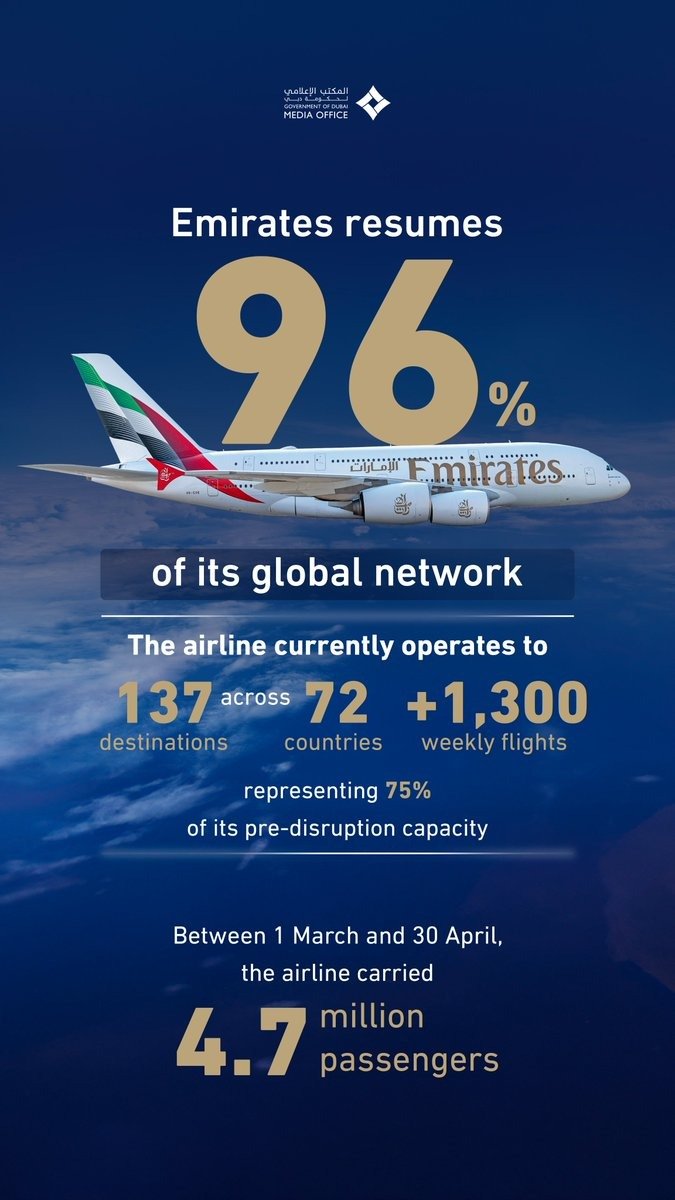
Emirates has resumed 96% of its global network, now flying to 137 destinations across 72 countries with more than 1,300 weekly flights , a near-complete return that puts Dubai back at the centre of intercontinental aviation. For UAE residents and inbound visitors, the recovery translates directly into more nonstop options, shorter connection times at Dubai International Airport (DXB), and stronger fare competition as frequencies continue to climb.
Emirates Resumes 96% Network: 4.7 Million Passengers in Two Months
Between 1 March and 30 April 2026, Emirates carried 4.7 million passengers , a figure that underlines how quickly demand has returned to the airline’s Dubai hub. The carrier is currently running at 75% of its pre-disruption seat capacity, meaning route coverage has outpaced the full restoration of frequencies and aircraft gauge. In plain terms: the destinations are back, but some routes are still building toward their original flight counts and widebody configurations.
The hub-and-spoke model at DXB is designed to funnel long-haul traffic between Asia, Europe, Africa, and the Americas through a single, high-efficiency transfer point. Restoring 137 destinations across 72 countries signals that the critical operational requirements , aircraft availability, crew rostering, airport slot access, and destination-level entry clearances , have stabilised enough to support reliable schedules across all major regions simultaneously.
What the U.S. Network Restoration Means for Dubai Travellers
Emirates fully restored its U.S. network in May 2026, a milestone with direct consequences for travellers moving between the UAE and North America. U.S. routes are among the longest and most operationally demanding services in the Emirates network, requiring consistent aircraft rotation and high load factors to remain viable. The General Civil Aviation Authority (GCAA), which oversees UAE carrier operations and international route approvals, has not announced any restrictions on transatlantic services, and Emirates’ U.S. schedules are now running at full pre-disruption frequency.
| Metric | Current Figure |
|---|---|
| Network restored | 96% of global network |
| Destinations served | 137 across 72 countries |
| Weekly flights | 1,300+ |
| Seat capacity vs. pre-disruption | 75% |
| Passengers carried (Mar, Apr 2026) | 4.7 million |
| U.S. network status | Fully restored , May 2026 |
- Hub airport: Dubai International Airport (DXB), Emirates’ primary long-haul transfer point
- Passenger volume: 4.7 million travellers carried between 1 March and 30 April 2026
- Capacity gap: Route coverage at 96% but total seat capacity still at 75% of pre-disruption levels
- U.S. connectivity: Full U.S. network restored in May 2026, supporting onward connections to South Asia, the Middle East, and Africa via DXB
UAE-based frequent flyers and corporate travel managers planning North America trips in Q2, Q3 2026 now have access to Emirates’ fully restored U.S. schedule, but the 25% capacity gap means premium cabin availability on high-demand routes could remain tight. Travellers should confirm seat availability and book early, and monitor verified schedule updates directly through the Emirates official website or the airline’s verified X account (@emirates).

DIFC-founded fintech Sarwa surpasses USD 1 billion in client assets
Sarwa USD 1 Billion Assets: DIFC Fintech Hits Historic Milestone
Sarwa's achievement of USD 1 billion in assets is now a confirmed reality. The DIFC-founded investment platform has become the first UAE-built fintech to surpass this threshold. For residents using app-based platforms to grow their savings, this milestone shows that digital wealth management in the UAE has moved beyond early adoption and into the financial mainstream.
Sarwa USD 1 Billion Assets: DIFC Ecosystem Named Key Driver
Sarwa, founded in the Dubai International Financial Centre, announced on May 4, 2026, that its total client assets have exceeded USD 1 billion. It is the first UAE-founded fintech to reach this milestone, setting a new standard for locally built digital wealth platforms. This achievement holds significant importance in a market where consumer trust and regulated custody arrangements directly influence adoption rates.
DIFC's structure directly contributed to this growth. The center offers fintech firms clear licensing pathways, proximity to banks and custodians, and a compliance framework focused on investor protection. This environment reduces the friction that usually hinders early-stage financial platforms. Faster product launches, smoother onboarding, and access to professional services all contribute to scalable customer acquisition, propelling a platform from niche to mainstream.
What This Means for UAE Retail Investors
The UAE Securities and Commodities Authority (SCA) and the Dubai Financial Services Authority (DFSA), the regulatory body for the Dubai International Financial Centre (DIFC), have both played significant and influential roles in establishing frameworks that support the growth and regulation of digital investment products.
Sarwa operates effectively within this dynamic and continuously evolving regulatory environment. Its rapid growth signifies a broader and important shift in how residents of the UAE, particularly salaried professionals and first-time investors, approach and manage their personal finance portfolios. Rather than focusing solely on individual stocks, more residents are opting for diversified, app-based portfolios that provide greater convenience and risk management. This growing trend is further driven by the UAE’s substantial and diverse expatriate population, many of whom are actively involved in managing and optimizing cross-border savings and investments.
| Detail | Fact |
|---|---|
| Platform | Sarwa |
| Founded | Dubai International Financial Centre (DIFC) |
| Milestone Reached | USD 1 billion in client assets |
| Date Confirmed | May 4, 2026 |
| First UAE-Founded Fintech to Hit Milestone | Yes (as described by DIFC) |
| Key Growth Drivers | Rising UAE retail investor participation, DIFC regulatory ecosystem |
- Platform Origin: Sarwa was founded inside DIFC, Dubai's primary regulated financial hub
- Assets Milestone: USD 1 billion in total client assets as of May 4, 2026
- Regional First: Described as the first UAE-founded fintech platform to reach this AUM level
- Investor Profile: Growth driven by salaried professionals and first-time investors seeking diversified exposure
- Regulatory Framework: Sarwa operates under DIFC's investor-protection architecture, overseen by the DFSA
Sarwa said the $1 billion milestone reflects rising retail investor participation in the UAE, as more residents shift to diversified, app-based portfolios for long-term savings.

UAE condemns attack on ADNOC-linked vessel in Strait of Hormuz
UAE Strongly Condemns Attack on ADNOC Carrier in Strait of Hormuz
The UAE has condemned an Iranian attack targeting an ADNOC national carrier while it was transiting the Strait of Hormuz on May 4, 2026 , a direct strike on one of the world's most critical energy shipping corridors that sends immediate shockwaves through global freight costs, maritime insurance rates, and regional supply chains.
UAE Condemns Attack ADNOC Carrier: MoFA Issues Official Statement
The UAE Ministry of Foreign Affairs issued an official condemnation of the attack, framing it as a threat to maritime security and the freedom of navigation through the Strait of Hormuz. The UAE also welcomed international condemnation of Iran's actions, signalling a deliberate push to build coordinated global pressure against attacks on commercial and energy shipping infrastructure. The Strait of Hormuz links the Arabian Gulf to the Gulf of Oman and the wider Indian Ocean, and a significant share of globally traded crude oil and liquefied natural gas moves through this narrow corridor every day.
ADNOC is a central pillar of the UAE economy and a major supplier to international energy markets. Its carriers regularly transit the Strait of Hormuz as part of the country's export operations. When a vessel linked to ADNOC is targeted in transit, the consequences extend well beyond a single ship. Shipping operators reassess routing decisions, port call schedules shift, and war-risk insurance premiums rise , costs that cascade through supply chains and eventually reach businesses and consumers across the region.
What This Means for UAE Businesses and Shipping Operators
For logistics firms, energy traders, and importers operating out of Dubai and Abu Dhabi, the attack creates immediate operational pressure. War-risk premiums on vessels transiting the Strait of Hormuz are expected to rise in response to heightened threat perceptions. Charter rates can follow. Dubai's trading and re-export ecosystem , one of the largest in the world , depends heavily on stable Gulf shipping lanes, and any sustained disruption forces companies to increase inventory buffers, widen delivery windows, or explore costlier alternative routes. The UAE Ministry of Foreign Affairs continues to monitor the situation and coordinate with international partners on the diplomatic response.
- Incident Date: May 4, 2026
- Location: Strait of Hormuz, during transit
- Vessel Targeted: ADNOC national carrier
- UAE Response: Official condemnation issued by the Ministry of Foreign Affairs (MoFA)
- International Position: UAE welcomed global condemnation of Iran's actions
- Key Risk: Rising war-risk insurance premiums and potential freight rate increases on Gulf shipping routes
Subsequently in another report, the US Navy announced plans to escort vessels transiting the Strait of Hormuz following the attack, underscoring heightened security risks for commercial shipping in the waterway.
The Ministry of Foreign Affairs said the attack targeted an ADNOC-linked vessel in the Strait of Hormuz, warning it posed a direct threat to regional and global energy security.
The UAE called on Iran to halt actions that endanger international shipping and to reopen the Strait of Hormuz to ensure the uninterrupted flow of maritime trade and energy supplies.

UAE tourist visa guide 2026: visa types, fees, and how to apply
UAE Tourist Visa 2026: Types, Fees and How to Apply
The UAE tourist visa 2026 system gives travellers four clear duration options , 14, 30, 60, and 90 days , with publicly cited fees running from $185 to $235. For the millions of visitors who make Dubai and the wider Emirates a top destination each year, knowing the right visa type, the correct application channel, and the realistic total cost directly shapes flight bookings, hotel stays, and family visit plans.UAE Tourist Visa 2026: Four Durations, One Clear Fee Range
In 2026, the UAE offers tourist visas across four standard durations: 14-day, 30-day, 60-day, and 90-day. These short-stay permissions cover leisure travel, family visits, and brief business trips that do not involve employment. The fee range cited publicly sits between $185 and $235, varying by duration and the channel through which the application is submitted. Travellers applying through intermediaries , airlines, hotels, or licensed travel agencies , should budget for potential add-ons such as service charges, insurance requirements, or processing fees that can push the final checkout total above the base price.Applications reach UAE immigration authorities through two primary routes: official online government portals and UAE embassies or consular channels. The route available to any individual applicant depends on their nationality and where they are applying from. Online applications typically deliver status updates via email, SMS, or portal notifications. Embassy and consular routes follow separate document requirements and processing timelines. Airlines, hotels, and licensed travel agencies can act as sponsors or intermediaries for certain applicant profiles, adding a third practical pathway for some travellers.What This Means for Visitors and UAE-Based Hosts
The Federal Authority for Identity, Citizenship, Customs and Port Security , known as ICP , is the governing authority over UAE visa issuance and the primary official reference for confirmed fees, required documents, and processing timelines. For UAE residents sponsoring visits from family or friends, the choice of application channel directly affects which documents to prepare and how long to wait before confirming travel dates. Booking flights or hotels before a visa is confirmed carries financial risk, particularly during peak windows such as school holidays and major exhibition seasons in Dubai, when demand on processing systems is highest.| Visa Duration | Typical Use Case | Published Fee Range (USD) | Application Channel |
|---|---|---|---|
| 14-Day Tourist Visa | Short leisure trip or transit stay | $185 , $235 | Online portal / UAE embassy |
| 30-Day Tourist Visa | Standard holiday or family visit | $185 , $235 | Online portal / UAE embassy |
| 60-Day Tourist Visa | Extended stay or multi-city itinerary | $185 , $235 | Online portal / UAE embassy |
| 90-Day Tourist Visa | Long-stay visit or extended family stay | $185 , $235 | Online portal / UAE embassy |
- Visa Durations Available: 14-day, 30-day, 60-day, and 90-day tourist visas
- Published Fee Range: $185 to $235, depending on duration and application channel
- Primary Application Routes: UAE ICP online portal or UAE embassies and consular offices
- Additional Cost Risk: Service charges, insurance, and processing fees may apply when using intermediaries
- Governing Authority: ICP (Federal Authority for Identity, Citizenship, Customs and Port Security)
- Status Notifications: Email, SMS, or portal updates depending on the channel used
UAE residents sponsoring visits for family or friends face the most direct exposure to fee and processing changes in 2026, particularly those planning arrivals during Dubai's peak exhibition and school holiday seasons. Confirming the correct application channel before booking flights is essential, as the route chosen determines required documents, processing timelines, and total cost. The ICP official website at icp.gov.ae is the verified source for current fees, document checklists, and any rule updates before payment is made.

UAE airspace: GCAA resumes normal air navigation operations
GCAA UAE Airspace Returns to Full Normal Operations
GCAA UAE airspace has returned to full normal operations. The UAE’s General Civil Aviation Authority (GCAA) announced that normal air navigation operations resumed on May 2, 2026, with all precautionary measures lifted and air traffic returning to normal.
GCAA UAE Airspace: Precautionary Measures Fully Lifted
The General Civil Aviation Authority confirmed the decision following a comprehensive evaluation and coordination with relevant national authorities. The GCAA acknowledged stakeholders for their cooperation throughout the precautionary period, signalling a clean return to baseline air traffic management across UAE airspace.
Under UAE airspace management protocols, the GCAA coordinates directly with air traffic control units to maintain safe separation standards and manage traffic demand. When precautionary measures are active, airlines adjust flight paths, altitudes, and timings on instruction. With those restrictions now removed, carriers can progressively return to planned schedules , though full network recovery typically takes additional hours as aircraft and crews reposition across the system.
What Travellers and Airlines Face Today
Passengers flying through Dubai International Airport and Abu Dhabi International Airport on May 4, 2026 should still check airline apps for gate changes and updated departure times. Even after a formal resumption notice from the GCAA, operational normalization is phased , airlines need time to clear backlogs, re-accommodate disrupted passengers, and restore aircraft rotations. Tightly timed connections remain the highest risk, as disruptions from earlier in the day can ripple through an entire schedule.
- Authority: General Civil Aviation Authority (GCAA) confirmed the resumption
- Measures Lifted: All temporary precautionary air navigation restrictions removed
- Flight Routings: Standard routings and slot plans restored across UAE airspace
- Passenger Action: Check airline apps for same-day schedule updates and gate changes
- Airline Recovery: Full schedule normalization may take several additional rotation cycles
The General Civil Aviation Authority said the decision to resume normal air navigation operations followed coordination with relevant national authorities and a comprehensive evaluation of the situation.Monitor the General Civil Aviation Authority's official channels and your airline's app directly for verified gate and schedule updates.

Dubai RTA cycling tracks and Instagram campaign
Dubai Cycling Tracks: RTA Launches Instagram Win Campaign
Dubai cycling tracks are taking centre stage as the Roads and Transport Authority (RTA) launches a community Instagram campaign, inviting riders across the city to share their favourite routes for a chance to win. The push comes as RTA confirms 13 newly completed cycling tracks, advancing a bold plan to build a 1,000km connected cycling network across Dubai by 2030.
Dubai Cycling Tracks: 13 New Routes Confirmed
RTA is calling on cyclists to capture their rides , whether through desert dunes, mountain terrain, or the city skyline , post them as Instagram Stories, tag @rta_dubai, and use the hashtag #DubaiThroughtheEyesofCyclists for a chance to win. The campaign runs across RTA's official social channels and is open to all Dubai-based riders.
The 13 newly completed tracks are part of a structured infrastructure rollout designed to move cycling beyond recreational loops. RTA's programme links residential communities with commercial centres, public spaces, and leisure destinations , positioning cycling as a practical first-and-last-mile option that connects directly with Dubai's wider public transport network.
What This Means for Dubai Cyclists and Commuters
The Roads and Transport Authority is building dedicated, separated cycling facilities with clearly marked crossings , a design approach that reduces conflict points between cyclists, pedestrians, and vehicles. For families, new riders, and daily commuters navigating Dubai's high-speed road network, continuous and connected tracks remove one of the biggest barriers to cycling: the confidence to complete an entire journey without switching to fragmented or unprotected segments.
| Detail | Confirmed Information |
|---|---|
| New Tracks Completed | 13 cycling tracks |
| Network Target | 1,000km by 2030 |
| Campaign Platform | Instagram Stories |
| Tag Required | @rta_dubai |
| Hashtag Required | #DubaiThroughtheEyesofCyclists |
| Route Types Covered | Desert, mountain, and city skyline |
- Infrastructure Goal: 1,000km of cycling tracks across Dubai by 2030
- Tracks Completed: 13 new cycling tracks added to the existing RTA network
- Campaign Mechanic: Post an Instagram Story, tag @rta_dubai, and use #DubaiThroughtheEyesofCyclists to enter
- Mobility Purpose: Tracks are designed as connected corridors, not standalone leisure loops, supporting first-and-last-mile travel
Dubai-based cyclists and active commuters are the group most directly exposed to this expansion, with 13 new tracks now operational and a 1,000km network target set for 2030. Riders who engage with the #DubaiThroughtheEyesofCyclists campaign gain early visibility into new routes while contributing to a community feedback loop that can shape future track priorities, lighting, and rest points. Follow @rta_dubai on Instagram and RTA's official website for verified route maps and campaign updates.