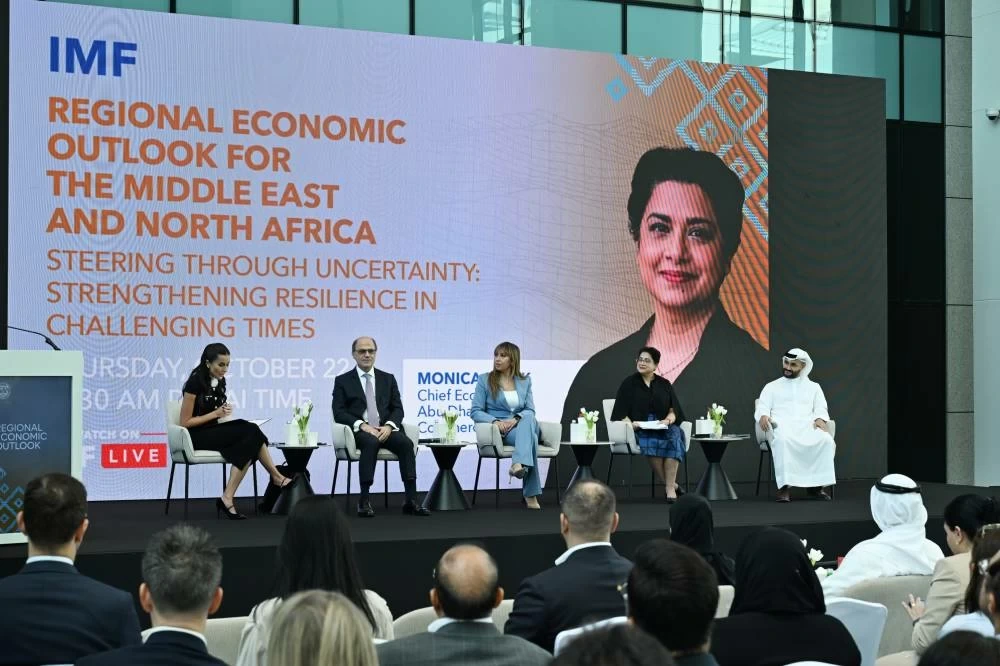
The International Monetary Fund now expects the UAE economy to grow 7.7% in 2027, an upgrade of 2.4 percentage points from its April projection. The figure comes from the IMF’s October 2026 Regional Economic Outlook for the Middle East and Central Asia, presented on Thursday 22 October 2026 at a press conference in Dubai organised by the Dubai International Financial Centre (DIFC) in cooperation with the fund.
The findings were presented by Jihad Azour, Director of the IMF’s Middle East and Central Asia Department, under the theme “Resilience in the Face of Challenges: Diverging Economic Outlooks in the Middle East and North Africa.” The IMF said continued investment in artificial intelligence could add about 0.5 percentage points to the UAE’s annual economic growth, and put the effect across the wider region at between 0.1 and 0.6 percentage points over the medium term.
The report also looked at the Gulf Cooperation Council as a whole. It projects GCC inflation of 2.4% in 2027 and about 2% from 2028. The IMF also pointed to its support for member countries, around $48 billion in financing since 2020 and 437 technical assistance projects across 31 countries in its 2026 financial year.
The 7.7% figure is a forecast, not a result, and it sits alongside the IMF’s much weaker projection for the Gulf as a whole in 2026. The open questions are how much of the rebound depends on energy exports and shipping returning to normal, and whether investment in artificial intelligence reaches the scale the IMF assumes. The wider regional picture is covered in our report on the IMF’s outlook for Gulf economies in 2026 and 2027.