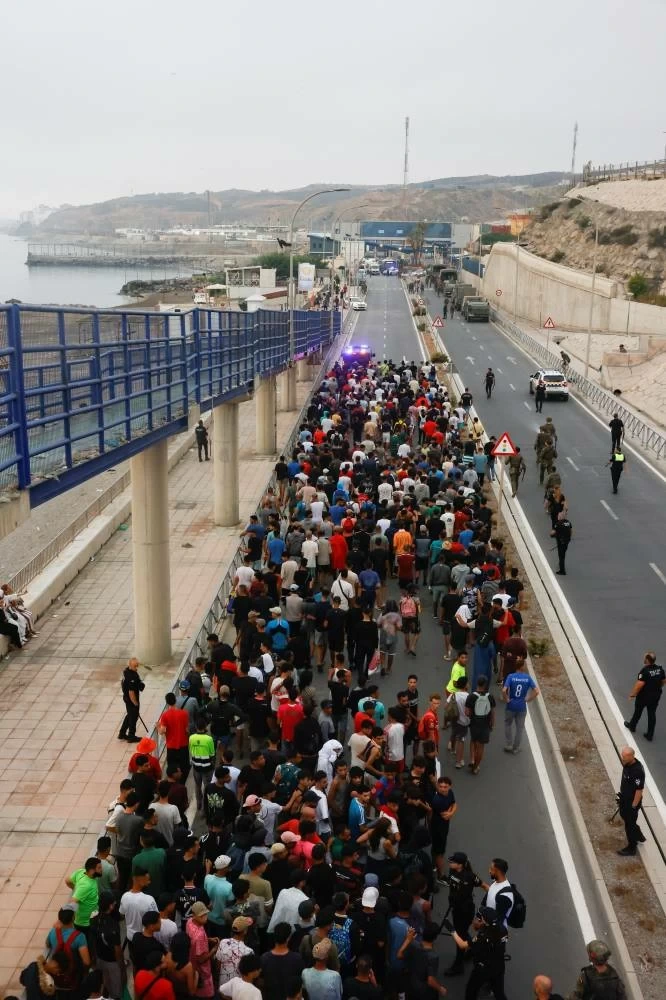
Ceuta Border Gets 500m Floating Barrier
Spain has installed a 500-metre floating barrier in its North African enclave of Ceuta following an unprecedented rush of approximately 50,000 migrants from Morocco, which resulted in at least 67 deaths. Migrants, mostly young Moroccan men seeking work, had crossed into Ceuta by land and sea, prompting Spanish authorities to reinforce border controls.
The floating barrier, installed by Civil Guard police, is designed to stand 30 to 70 centimetres above water and extend as much as one metre below the surface, with a channel between the barriers allowing Civil Guard vessels to patrol the area. According to Spanish authorities, about 48,300 of the roughly 50,000 to 60,000 people who entered from Morocco had returned there by late Friday afternoon.
The installation of the barrier comes after Prime Minister Pedro Sánchez announced that the country would install buoys to create a containment barrier, a physical barrier, if only a visual one, to strengthen the border, complying with a recent ruling from Spain’s Supreme Court that prompted the influx of migrants this week.
In contrast to most of Europe, Spain has adopted a more open stance on migrants, introducing a programme to grant residency to more than half a million undocumented people, although it has rejected suggestions that the regularisation scheme had encouraged the rush into Ceuta.


UEFA No Confidence Infantino After World Cup Investment Plan Scrapped
FIFA Chief Loses UEFA Confidence Over Axed World Cup Stake Sale
UEFA has lost confidence in FIFA President Gianni Infantino after his plan to sell stakes in the World Cup to private investors was scrapped. The proposal, which met with fierce opposition from governing bodies across Europe, Asia, and South America, was abandoned late last night. UEFA insisted its nations would boycott FIFA tournaments if the plan had gone ahead, and now the European football body is calling for a full review and accountability, accusing Infantino of a "shabby, back room, opaque" deal.
Infantino's senior adviser, Carlos Cado, resigned yesterday, and FIFA's chief operating officer, Kevin Lamour, described the project as one that "couldn't be accepted" by UEFA or its national associations. UEFA believes Infantino has lost the trust of the football world and is demanding a review of his leadership. The FIFA President's current term expires in 2027, and he is due to stand for re-election in March.
The scrapped plan would have allowed private investors to buy stakes in flagship football events such as the World Cup, with Infantino proposing to spin off FIFA's commercial businesses into a $20 billion subsidiary, 20% of which would be owned by private investors. However, the plan was met with fierce opposition, and UEFA has now declared that it has lost confidence in Infantino's leadership.
The UEFA statement concluded that the proposal's abandonment is a victory for the whole game, but it must not be the end of the story. The task of rebuilding trust in FIFA has only just begun. Challengers to Infantino must submit their candidacies for the March election by November 18.
In the context of FIFA's governance, this development comes after years of controversy surrounding Infantino's leadership, including criticism over his handling of FIFA's financial resources and his commitment to transparency. The abandonment of the World Cup investment plan and the loss of confidence from UEFA mark a significant turning point in the FIFA President's tenure.

US Embassy Issues Warning to Americans in UAE
US Embassy Warns Americans to Leave Middle East Amid Escalating Conflict
US embassies in the Middle East, including the UAE, have issued a security alert urging American citizens to consider departing the region due to potential escalation in the ongoing conflict. Americans in the region should exercise caution and heightened vigilance, and be prepared for flight cancellations, periodic airspace closures, and potential travel disruptions. The warning comes a day after US President Donald Trump threatened to hit Iran "very hard", and amid a backdrop of heightened tensions between the US, Israel, and Iran.
The security alert, posted online by US embassies in Bahrain, Iraq, Israel, Jordan, Kuwait, Lebanon, Oman, Qatar, Saudi Arabia, and the UAE, advises Americans to check flight details and follow safety advice from local authorities. Americans in Jordan were told not to visit US military bases, which have recently come under Iranian missile attack, and in Israel, they were urged to seek the location of the nearest bomb shelter.
The US embassy in Beirut said that the mission remained on "ordered departure status", meaning that non-emergency US government personnel were still relocated outside of Lebanon. The warning highlights the unpredictable nature of the Iranian regime, which has recently attacked areas in the region without warning or provocations.
The conflict between the US, Israel, and Iran has been ongoing since February 28, with a period of calm following a ceasefire, though that collapsed with a return of strikes. The war has upended the lives of people across the Middle East and rattled global energy markets.
The US embassy's warning is a clear indication of the escalating tensions in the region, and American citizens are advised to take necessary precautions to ensure their safety.
In a related development, Iran's military on Saturday accused Washington of "escalating tensions" in the region. The US has reported a wave of strikes on Iran, as the war returns.
The security alert is a reminder of the ongoing conflict in the Middle East and the potential risks associated with traveling to the region. American citizens are urged to stay informed and follow the instructions of local authorities to ensure their safety.

France Wildfire: 42,000 Hectares Scorched
Bordeaux Fire Contained After Burning 42,000 Hectares
France's largest wildfire since 1949, which erupted near the southwestern city of Bordeaux, has been brought under control, according to Interior Minister Laurent Nunez. The fire, which started over a week ago, scorched 42,000 hectares of pine forest along the Atlantic coastline, forcing 220,000 people to evacuate and destroying around 240 homes. Local inhabitants allege that a brushwood-clearing machine accidentally started the blaze with a spark.
The fire is no longer progressing, although some areas remain active, said Minister Nunez. France has been battling wildfires for weeks, following a series of deadly heatwaves that have dried up riverbeds and vegetation, extreme weather events linked to human-made climate change. The total area of land burnt so far this year in France is the largest on record for any year over the past 20 years, with 92,000 hectares burnt, according to satellite data from the European Forest Fire Information System (EFFIS).
In the Gironde region, near Bordeaux, more than 2,000 firefighters and 500 firefighting vehicles have been deployed to combat the fire, alongside gendarmerie and army personnel. Residents have been urged not to return home while operations continue, with 17 temporary accommodation sites opened up. The wildfire is the largest in France since 1949, with French Prime Minister François Bayrou calling it a "catastrophe on an unprecedented scale".
This wildfire is connected to a prior story about the extreme weather events in Europe, where scientists have linked the deadly heatwaves to human-made climate change.

Total Solar Eclipse 2026: Millions to Witness Rare Event
96% Sun Obscuration Expected in North Africa During Rare Eclipse
Millions of skywatchers are expected to turn their eyes to the heavens on August 12, 2026, when a rare total solar eclipse unfolds. While the path of totality will bypass the Arab world, parts of North Africa, particularly the Maghreb, are set to witness an unusually deep partial eclipse, with as much as 96% of the Sun's disc obscured in some areas.
The total solar eclipse will occur at the Moon's descending node of orbit on August 12, 2026, with a magnitude of 1.0386. The path of totality will be visible across parts of Greenland, Iceland, Spain, and northern Russia. The eclipse will also be visible as a partial eclipse in other parts of Europe, the UK, Ireland, and parts of northern Canada and the US. However, the UAE, Gulf states, Egypt, Iraq, the Levant, and Libya will not witness the event significantly.
Astronomers expect the August 12, 2026 eclipse to attract millions of observers worldwide, with travelers, photographers, and astronomy enthusiasts expected to gather along the path of totality. The total phase of the eclipse will also allow the normally hidden solar corona to become visible, a phenomenon impossible to observe under ordinary daylight conditions.
In North Africa, Algeria and Morocco will enjoy the region's best views, with up to 96% of the Sun's disc obscured. The deep partial eclipse will provide a unique opportunity for skywatchers in the region to witness this rare astronomical event.
The solar eclipse is a rare and awe-inspiring event that occurs when the Moon passes directly between the Earth and the Sun, blocking sunlight and creating a shadow on Earth. The eclipse will occur about 2.2 days after perigee, which means the Moon's apparent diameter will be larger, making the eclipse more pronounced.
For those planning to witness the eclipse, it is essential to take necessary precautions to ensure safe viewing. The eclipse will be visible in the late afternoon or early evening in most parts of the world, and skywatchers should be prepared with proper eye protection and equipment to enjoy this rare event.
In conclusion, the total solar eclipse on August 12, 2026, will be a rare and spectacular event that will captivate millions of skywatchers worldwide. While the path of totality will bypass the Arab world, parts of North Africa will experience a deep partial eclipse, making it an exciting opportunity for astronomy enthusiasts in the region.
UAE travel: Flight updates amid Iran conflict
UAE Travel Disrupted: Check Flights, Airport Updates as Iran Conflict Unfolds
For UAE residents, the ongoing conflict between the US and Iran has brought significant disruptions to travel plans. With flights cancelled or delayed, and airspace closures in place, it's essential to stay informed about the latest developments. As of today, UAE airspace has partially reopened, with limited flights operating from Dubai International, Dubai World Central, and Zayed International Airport.
UAE residents planning to travel should check their flight status before heading to the airport and allow extra time for check-in, security, and immigration procedures. It's also crucial to follow airline and airport updates, as well as monitor official government travel advisories. Avoid relying on unofficial social media updates, as they may not provide accurate information.
The conflict has led to mass flight delays and cancellations, disrupting the travel plans of thousands of passengers. Israeli airspace remains heavily restricted, with many international carriers continuing to suspend services or pause routes. In the UAE, services remain selective, and passengers are being contacted directly by airlines if booked on operating flights.
As the situation continues to unfold, UAE residents should stay vigilant and up-to-date with the latest news and developments. With the US pausing planned military strikes on Iran, there may be a brief respite, but the situation remains volatile. Oil prices have fallen more than two percent in early Asian trade, following strong gains in recent days due to the conflict in the Middle East.
In this complex and rapidly changing situation, it's essential for UAE residents to prioritize their safety and stay informed about the latest developments. By checking flight status, allowing extra time for airport procedures, and monitoring official travel advisories, residents can navigate the disruptions caused by the Iran conflict.
The UAE's Armed Forces are ready for any potential action, and the country is working to de-escalate tensions in the region. As the situation continues to evolve, UAE residents should remain cautious and prepared for any eventuality.
In the context of the UAE's strategic development plans, this situation highlights the importance of being prepared for unexpected events and having contingency plans in place. While there is no direct connection to a specific emirate-level plan, the UAE's focus on resilience and adaptability will be crucial in navigating the challenges posed by the Iran conflict.