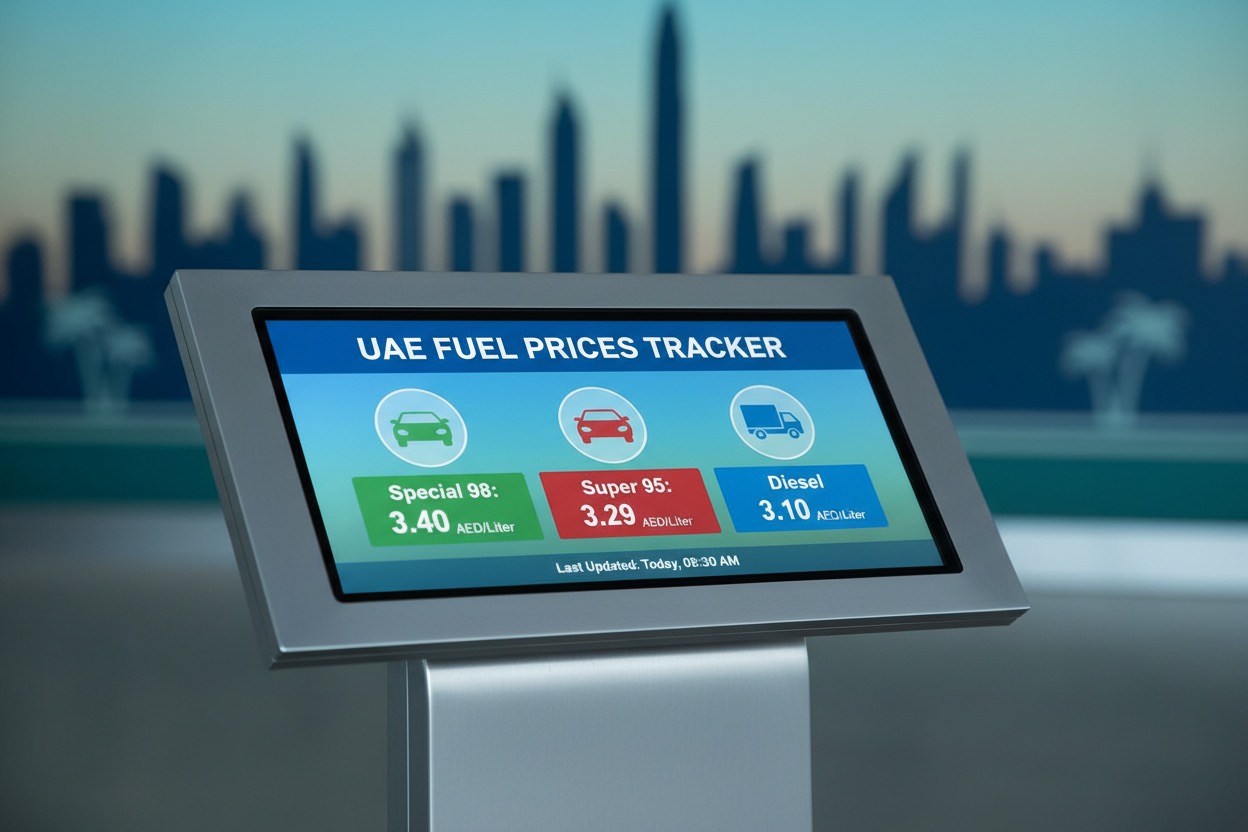
Stay ahead of your monthly commute expenses with our live UAE Fuel Prices tracker, offering the most accurate and current rates for Super 98, Special 95, E-Plus 91 and Diesel throughout the Emirates. Monitored by the UAE Ministry of Energy and Infrastructure, these prices are refreshed on the last day of each month to mirror global oil market trends, ensuring you have the latest information for effective budgeting in Dubai, Abu Dhabi, and beyond.
UAE Fuel Prices
UAE FUEL PRICES
| Super 98 | High 4.40 (Oct) | Low 2.45 (Feb) |
| Special 95 | High 4.28 (Oct) | Low 2.33 (Feb) |
| E-Plus 91 | High 4.21 (Oct) | Low 2.26 (Feb) |
| Diesel | High 4.80 (Oct) | Low 2.52 (Feb) |
The UAE deregulated fuel pricing in 2015, so retail petrol and diesel prices now follow a formula tied to average international oil benchmarks from the prior month, rather than being fixed indefinitely by the government. Unlike countries where pump prices shift daily, the UAE Fuel Price Committee sets one rate for the entire upcoming calendar month and announces it on the last day of the current month. This means the price you see today is locked in for the rest of this month, regardless of what happens in global oil markets in the meantime.
How UAE Fuel Prices Are Set
Unlike several of its Gulf neighbours, the UAE does not subsidise or fix fuel prices. In August 2015, the UAE Cabinet deregulated the petrol and diesel market, linking retail prices directly to international oil benchmarks rather than government-controlled rates. A dedicated Fuel Price Committee reviews global crude and refined-product prices each month and publishes new rates for the following month, typically announced on the last day of the month and taking effect from the 1st.
This system means UAE motorists feel global oil market swings faster than drivers in Kuwait, Qatar, or Bahrain — but it also means the UAE passes on falling prices just as quickly when global crude eases, rather than absorbing losses through a subsidy fund the way more heavily regulated markets do.
The 2026 UAE Fuel Price Story So Far
2026 has been an unusually volatile year for UAE motorists, and it’s worth understanding why, because the story behind the numbers is genuinely one of the year’s biggest regional economic events.
April–May 2026: The UAE Exits OPEC
On 28 April 2026, the UAE announced its exit from OPEC and the wider OPEC+ alliance, effective 1 May — ending nearly six decades of membership. The UAE had been producing under an OPEC+ quota capped well below its actual capacity of around 4.85 million barrels per day, with the government targeting 5 million bpd by 2027 on the back of roughly $145 billion in planned upstream investment. Freed from quota constraints, the UAE signalled it intended to pump closer to its full capacity.
Analysts were split on the implication: some saw it as a long-term bearish signal for oil prices, since more UAE barrels outside coordinated OPEC+ limits would eventually mean more global supply. Others warned that losing one of OPEC’s largest producers weakened the group’s ability to manage prices during a crisis — which mattered a great deal, because a crisis was already unfolding.
May–June 2026: The Iran Conflict and the Hormuz Shock
At the same time as the OPEC exit, an escalating conflict involving Iran disrupted shipping through the Strait of Hormuz — the narrow waterway that normally carries roughly a fifth of the world’s seaborne oil and gas. With the Strait effectively closed to normal traffic, Brent crude spiked above $117 a barrel, and UAE fuel prices climbed for three consecutive months, reaching some of the highest levels UAE drivers had seen since the 2022 energy crisis that followed the Russia-Ukraine war.
July 2026: A Sharp Correction
As the Hormuz disruption began to ease and global oil markets stabilised, the UAE Fuel Price Committee delivered one of the largest single-month price drops in years, cutting rates across all four fuel grades by a significant margin in one announcement.
August–October 2026: Three Monthly Rises in a Row
Prices dipped in July and then turned upward again. Super 98 rose from Dh3.40 in July to Dh3.60 in August and Dh3.80 in September, before the October announcement added a further 60 fils to reach Dh4.40 a litre, a rise of about 16 per cent. Special 95 moved from Dh3.69 to Dh4.28 and E-Plus 91 from Dh3.61 to Dh4.21 over the same step, while diesel climbed from Dh4.30 to Dh4.80.
The Fuel Price Committee, which is chaired by the Ministry of Energy and Infrastructure, approved the October rates under the UAE’s monthly pricing mechanism, which reflects global energy price movements while meeting local market needs.
Current prices, and how they compare to last month, are shown live in the price tracker above — this section covers the underlying story, not the up-to-the-minute numbers.
How UAE Fuel Prices Compare Across the GCC
Despite operating one of the most transparent, market-linked pricing systems in the region, the UAE is typically not the cheapest place to fill up in the Gulf. Kuwait tends to be the cheapest by a wide margin, thanks to deep government subsidies that keep pump prices largely insulated from global swings. Saudi Arabia, Qatar, Oman, and Bahrain generally sit in the middle, using varying degrees of price caps and partial subsidy. The UAE’s full market-link approach means it tends to sit above the rest of the GCC in dirham terms — even though, on a global scale, UAE prices remain moderate compared to Europe, where fuel duties push per-litre costs several times higher.
Because every GCC country sets its own rates on its own monthly or ad hoc schedule, exact comparative figures shift independently of the UAE’s own price cycle — for a snapshot of current regional pricing, GCC government energy ministry sites and fuel price aggregators are updated more frequently than this page.
What a Fuel Price Change Actually Costs You
A change of even a few fils per litre adds up quickly for regular UAE drivers. As a rough rule of thumb: a commuter driving 60km a day round-trip in an average sedan (roughly 8L/100km) burns close to 150 litres a month. Multiply that monthly litre figure by however many fils per litre a given month’s price moved, and you’ll get a reasonable estimate of the change to your monthly fuel spend. Scaled up across a household with two vehicles, or a delivery fleet running dozens of vehicles daily, even modest monthly swings can shift transport costs by hundreds or thousands of dirhams over a year.
This is also why fuel prices ripple into other parts of UAE life: commuting costs from outer communities rise and fall with the pump price, and companies offering transport allowances or running delivery-heavy operations feel monthly announcements directly on their bottom line.
Tips for Managing Fuel Costs in the UAE
- Time non-urgent fill-ups around the monthly announcement. If a price drop is expected, topping up just after the 1st, rather than at the end of the prior month, can save money on larger fill-ups.
- Choose the right octane for your engine. Many newer UAE vehicles run fine on Special 95 rather than Super 98 — check your manufacturer’s recommendation rather than defaulting to premium.
- Combine errands to reduce total distance. With UAE prices typically among the highest in the GCC, reducing unnecessary trips has a more direct financial impact than in more heavily subsidised neighbouring markets.
- Track the trend, not just the month. A single month’s price doesn’t tell you much on its own — UAE fuel prices can move substantially within a single year, so budgeting around a 3-6 month average is more realistic than assuming any one month’s rate will hold.
Frequently Asked Questions
How often do fuel prices change in the UAE?
The UAE Fuel Price Committee reviews and announces new petrol and diesel prices once a month, on the last day of the month, with new rates taking effect from the 1st of the following month.
Why are UAE fuel prices not fixed like in Saudi Arabia or Kuwait?
The UAE deregulated its fuel market in August 2015, tying retail petrol and diesel prices directly to international benchmark oil prices. This means UAE motorists feel global price swings faster than drivers in more heavily subsidised GCC markets like Kuwait, Qatar, and Saudi Arabia, but they also benefit sooner when global prices fall.
Is fuel generally cheaper in the UAE than in other GCC countries?
Generally, no. Because the UAE fully deregulated its fuel market and links prices directly to global benchmarks, it tends to run higher than more heavily subsidised neighbours such as Kuwait, Qatar, Saudi Arabia, Oman, and Bahrain, which cushion consumers from global price swings through varying degrees of subsidy.
How is the UAE petrol price calculated?
Since deregulation in 2015, the UAE Fuel Price Committee sets monthly retail rates based on prevailing international oil benchmark prices, rather than a government-fixed rate. This keeps pump prices closely aligned with global crude and refined-product markets. See the tracker above for the current confirmed rate.
Why did UAE fuel prices rise in October 2026?
Petrol prices were raised by about 60 fils a litre for October, around 16 per cent. The Fuel Price Committee approved the new rates under the UAE’s monthly pricing mechanism, which reflects global energy price movements. Because prices are linked to international benchmarks, each month’s rates follow the market.
Are fuel prices the same at all petrol stations in the UAE?
Yes. The monthly rates announced by the Fuel Price Committee apply across the country, so Super 98, Special 95, E-Plus 91 and diesel cost the same at ADNOC, ENOC, EPPCO and other stations in every emirate.
Do UAE fuel prices change daily?
No. The UAE sets one price per fuel grade for the whole calendar month. The new rates are announced on the last day of the previous month and take effect on the 1st.
How This Page Is Updated
Prices on this page are the monthly rates announced by the UAE’s fuel price committee, which is chaired by the Ministry of Energy and Infrastructure (see the UAE government’s official fuel price information), and are shown in UAE dirhams per litre. The tracker is updated each month after the announcement by the My Dubai Today editorial team, and the page’s last-updated date reflects the most recent price change.
Historical account current as of publication. Live current-month prices, trends, and comparisons are shown in the price tracker at the top of this page.