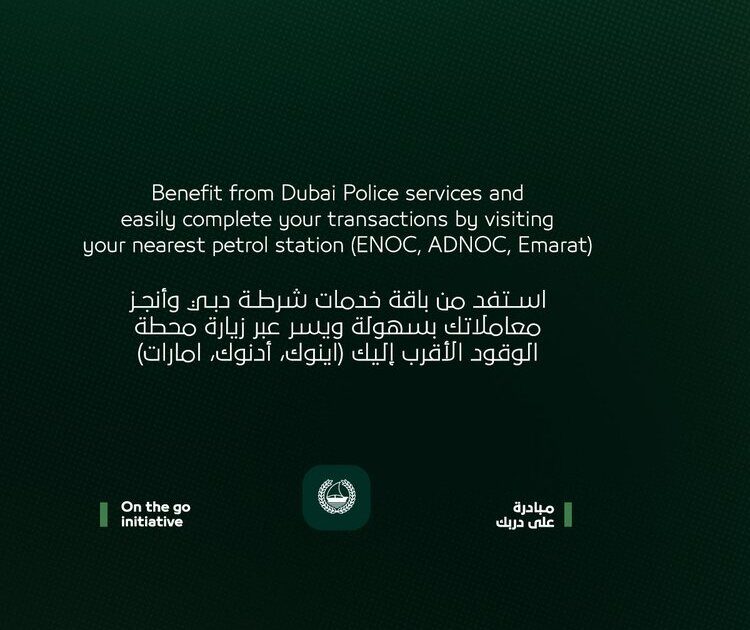
Dubai Police On the Go initiative allows drivers involved in minor Traffic accidents in Dubai to obtain a minor accident report at nearby ADNOC, ENOC or Emarat petrol stations, without waiting for a police patrol, authorities said.
Key Takeaways: Reporting minor Accidents via fuel stations
- Go to ADNOC, ENOC or Emarat stations for help issuing a minor accident report Dubai.
- Authorities said minor traffic accidents do not require waiting for a police patrol.
- The approach supports Road Safety by reducing roadside congestion and keeping roads clear.
Where to report minor accident UAE without waiting for a police patrol
Authorities said drivers can visit the nearest ADNOC, ENOC or Emarat fuel station, where trained staff will help issue a minor traffic accident report under Dubai Police services.
Authorities said the stations can help drivers obtain a minor accident report as minor traffic accidents do not require waiting for a police patrol.
UAE road-safety guidance commonly instructs motorists to move vehicles to a safe location after minor crashes, where there are no injuries and vehicles are drivable, to avoid blocking traffic.
This guidance applies to minor traffic accidents, typically where there are no injuries and vehicles are still movable, supporting faster clearance under UAE traffic rules and Road Safety policy.
This on the go initiative Public Service option is intended to reduce congestion and speed up documentation commonly needed for an insurance claim and vehicle repair processes, while supporting Road Safety in UAE Traffic incidents.
Other traffic accident reporting options in the UAE, including the Saed app
Across the UAE, motorists may also be directed to use digital reporting channels such as the Saed app for minor accident reporting, depending on the emirate and the circumstances.


Spain migrant minors transfer within weeks
1,342 Migrant Minors to be Transferred from Ceuta to Mainland Spain
Spain's leftist government expects to transfer some migrant minors from overcrowded reception centres in the North African enclave of Ceuta to the mainland within weeks. Youth Minister Sira Rego stated that 1,342 minors have been registered so far, and more staff will be drafted in to help the effort. The transfer aims to alleviate the migration crisis in Ceuta after a deadly border rush last week, in which as many as 72,000 migrants illegally crossed into Ceuta from Morocco, resulting in dozens of deaths.
The situation in Ceuta remains challenging, with many unaccompanied minors still in the territory. Rego acknowledged the "painful images" of children sleeping rough on Ceuta's streets and announced that two schools have been opened and more spaces will be evaluated as potential reception centres. Priority will be given to girls and boys under 13 for the transfer to the mainland.
The far-right opposition has raised objections to the transfers, citing concerns about regional authorities' ability to handle the reception of migrant minors on the mainland. Meanwhile, Morocco has expressed its readiness to cooperate with Spain on the return of unaccompanied minors who crossed into Ceuta last week. Spain will evaluate Morocco's offer on a case-by-case basis, with Rego emphasizing that the country will prioritize the safeguarding of children's rights.
1,100 unaccompanied minors who arrived before the border rush have saturated the local facilities, which can host up to 90 children. NGOs and resident groups estimate that the total number of minors could be several thousand. The Spanish government's efforts to transfer the migrant minors to the mainland are expected to provide some relief to the overcrowded reception centres in Ceuta.
The migration crisis in Ceuta is not a new issue, with the territory experiencing a major border rush in 2021, when 8,000 people crossed the border. However, Rego noted that the profile of child migrants has changed in the past five years, with more unaccompanied girls and very young children arriving in Ceuta.

Trump White House Ballroom Construction Halted By US Federal Appeals Court Order
Trump's $600 Million White House Ballroom Project Halted
A US federal appeals court has ordered a halt to construction on President Donald Trump's planned White House ballroom, ruling that the project requires congressional authorization. The US Court of Appeals for the DC Circuit upheld a lower court's decision, stating that such a massive White House overhaul needs the explicit consent of Congress. The court granted a two-week stay to allow the Trump Administration time to appeal the ruling to the US Supreme Court.
The Trump Administration had argued that only Congress could stop the construction, but the appeals court disagreed, with two judges appointed by Democratic presidents forming the majority. The dissenting judge was nominated by Trump himself. The president has vowed to immediately appeal to the Supreme Court, calling the ruling "horrendous, politically motivated, and unlawful." Trump has repeatedly pointed to the addition of an underground military bunker and other security features as reasons for the project, which he claims is necessary for national security.
The construction of the ballroom, which could cost as much as $600 million, began last year with the demolition of the White House's historic East Wing. While the White House initially cited a $200 million price tag, it quickly doubled the estimate to $400 million. The project is one of several of Trump's pet projects aimed at leaving his mark on Washington before he leaves office in 2029.
The US Court of Appeals for the DC Circuit's decision is connected to a prior ruling that major White House structural overhauls require explicit authorization from Congress, a principle that has been tested in several of Trump's other projects, including a renovation of the Lincoln Memorial Reflecting Pool.

ADNOC Tanker Attack in Strait of Hormuz
Missile Strikes ADNOC Vessel in Hormuz
A missile attack has targeted an ADNOC commercial tanker in the Strait of Hormuz, prompting strong condemnation from UAE officials. The attack on the ADNOC vessel is the latest incident to disrupt commercial shipping lanes in the region, with Oman reporting ongoing talks to ease tensions alongside warnings of threats to maritime trade.
The UAE has condemned the missile attack on the ADNOC tanker, with officials emphasizing the need to protect commercial shipping and ensure the safe passage of vessels through the Strait of Hormuz. Regional diplomatic channels remain active, with Oman playing a key role in efforts to reduce tensions and prevent further attacks on commercial shipping.
The attack on the ADNOC tanker is a significant escalation of the maritime crisis in the Strait of Hormuz, with heightened military tensions posing a major threat to commercial shipping and global trade. The UAE's strong condemnation of the attack reflects the country's commitment to protecting its shipping interests and ensuring the safety of its vessels and crew.
In recent weeks, the Strait of Hormuz has witnessed a surge in military activity, with several incidents of ships being targeted or seized by Iranian forces. The latest attack on the ADNOC tanker has raised concerns about the safety of commercial shipping in the region and the potential for further escalation.
The UAE's response to the attack has been swift and decisive, with officials calling for increased security measures to protect commercial shipping and prevent further incidents. The country's shipping industry is a critical component of its economy, and the UAE is taking all necessary steps to ensure the safe passage of its vessels and crew.

Nazi Warships Exposed in Danube River
Sunken Nazi Fleet Emerges in Danube River Amid Heatwave
The Danube River, Europe's second-longest river, has reached record-low water levels due to extreme heatwaves, exposing dozens of sunken World War II Nazi warships near Prahovo, Serbia. The ships, which were sunk by the Germans in 1944 to block the Soviet Union's forces, have been a hazard for navigation, and their emergence has prompted the Serbian government to initiate a salvage operation.
The salvage operation, which began in 2020 and is expected to cost 23 million euros, aims to raise up to 80 of the sunken ships, including minesweepers, patrol boats, and artillery vessels. The operation has become more urgent due to the presence of unexploded ordnance on some of the wrecks, posing a risk to passing boats. President Aleksandar Vucic of Serbia has promised a cleanup of the Danube River, aiming to make its waters "as clear as they are in Vienna."
The heatwave has not only affected the Danube River but also other countries in the region. In Hungary, the receding water levels nearly forced the shutdown of the Paks nuclear power plant, while in Poland, temperatures reached over 40°C, prompting the prime minister to urge companies to let employees work from home or take precautions. In Slovakia, the police detonated a 1,543-pound World War II bomb that appeared as the Danube receded.
The Serbian government's efforts to salvage the sunken ships are crucial to ensuring the safety of commercial vessels and the environment. The operation is expected to take time, but it is a necessary step to mitigate the risks posed by the exposed wrecks. As the heatwave continues to affect the region, it is essential to monitor the situation and take necessary precautions to prevent any further hazards.
For local residents and fishermen, the emergence of the sunken ships has been a concern. Igor Skodric, a local fisherman, noted that the wrecks appear almost every year, but this year the water level is extremely low, making it difficult to navigate. The salvage operation is a welcome relief for the community, as it will help to restore the river to its former state.
As the situation continues to unfold, it is essential to follow the updates and take necessary precautions. The Serbian government's efforts to address the issue are commendable, and it is crucial to support their initiatives to ensure the safety of the Danube River and its surroundings.

Maradona Hand of God ball auction
$10 Million Ball: Maradona's Hand of God Up for Auction
The soccer ball used by Diego Maradona to score his infamous "Hand of God" goal in the 1986 World Cup is expected to sell for $10 million at a US auction. The ball, which is being auctioned by Heritage Auctions in Texas, was used by Maradona in the quarter-final match between Argentina and England, which Argentina won 2-1. Football collectors and fans are affected as they will have the opportunity to bid on this historic piece of sports memorabilia from August 21 to 23, with an opening bid of $2.5 million.
The ball is considered one of the most historic in the realm of soccer, as it was also used by Maradona to score the "Goal of the Century" in the same match. Dan Imler, vice president of sports at Heritage Auctions, noted that both goals scored by Maradona in that match are iconic and memorable. The auction of this ball is a significant event for sports memorabilia collectors, as it provides a rare opportunity to own a piece of football history.
The "Hand of God" ball is not the only notable item of Maradona's to be sold at auction. The jersey he wore during the Argentina-England clash currently holds the record for the most expensive soccer shirt, selling for $9.3 million. The sale of the ball is expected to attract significant attention from football fans and collectors around the world.
The auction of the "Hand of God" ball is connected to the recent sale of Pelé's 1958 World Cup final jersey, which sold for a record $4.9 million at a New York auction. This highlights the growing demand for sports memorabilia and the significant value that can be attached to historic items.