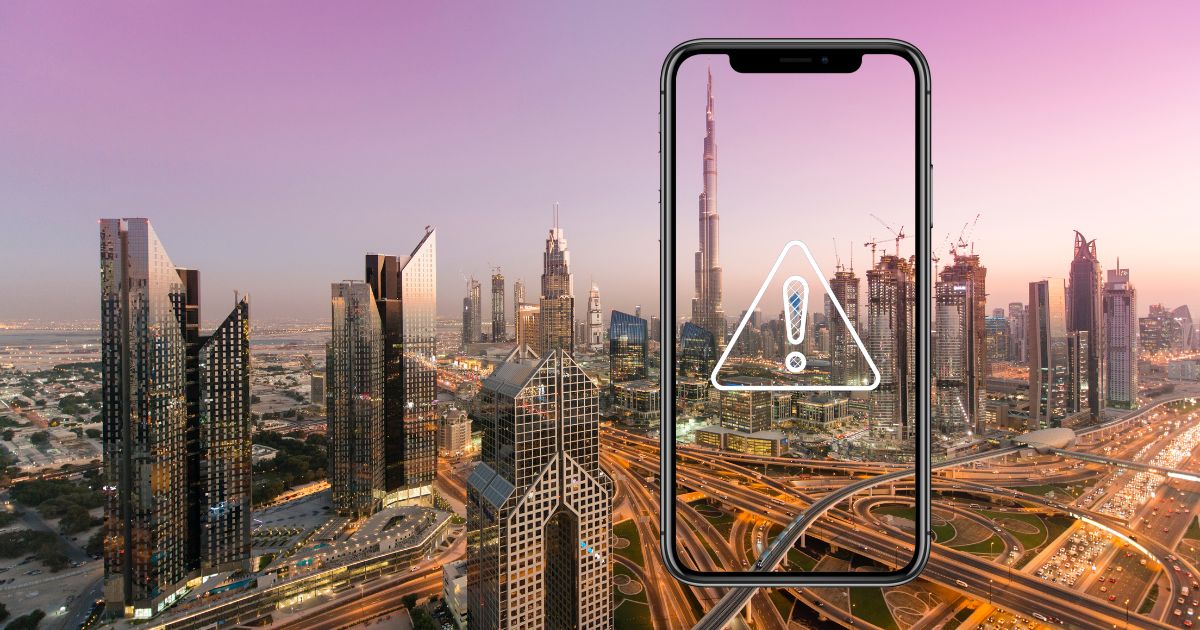
You’re in Dubai or wider UAE, your phone blares an emergency notification, and within seconds your WhatsApp group chat is chaos. Half the group swears they got nothing. It feels random, even unfair, and the first thought is usually the same: why didn’t I get the emergency alert, or why did I get it when others didn’t?
Here’s the real-world explanation from National Emergency Crisis and Disaster Management Authority (NCEMA): UAE emergency alerts are built to be targeted. They are sent based on location, so only people in the affected area, or an area considered at risk, may receive the message. That is the point of the UAE public warning system. It aims to protect people who need to act, without alarming everyone else across the country.
This is important now because the UAE often uses official public safety messages for quickly changing situations, like severe weather, major traffic jams, industrial accidents, and regional security issues, including missile warnings that residents have talked about a lot. In crowded cities where people frequently travel between neighborhoods, highways, metro lines, and even across emirate borders, the difference between receiving or missing a message can be just a few minutes and one cell tower.
The Short Version, in plain English
- UAE emergency alerts are location-based, so only phones in the affected or at-risk zone may receive them.
- Your phone’s connection to a specific tower matters. Two people a few kilometres apart can be on different cells and see different results.
- Even in the same area, Mobile notifications can be blocked or hidden by settings like Focus or Do Not Disturb, disabled alert categories, or outdated software.
- Temporary carrier congestion or delayed handoffs between towers can make an alert arrive late, or look like it never arrived.
How the system works
Think of NCEMA alerts UAE as a targeted broadcast, not a mass text to the whole country. The goal is speed and precision. When authorities identify a risk area, they can push instructions to phones in that geographic zone using carrier-level alerting, commonly described as Cell broadcast style messaging or similar technology.
This is also why these alerts can still come through when app-based channels are struggling. If WhatsApp is slow, or social feeds are flooded with rumours, the official alert is designed to cut through because it is delivered through the mobile network layer, not as a normal app message.
Why your neighbour got it and you didn’t
The most common reason is simple proximity. UAE location-based alerts depend on where your device is registered at that moment. If your phone is connected to a tower serving the affected zone, you may get the alert. If your friend is connected to a different tower outside the defined area, they may not, even if they feel “nearby” in everyday terms.
Movement makes this more noticeable. People traveling on Sheikh Zayed Road, drivers using interchanges, metro passengers, and those living near emirate borders can switch between network cells quickly. This can affect whether your phone receives the alert right when it is sent.
The settings and tech stuff that quietly blocks alerts
Sometimes people are in the same building and still have different experiences. That is where device behaviour comes in. Emergency notification settings iPhone Android UAE can vary widely depending on what you have enabled, how your phone handles alerts, and whether your software is up to date.
- Alert categories disabled: Some phones let you switch off certain emergency alert types. If those are off, you might never see the notification.
- Focus or Do Not Disturb: Depending on your device and configuration, the alert may be silenced, hidden, or easy to miss.
- Language and region settings: Misaligned settings can affect how alerts display, or whether they show as expected.
- Outdated operating system: Older software can mishandle Mobile notifications, especially system-level alerts.
- Network congestion or tower handoff delays: In busy moments, an alert can arrive late. People often interpret “late” as “never.”
Put another way, if you are searching “cell broadcast alerts UAE” after an incident, you are not alone. Many “missed” alerts are actually a mix of location rules and phone settings.
Why targeted alerts are a public safety feature, not a glitch
It is tempting to assume every alert should go to everyone. NCEMA’s approach is the opposite. Targeting reduces panic, limits misinformation, and keeps attention on the people who need to take action. In a country with high smartphone use and dense urban living, that precision is part of how UAE public safety messaging stays effective.
It also helps emergency services. When the right people get the right instructions quickly, resources can be focused where they are needed most, instead of managing unnecessary calls and confusion from unaffected areas.
What to do next if you think you missed an alert
If you are worried you are not receiving UAE emergency alerts, treat it like a quick safety check, the same way you would check your smoke alarm at home.
- Open your phone settings and review emergency alert toggles. Make sure emergency alerts are enabled and not filtered by category.
- Review Focus or Do Not Disturb settings and how they handle time-sensitive or emergency notifications.
- Update your operating system to the latest version available for your device.
- If you are near an emirate border or commuting, remember that location-based public safety alerts can vary by the tower your phone is connected to at that moment.
And when an alert does come in, rely on the official instruction in the notification itself. Group chats can help you check who received what, but they can also spread half-true screenshots fast, especially on WhatsApp.
Bottom line
NCEMA guidance is clear: the system is designed so that not everyone receives the same warning. If you are asking “why didn’t I get the emergency alert,” the answer is usually that you were outside the defined risk area when it was sent, or your phone settings and network conditions affected delivery. The practical takeaway is simple. Keep your emergency alert settings enabled, keep your phone updated, and treat location-based alerts as a sign that authorities want people in a specific area to act quickly.


UAE work visa 2026 (employment entry permit & residence visa)
UAE Work Visa 2026 Requirements Every Job Seeker Must Know
Securing a UAE work visa in 2026 starts with one non-negotiable step: a valid job offer backed by employer sponsorship, with all approvals routed through the Ministry of Human Resources and Emiratisation (MoHRE). Without that employer-driven foundation in place, the entire residency pathway , from entry permit to Emirates ID , cannot move forward.
UAE Work Visa 2026: MoHRE Sponsorship Drives the Process
In the UAE's private sector, employees cannot self-sponsor a standard work visa. The employer , whether a mainland company or a free zone entity , initiates the process by securing MoHRE work permit approvals and issuing the employment entry permit. Only after that clearance can the applicant either enter the UAE or, if already in the country, proceed with a status change. Dubai remains the most common processing hub, though the same framework applies across all seven emirates.
The process runs in a fixed sequence. First, the employer submits the job offer and obtains MoHRE approval and the work permit. Next, the employment entry permit is issued, or a status change is processed for applicants already inside the UAE. The employee then completes a medical fitness test at an approved government health centre, followed by biometrics registration for the Emirates ID. The final step is residence visa stamping and Emirates ID production. Delays most commonly occur when attestations are missing, personal details are mismatched across documents, or medical and biometric appointments are pending.
Documents Required for a UAE Work Visa in 2026
Applicants need to prepare a core document set before the process begins. A passport with sufficient remaining validity is essential, along with a compliant personal photograph, a signed job offer or labour contract, and employer-provided paperwork for MoHRE processing. Once the entry permit is issued, the residency stage requires proof of a passed medical fitness test, Emirates ID biometric registration, and valid health insurance , mandatory under rules enforced across UAE emirates and employer compliance policies. Certain roles also require attested educational certificates or professional licences, and some nationalities or occupations trigger additional security verification checks.
What UAE Work Visa Fees Actually Look Like in 2026
There is no single flat fee for a UAE work visa. MoHRE and the Federal Authority for Identity, Citizenship, Customs and Port Security (ICP) each charge separate line items. The total cost is split across the employment entry permit, status change processing if applicable, the medical fitness test, Emirates ID issuance, and residence visa stamping. Employer-side MoHRE and work permit charges add further to the overall figure. Whether the sponsor is a mainland company or a free zone entity, and whether the applicant is processing from outside the UAE or changing status from within, both directly affect the final cost. Applicants relocating to Dubai or any other emirate for work in 2026 should confirm in writing , before their start date , exactly which line items the employer will cover and which will be deducted from the employee's salary, ensuring any such arrangement aligns with UAE labour law.
| Process Stage | Key Requirement | Responsible Party |
|---|---|---|
| Work Permit / MoHRE Approval | Valid job offer and employer quota clearance | Employer |
| Employment Entry Permit | Issued after MoHRE approval; or status change if in-country | Employer / Sponsor |
| Medical Fitness Test | Completed at approved government health centres | Employee |
| Emirates ID Biometrics | Registration with ICP | Employee |
| Residence Visa Stamping | Final residency issuance linked to employer sponsor | Employer / Sponsor |
- Sponsorship Model: Employer or authorised free zone entity initiates and controls all MoHRE steps , employees cannot self-sponsor in the standard private sector.
- Document Checklist: Valid passport, compliant photo, signed labour contract, employer MoHRE paperwork, medical fitness certificate, and Emirates ID biometrics.
- Fee Structure: Costs are split across multiple line items , entry permit, medical test, Emirates ID, and residence stamping , and vary by sponsor type and applicant location.
- Common Delay Triggers: Missing attestations, mismatched personal details across documents, and pending medical or biometric appointments.
The UAE introduced an AI-based work permit screening system in May 2026, applying automated checks to skilled employment permits processed through the MoHRE work-permit pathway.
For all official fees and updates, visit MoHRE official website at mohre.gov.ae for the latest work permit fee schedules and compliance requirements.

UAE visit visa 2026
UAE Visit Visa 2026 Rules Tighten Overstay Penalties for All Nationalities
UAE visit visa 2026 rules took effect on January 1, 2026, introducing smoother online application processes, broader long-stay options, and stricter enforcement of overstay penalties across the country. For travellers, UAE residents hosting family, and frequent business visitors, the changes directly affect how entry permits are tracked, extended, and exited , with financial and travel consequences for those who miss their deadlines.
UAE Visit Visa 2026: 5-Year Multiple-Entry Option Confirmed
The UAE continues to offer a five-year multi-entry tourist visa, positioned as a long-term option for frequent visitors who want to avoid repeated applications.
The Federal Authority for Identity, Citizenship, Customs and Port Security , known as ICP , oversees entry permit issuance at the federal level, while GDRFA Dubai handles immigration processing for Dubai-related applications. Both authorities confirmed the continued availability of the 5-year multiple-entry tourist visa, now positioned as an accessible option for all nationalities. This visa has become a key planning tool for business travellers, families with relatives in the UAE, and leisure visitors who make multiple trips each year without wanting to reapply each time.
The application process has shifted firmly toward digital channels. Applicants are expected to use ICP's official portal or authorised airline and travel agent channels, upload passport scans and photographs in the required format, and receive electronic entry permits that are verified at check-in and on arrival. This digital-first approach directly reduces boarding denials caused by mismatched passport details, incorrect passport validity, or missing supporting documents , problems that previously created last-minute disruptions at UAE airports.
Stricter Overstay Enforcement Changes the Risk for Visitors
The most immediate consequence of the 2026 update falls on visitors who lose track of their visa validity. ICP and GDRFA Dubai are enforcing overstay penalties more strictly, meaning accumulated fines, complications for future visa approvals, and potential travel disruption at exit points are now more likely for those who overstay , even by a short period. UAE residents who sponsor visiting family members face added pressure during peak travel periods such as Eid, summer, and year-end holidays, when extension applications and urgent ticket changes create the highest volume of last-minute compliance emergencies.
| Visa Feature | 2026 Status |
|---|---|
| 5-Year Multiple-Entry Tourist Visa | Available to all nationalities |
| Online Application Process | Streamlined via ICP portal and authorised channels |
| Long-Stay Options | Promoted for repeat and business travellers |
| Overstay Penalty Enforcement | Stricter , fines accumulate per day of overstay |
| Federal Processing Authority | ICP (Federal Authority for Identity, Citizenship, Customs & Port Security) |
| Dubai Processing Authority | GDRFA Dubai |
- Who Is Affected: All international visitors, frequent travellers, and UAE residents hosting family on visit visas
- Key Risk: Overstaying a visit visa now carries stricter financial penalties and can affect future UAE visa approvals
- Application Channel: ICP official portal and authorised airline or travel agent channels for electronic entry permits
- 5-Year Visa Advantage: Allows multiple entries without reapplying , highest value for travellers making several UAE trips per year
- Dubai Processing: GDRFA Dubai manages Dubai-specific immigration applications and extensions
- Grace Period: Travellers should verify any grace-period conditions specific to their permit type directly through ICP or GDRFA Dubai before travel
UAE visit visas are now issued in 30-day, 60-day, or 90-day options, giving travellers clearer short-stay and medium-stay choices depending on trip length. A mandatory digital application process now applies to all UAE visit visa types, standardising online submission as the default route for applicants.
UAE residents who regularly sponsor visiting family members , particularly during Eid, summer, and year-end travel peaks , face the highest exposure to the stricter overstay enforcement that took effect on January 1, 2026.
A missed exit date now carries a faster path to accumulated fines and potential blocks on future visa approvals for the visitor. Monitor entry and exit dates through the ICP smart services portal or GDRFA Dubai's official app for verified, real-time permit status.

UAE tourists can open digital bank accounts and get instant debit cards under Central Bank ‘Tourist Identity’ initiative
UAE Tourist Identity Initiative Lets Visitors Get Instant Debit Cards
The UAE Tourist Identity initiative, launched this year, now allows tourists visiting the UAE to open a digital bank account and receive a debit card instantly , removing one of the most persistent friction points for visitors in a country that runs almost entirely on cashless payments. For the millions of tourists who arrive without a local card, this directly eliminates the scramble for currency exchange counters, cash withdrawals, and the awkward moments at hotel desks and ride-hailing apps that only accept card or contactless payment.
UAE Tourist Identity Initiative: CBUAE, ICP, and ADCB Join Forces
The Central Bank of the UAE (CBUAE) is leading the initiative in partnership with the Identity and Citizenship, Customs and Port Security authority (ICP) and Abu Dhabi Commercial Bank (ADCB). The collaboration brings together the UAE's financial regulator, its official identity authority, and one of the country's largest commercial banks to deliver a fully digital, secure onboarding experience designed specifically for short-stay visitors.
The onboarding process is anchored to official visitor identity data , passports and entry or visa records held by ICP , which means tourists do not need to visit a branch or submit physical paperwork. The ICP connection allows the system to verify identity accurately and quickly, meeting the UAE's strict Know Your Customer (KYC) and anti-money laundering (AML) requirements that historically made it nearly impossible for tourists to access local banking products. Once verified, ADCB issues a debit card linked to the new digital account, giving visitors a locally issued payment instrument they can use immediately across hotels, dining, shopping, transport, and attractions.
What This Means for Tourists Arriving in the UAE
For tourists on the ground, the practical change is immediate. Hotel deposits, Careem rides, mall purchases, and ticketed attractions , all of which increasingly prefer card or contactless payment , become straightforward from day one of arrival. The Central Bank of the UAE's backing means the account operates within the regulated banking system, offering consumer protections that informal prepaid instruments or foreign exchange counters simply do not provide.
| Feature | Detail |
|---|---|
| Initiative Name | Tourist Identity |
| Lead Authority | Central Bank of the UAE (CBUAE) |
| Partners | ICP and Abu Dhabi Commercial Bank (ADCB) |
| Account Type | Digital bank account with instant debit card |
| Onboarding Method | Fully digital, app-based, no branch visit required |
| Identity Verification | Anchored to ICP passport and visa/entry records |
| Compliance Framework | UAE KYC and AML standards |
- No Branch Visit Required: The entire account opening process is digital, using ICP identity data for verification.
- Instant Card Issuance: ADCB issues a debit card linked to the tourist's new digital account immediately upon successful onboarding.
- Regulated Product: The account operates under CBUAE supervision, giving tourists the same consumer protections as standard bank customers.
- Cashless Spending Coverage: The debit card works across hotels, restaurants, retail, ride-hailing, and tourist attractions throughout the UAE.
The “Tourist Identity” initiative is designed to support the UAE’s cashless-economy agenda by giving short-stay visitors seamless access to regulated digital payments without relying on cash exchange or foreign cards.
Hotel finance teams, tour operators, and retail merchants who currently handle large volumes of foreign cash or rely on guests using international cards face a direct shift in payment behaviour as UAE-issued tourist debit cards enter circulation this year.
The move to locally issued, regulated debit instruments reduces foreign card decline rates and simplifies deposit handling , but also requires updated payment acceptance policies and staff training for new card types. Monitor the Central Bank of the UAE (CBUAE) official channels and ADCB's business banking communications for verified onboarding procedures and merchant integration guidance.

Emirates restores global flight network capacity
Emirates Resumes 96% Network With 137 Global Destinations
Emirates has resumed 96% of its global network, now flying to 137 destinations across 72 countries with more than 1,300 weekly flights , a near-complete return that puts Dubai back at the centre of intercontinental aviation. For UAE residents and inbound visitors, the recovery translates directly into more nonstop options, shorter connection times at Dubai International Airport (DXB), and stronger fare competition as frequencies continue to climb.
Emirates Resumes 96% Network: 4.7 Million Passengers in Two Months
Between 1 March and 30 April 2026, Emirates carried 4.7 million passengers , a figure that underlines how quickly demand has returned to the airline's Dubai hub. The carrier is currently running at 75% of its pre-disruption seat capacity, meaning route coverage has outpaced the full restoration of frequencies and aircraft gauge. In plain terms: the destinations are back, but some routes are still building toward their original flight counts and widebody configurations.
The hub-and-spoke model at DXB is designed to funnel long-haul traffic between Asia, Europe, Africa, and the Americas through a single, high-efficiency transfer point. Restoring 137 destinations across 72 countries signals that the critical operational requirements , aircraft availability, crew rostering, airport slot access, and destination-level entry clearances , have stabilised enough to support reliable schedules across all major regions simultaneously.
What the U.S. Network Restoration Means for Dubai Travellers
Emirates fully restored its U.S. network in May 2026, a milestone with direct consequences for travellers moving between the UAE and North America. U.S. routes are among the longest and most operationally demanding services in the Emirates network, requiring consistent aircraft rotation and high load factors to remain viable. The General Civil Aviation Authority (GCAA), which oversees UAE carrier operations and international route approvals, has not announced any restrictions on transatlantic services, and Emirates' U.S. schedules are now running at full pre-disruption frequency.
| Metric | Current Figure |
|---|---|
| Network restored | 96% of global network |
| Destinations served | 137 across 72 countries |
| Weekly flights | 1,300+ |
| Seat capacity vs. pre-disruption | 75% |
| Passengers carried (Mar, Apr 2026) | 4.7 million |
| U.S. network status | Fully restored , May 2026 |
- Hub airport: Dubai International Airport (DXB), Emirates' primary long-haul transfer point
- Passenger volume: 4.7 million travellers carried between 1 March and 30 April 2026
- Capacity gap: Route coverage at 96% but total seat capacity still at 75% of pre-disruption levels
- U.S. connectivity: Full U.S. network restored in May 2026, supporting onward connections to South Asia, the Middle East, and Africa via DXB
UAE-based frequent flyers and corporate travel managers planning North America trips in Q2, Q3 2026 now have access to Emirates' fully restored U.S. schedule, but the 25% capacity gap means premium cabin availability on high-demand routes could remain tight. Travellers should confirm seat availability and book early, and monitor verified schedule updates directly through the Emirates official website or the airline's verified X account (@emirates).

DIFC-founded fintech Sarwa surpasses USD 1 billion in client assets
Sarwa USD 1 Billion Assets: DIFC Fintech Hits Historic Milestone
Sarwa's achievement of USD 1 billion in assets is now a confirmed reality. The DIFC-founded investment platform has become the first UAE-built fintech to surpass this threshold. For residents using app-based platforms to grow their savings, this milestone shows that digital wealth management in the UAE has moved beyond early adoption and into the financial mainstream.
Sarwa USD 1 Billion Assets: DIFC Ecosystem Named Key Driver
Sarwa, founded in the Dubai International Financial Centre, announced on May 4, 2026, that its total client assets have exceeded USD 1 billion. It is the first UAE-founded fintech to reach this milestone, setting a new standard for locally built digital wealth platforms. This achievement holds significant importance in a market where consumer trust and regulated custody arrangements directly influence adoption rates.
DIFC's structure directly contributed to this growth. The center offers fintech firms clear licensing pathways, proximity to banks and custodians, and a compliance framework focused on investor protection. This environment reduces the friction that usually hinders early-stage financial platforms. Faster product launches, smoother onboarding, and access to professional services all contribute to scalable customer acquisition, propelling a platform from niche to mainstream.
What This Means for UAE Retail Investors
The UAE Securities and Commodities Authority (SCA) and the Dubai Financial Services Authority (DFSA), the regulatory body for the Dubai International Financial Centre (DIFC), have both played significant and influential roles in establishing frameworks that support the growth and regulation of digital investment products.
Sarwa operates effectively within this dynamic and continuously evolving regulatory environment. Its rapid growth signifies a broader and important shift in how residents of the UAE, particularly salaried professionals and first-time investors, approach and manage their personal finance portfolios. Rather than focusing solely on individual stocks, more residents are opting for diversified, app-based portfolios that provide greater convenience and risk management. This growing trend is further driven by the UAE’s substantial and diverse expatriate population, many of whom are actively involved in managing and optimizing cross-border savings and investments.
| Detail | Fact |
|---|---|
| Platform | Sarwa |
| Founded | Dubai International Financial Centre (DIFC) |
| Milestone Reached | USD 1 billion in client assets |
| Date Confirmed | May 4, 2026 |
| First UAE-Founded Fintech to Hit Milestone | Yes (as described by DIFC) |
| Key Growth Drivers | Rising UAE retail investor participation, DIFC regulatory ecosystem |
- Platform Origin: Sarwa was founded inside DIFC, Dubai's primary regulated financial hub
- Assets Milestone: USD 1 billion in total client assets as of May 4, 2026
- Regional First: Described as the first UAE-founded fintech platform to reach this AUM level
- Investor Profile: Growth driven by salaried professionals and first-time investors seeking diversified exposure
- Regulatory Framework: Sarwa operates under DIFC's investor-protection architecture, overseen by the DFSA
Sarwa said the $1 billion milestone reflects rising retail investor participation in the UAE, as more residents shift to diversified, app-based portfolios for long-term savings.