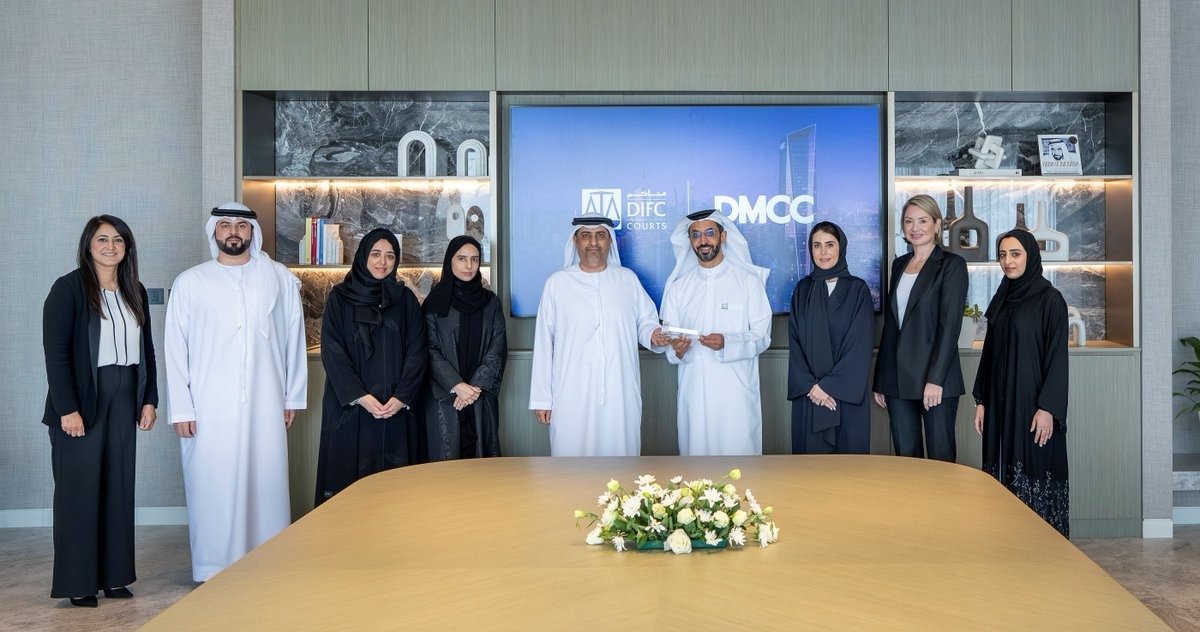
(Credit - DMCC and DIFC Courts)
DMCC, DIFC Courts Partnership Opens Full Legal Suite to 26,000+ Dubai Companies
If you run a business registered in DMCC, this changes how you handle contracts, disputes, and legal risk from today. The DMCC, DIFC Courts partnership has been significantly expanded, giving all 26,000-plus DMCC member companies structured access to the complete range of DIFC Courts’ commercial and personal legal services, not just a referral arrangement, but a formalised pathway into one of the region’s most respected common-law court systems.
What Has Actually Changed for DMCC Companies
Until now, DMCC-registered firms could technically pursue DIFC Courts as an option, but the route was neither structured nor actively supported through the free zone itself. The expanded partnership changes that by embedding access to DIFC Courts’ full service suite, covering commercial dispute resolution, contract enforcement, and personal legal matters, directly within the DMCC ecosystem. Think of it as the difference between knowing a door exists and having a key cut for it.
The expansion also comes with physical infrastructure to back it up: new facilities, a meaningful increase in office capacity, and a five-year growth strategy designed to absorb rising demand. This is not a one-off memorandum of understanding refresh, it is a longer-term commitment to scale legal service delivery alongside Dubai‘s growing business base.
Why This Reshapes Day-to-Day Business Decisions in Dubai
DIFC Courts operate as an independent, English-language, common-law court system within Dubai’s financial centre, widely regarded as the gold standard for commercial dispute resolution in the region. For DMCC companies dealing with international counterparties, high-value contracts, or complex supply chains, having a clear, structured route to DIFC Courts can directly affect how contracts are drafted, which jurisdiction clauses are inserted, and how legal risk is priced at the negotiation stage.
- Scope of Access: Full suite of DIFC Courts commercial and personal legal services, not a limited or tiered subset.
- Who Benefits Most: DMCC-registered SMEs and multinationals with cross-border contracts, international counterparties, or higher-value transactions where enforceability is critical.
- Infrastructure Commitment: New facilities and increased office space are being added to meet rising demand, underpinned by a five-year growth strategy.
- Announcement Date: Confirmed 3 June 2026, via Dubai Media Office.
If You’re a Founder, GC, or CFO at a DMCC Company
The most immediate practical consequence sits in your contract templates. If your standard agreements currently route disputes to arbitration or a non-DIFC jurisdiction, this is a natural moment to review whether DIFC Courts should now be your default forum, particularly for contracts with counterparties outside the UAE, where enforceability and the credibility of the chosen court carry real commercial weight.
Professional services firms, law firms, corporate services providers, and consultancies operating within or alongside DMCC, should also expect increased client enquiries around dispute resolution structuring. As more DMCC companies formalise their legal risk management, demand for specialist advice on DIFC Courts procedures is likely to rise alongside it.
Before and After: What the Expanded Partnership Changes
| Aspect | Before Expansion | After Expansion |
|---|---|---|
| Access to DIFC Courts for DMCC firms | Available but unstructured; no formal pathway | Structured, formalised access through the partnership |
| Services covered | Not specified under a DMCC-specific arrangement | Full suite: commercial and personal legal services |
| Infrastructure | Existing capacity | New facilities + increased office space planned |
| Strategic horizon | Ad hoc / MoU basis | Five-year growth strategy to scale capacity |
| Who it covers | Individual firms navigating independently | All 26,000+ DMCC member companies |
Next Steps for DMCC Members
1. Review your dispute resolution clauses, check whether existing contracts specify a jurisdiction and whether DIFC Courts should now be your preferred forum for new agreements. 2. Visit the DIFC Courts portal at difccourts.ae to review the full range of commercial and personal services now accessible under the partnership. 3. Contact DMCC member services via the DMCC portal (dmcc.ae) for guidance on how to formally access the expanded partnership services. 4. Consult a UAE-qualified legal adviser if you have active contracts with international counterparties, this is the right moment to assess whether your current legal risk framework reflects the options now available to you.The DMCC, DIFC Courts partnership expansion gives more than 26,000 Dubai-based companies a clearer, more direct route into one of the region’s most credible commercial court systems. For businesses with international exposure, the practical upside shows up first in contract drafting and dispute escalation planning. The five-year growth strategy signals this is infrastructure being built for the long run, not a headline arrangement.

UAE Pledge Supports Global Education Fund
UAE Commits $5 Million to FIFA Education Fund
The UAE has pledged $5 million to the FIFA Global Citizen Education Fund, a joint initiative by FIFA and Global Citizen aimed at improving access to quality education worldwide. Local education advocates and international organizations are expected to benefit from this contribution, which will support initiatives that help children develop the knowledge and skills needed to thrive.
The FIFA Global Citizen Education Fund is a joint initiative that aims to raise resources to improve access to quality education, particularly for vulnerable and underserved children. The UAE's pledge reflects its commitment to investing in human development and supporting international partnerships that create sustainable and inclusive opportunities for future generations. Global Citizen, an international advocacy organization, works to end extreme poverty by mobilizing governments, businesses, philanthropies, artists, and citizens to take action on issues such as education, health, climate change, food security, and gender equality.
The $5 million pledge will support the Fund's efforts to improve educational opportunities through initiatives that advance global collaboration to address barriers to education. This contribution is part of the UAE's longstanding commitment to supporting international partnerships that empower children and young people worldwide.
The FIFA Global Citizen Education Fund's mission to improve access to quality education is closely aligned with the UAE's own goals for human development and international cooperation. By supporting this initiative, the UAE is reinforcing its position as a leader in global philanthropy and education.

Andrew Tate Arrested
Andrew Tate Arrested in US
Andrew Tate and his brother have been arrested in the United States on charges from the United Kingdom related to rape and human trafficking. The brothers are facing charges from the UK, which led to their arrest in the US on July 19, 2026.
The arrest of Andrew Tate and his brother is based on charges of rape and human trafficking, which were filed in the United Kingdom. This development indicates a significant legal issue for the brothers, given the serious nature of the charges against them.
The UAE is not mentioned in the context of the arrest or the charges against Andrew Tate and his brother.
This arrest follows other international news, such as the recent World Cup final and tensions between the US and Iran. However, there is no direct connection between these events and the arrest of Andrew Tate and his brother.

Dubai RTA Unveils Soft Mobility Plan
Dubai RTA Approves 5-Year Soft Mobility Expansion Plan
The Roads and Transport Authority (RTA) in Dubai has approved a five-year plan to expand the emirate's soft mobility network through 2030. This initiative aims to strengthen links between residential areas and public transport stations, enhancing first- and last-mile journeys for residents and visitors. The plan encompasses infrastructure development across 25 residential areas and upgrades to the infrastructure surrounding 63 public transport stations by 2030.
The soft mobility plan is part of Dubai's drive to boost reliance on public transport and sustainable mobility. It will deliver an integrated infrastructure network that is friendly and accessible to everyone, strengthening links between development projects, key destinations, and public transport stations through individual mobility modes such as walking, cycling, and e-scooters. Currently, soft mobility elements are being implemented in five areas: Dubai Marina, Al Murar, Naif, Al Rigga, and Al Muraqqabat.
The plan also includes upgrading the infrastructure surrounding 63 public transport stations by 2030, making it easier to access metro and bus stations and raising the efficiency of the integrated mobility system. This initiative reflects the RTA's vision of transitioning towards an interconnected urban mobility ecosystem, integrating the road network with the public transport system, comprising the Dubai Metro, Dubai Tram, public buses, marine transport, and taxis, together with individual mobility modes, within a single network.
This development connects to the Dubai Urban Plan 2040, which aims to create a sustainable and integrated urban environment. The soft mobility plan is a key component of this larger strategy, supporting the city's goal of enhancing the quality of life for its residents and visitors. By expanding the soft mobility network, Dubai is taking a significant step towards becoming a more sustainable and livable city.
In the context of Dubai's overall vision, this initiative is a crucial step towards achieving the city's urban development goals. The RTA's plan to expand the soft mobility network will have a positive impact on the daily lives of residents and visitors, making it easier and safer to travel around the city. As the city continues to grow and develop, initiatives like this will play a vital role in shaping the future of urban mobility in Dubai.

Iran strikes Kuwait power plant
Iran Hits Kuwait Power Plant Amid Escalating Tensions
Iran has struck a second power and water plant in Kuwait, following a night of US military strikes in the region. This escalation comes amidst ongoing tensions and retaliatory actions between Iran and the United States. Kuwaiti authorities are assessing the damage to the power and water plants, which were targeted by Iranian missiles.
The affected communities in Kuwait are experiencing disruptions to their daily lives due to the attacks on the power and water plants. The strikes have raised concerns about the stability of the region and the potential for further escalation.
The power plant in Kuwait was hit by Iranian missiles, resulting in significant damage to the facility. The attack on the power plant has disrupted the supply of electricity and water to nearby communities.
This development follows a series of events in the region, including the reported downing of Iranian missiles by Jordan and the targeting of Aqaba. The situation in the Middle East remains volatile, with ongoing tensions between Iran and the United States.
Jordan Intercepts Iranian Missiles
Jordan Intercepts 10 Iranian Missiles
Jordanian National air defence systems intercepted and downed 10 Iranian missiles that entered the country's airspace early Saturday morning. The military source at the General Command of the Armed Forces stated that the interceptions were carried out in accordance with established defence procedures to secure the country's airspace and ensure public safety, with Royal Engineering Corps teams deploying to the debris sites to secure and clear the fragments.
The successful interception of the missiles resulted in no casualties or material damage being reported from the operation. This incident highlights the effectiveness of Jordan's air defense systems in protecting the country's airspace and ensuring public safety.
The incident occurred on July 18, 2026, and is a significant development in the region's security environment. Jordan's air defense systems have demonstrated their capability to respond to potential threats, and the country's military has taken swift action to secure the airspace.
In a similar incident, regional security has been a concern in recent years, with various countries taking measures to protect their airspace and ensure public safety. This incident is a reminder of the importance of effective air defense systems in maintaining regional security.
Royal Engineering Corps teams have been working to clear the debris from the intercepted missiles, following standard safety protocols to ensure that the areas are secure. The successful interception of the missiles reflects the preparedness and effectiveness of Jordan's military in responding to potential threats.