(Credit - Khaleej Times)
Philippine Independence Day Dubai 2026: 40,000 Filipinos to Fill Dubai World Trade Centre on June 7
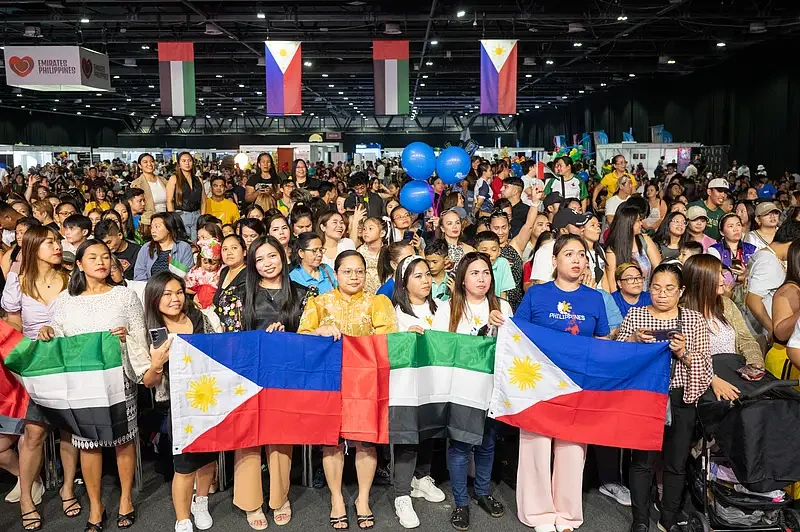
On the forecourts and exhibition halls of Dubai World Trade Centre this Sunday, Philippine Independence Day Dubai 2026 will take shape as one of the largest single-day diaspora gatherings the venue has ever hosted, with more than 40,000 Filipinos expected to attend.
What’s Happening at DWTC on June 7, and Why the Scale Stands Out
The celebration marks the 128th anniversary of the Philippines’ declaration of independence, an event that dates to 1898 and is commemorated annually by Filipino communities around the world through flag-raising ceremonies, cultural performances, and community programming. In the UAE, where Filipinos represent one of the largest expatriate groups, with strong representation across healthcare, hospitality, aviation, retail, and domestic services, the occasion carries particular weight.
Dubai World Trade Centre, a venue built for major exhibitions and high-capacity public events, will serve as the backdrop for what is shaping up to be a full-day community gathering. A turnout of 40,000-plus would place this celebration firmly among the biggest community-led events on Dubai’s 2026 calendar, not just within the Filipino diaspora but across all nationality groups in the emirate.
How June 7 Affects the DWTC Area, and Who Should Plan Ahead
An event of this scale at Dubai World Trade Centre will generate significant footfall around the Sheikh Zayed Road corridor and the surrounding road network on a Sunday. Residents and workers in the Business Bay, Za’abeel, and Trade Centre areas should factor in heavier-than-usual traffic and parking demand around the venue. Employers across sectors with large Filipino workforces, particularly in healthcare and hospitality, may find it practical to review staffing arrangements for June 7 in advance.
- Event Date: Sunday, June 7, 2026
- Venue: Dubai World Trade Centre (DWTC), Dubai
- Expected Attendance: 40,000+ Filipinos from across the UAE
- Anniversary: 128th anniversary of Philippine independence (1898 declaration)
Beyond the logistics, events of this kind serve a dual purpose for the Filipino community in the UAE, they function as cultural showcases and, in many cases, as community support touchpoints where workers and families connect with services, organisations, and each other. That combination is what consistently draws tens of thousands to a single venue in a single day.
The event’s scale also aligns with Dubai’s broader push to position itself as a city that actively hosts and celebrates its diverse resident communities, a thread running through the Dubai 2040 Urban Master Plan’s vision for inclusive, people-centred urban life.
Sunday’s gathering at Dubai World Trade Centre is a reminder of just how embedded the Filipino community is in the fabric of daily life across the UAE. With 40,000 people expected in one place, June 7 will be a visible, high-energy celebration of 128 years of Philippine independence. If you’re heading to the DWTC area that day for any reason, build in extra time.


Ras Al Khaimah Electric Bus Launches on Purple Route
Ras Al Khaimah Electric Bus Hits the Road as Purple Route Stretches to Manar Mall
The Ras Al Khaimah electric bus made its debut on June 3, 2026, marking a quiet but concrete shift in how the emirate moves its residents, and the Purple Route is now longer, connecting Al Nakheel directly to Manar Mall for the first time.
What the Purple Route Expansion Means for Al Nakheel Commuters
Until this week, residents along the Al Nakheel corridor had limited public transport options for reaching Manar Mall, one of RAK's busiest retail and transit anchors. The expanded Purple Route closes that gap, giving commuters, retail workers, and school-age passengers a direct bus link without needing a private car or taxi for what is, in distance terms, a short urban hop.
The electric bus itself signals a deliberate fleet decision. Electric vehicles on fixed, predictable urban routes are easier to schedule around charging cycles, which is why transit authorities typically introduce them on high-frequency corridors first. The Al Nakheel, Manar Mall stretch fits that profile: consistent demand, manageable distance, and a clear case for reducing tailpipe emissions and road noise in a residential zone.
How This Lands for Residents Day-to-Day
Ras Al Khaimah's public transport authorities, as reported by Gulf News on June 4, 2026, have framed the launch around two goals: improving connectivity and cutting emissions. For residents, the practical read is simpler.
- School run and errands: Families in Al Nakheel now have a bus option to Manar Mall, reducing reliance on private vehicles for short trips that previously had no direct public route.
- Parking pressure at Manar Mall: A functioning bus link on this corridor can ease weekend and weekday parking demand at the mall, particularly during peak retail hours.
- Emissions and noise: An electric bus produces zero tailpipe emissions and runs quieter than a diesel equivalent, a direct quality-of-life change for stops along residential stretches of the route.
- Fleet direction: This is RAK's first electric bus, meaning the launch is as much a signal about future procurement as it is about today's timetable.
What residents will want to watch: service frequency, operating hours, and fare structure. Those details, along with stop-by-stop maps and any charging infrastructure tied to depot operations, will determine whether the route becomes a daily habit or a novelty. RAK's public transport authorities have not yet published a full timetable publicly, so checking directly with the relevant transport office for updated schedules is the practical next step for anyone planning to use the service.
The Bigger Picture
RAK's electric bus launch connects directly to the UAE's broader net-zero and clean mobility targets, and mirrors the direction set by the UAE Net Zero by 2050 Strategic Initiative, where public transport electrification is a named lever for reducing urban emissions across all seven emirates, not just the federal capitals.
Ras Al Khaimah's first electric bus and the expanded Purple Route represent a measurable step forward in the emirate's public transport network, with the Al Nakheel, Manar Mall corridor now accessible without a private vehicle. The real test will come in the weeks ahead, as frequency and reliability data emerge from daily operations. For residents along the route, the simplest advice is to check current timetables directly with RAK transport authorities before planning your first trip.

Shakira Ghetto Kids: World Cup Halftime Confirmed
Shakira and the Ghetto Kids Are Taking the 2026 FIFA World Cup Final Halftime Stage Together
Shakira has invited Uganda's Ghetto Kids, the viral dance troupe known globally for high-energy choreography, to perform alongside her at the 2026 FIFA World Cup final halftime show, and the group has accepted. The collaboration was confirmed on June 5, 2026, marking one of the most talked-about entertainment announcements of the tournament cycle.
From Viral Videos to the World's Biggest Stage
The Ghetto Kids built their global following through social media, where their disciplined, joyful choreography earned them millions of views and a reputation as one of East Africa's most recognisable youth dance acts. A World Cup final halftime slot is a different scale entirely, it is among the highest-reach live entertainment moments on the planet, broadcast to hundreds of millions of viewers simultaneously.
Shakira herself has history with the FIFA World Cup stage, most famously with her 2010 South Africa World Cup anthem. Bringing the Ghetto Kids into her halftime production signals a deliberate choice to spotlight African creative talent on a genuinely global platform, rather than as a backdrop.
What This Moment Could Unlock for the Ghetto Kids
A single halftime appearance at a World Cup final carries real downstream consequences for a performing act. Historically, featured artists see immediate spikes in streaming numbers, social following, and inbound interest from brand sponsors and touring promoters. For a youth troupe from Uganda, the exposure could translate into international booking demand, sponsorship conversations, and wider recognition for East African dance culture at an institutional level.
- Who: Shakira (Colombian singer) and Uganda's Ghetto Kids dance troupe
- What: Confirmed collaboration for the 2026 FIFA World Cup final halftime show
- When: Invitation confirmed June 5, 2026; performance at the World Cup final
- Significance: One of live television's highest-reach entertainment slots, with global broadcast reach across hundreds of millions of viewers
What Comes Next
Details still to follow include the confirmed host city and stadium for the final, the full production run-of-show, broadcast partner arrangements, and whether additional performers will join the halftime lineup. Rehearsal schedules and staging logistics are typically confirmed closer to the final date.
Shakira's decision to bring Uganda's Ghetto Kids onto the 2026 FIFA World Cup final halftime stage is a genuine career inflection point for the troupe, the kind of slot that rewrites an act's international profile overnight. For fans of East African dance culture, it is a long-overdue moment of global visibility. Watch for sponsorship and touring announcements in the weeks that follow.

FIFA World Cup Mascots: 1966 to 2026 Explained
FIFA World Cup Mascots Span 60 Years, Here's What Every Character Said About Its Host Nation
The FIFA World Cup mascots have been football's most visible branding tool since 1966, when England introduced "World Cup Willie" and set a tradition that now ends, for this cycle, with a trio of characters representing three host nations in 2026.
Why the Mascot Timeline Runs From a Lion to Three Friends
FIFA introduced official mascots as a way to wrap each tournament's identity into a single, marketable character that could anchor licensing programmes, fan merchandise, and host-country storytelling for a global audience. The concept started simply: one host, one character, one cultural reference point. England's World Cup Willie was a Union Jack-wearing lion, unmistakably British, instantly reproducible on a badge or a pennant.
Over the following six decades, the design philosophy shifted from hand-drawn, locally themed figures toward more stylised, globally merchandisable characters. By the 1990s and 2000s, mascots were being built with animation pipelines and international licensing deals in mind, less folk art, more franchise asset. The shift tracks almost perfectly with the broader commercialisation of the tournament itself.
The Full Roster: Every Mascot, Every Year
- 1966, World Cup Willie (England): A lion in a Union Jack kit. The first official FIFA mascot and the template for everything that followed.
- 1970, Juanito (Mexico): A young Mexican boy in the national kit, reflecting the host nation's footballing passion.
- 1974, Tip and Tap (West Germany): Two boys in German colours, the first time FIFA used a pair rather than a single character.
- 1978, Gauchito (Argentina): A young gaucho figure, drawing directly on Argentine rural and cultural identity.
- 1982, Naranjito (Spain): An orange wearing a Spanish kit, one of the most recognisable and commercially successful mascots of the era.
- 1986, Pique (Mexico): A jalapeño pepper in a sombrero, leaning into Mexican iconography for the country's second hosting.
- 1990, Ciao (Italy): A stylised figure made of coloured blocks in the Italian tricolore, a sharp design departure toward abstraction.
- 1994, Striker (United States): A cartoon dog in a US kit, designed with American pop-culture sensibilities and broad family appeal.
- 1998, Footix (France): A rooster, France's national symbol, in blue, holding a football. Clean, confident, very French.
- 2002, Ato, Kaz, and Nik (South Korea/Japan): Three futuristic creatures called "The Spheriks," reflecting the co-hosted tournament's dual identity and the era's digital design trends.
- 2006, Goleo VI and Pille (Germany): A lion in a German shirt paired with a talking football, an attempt at a duo that drew mixed public reaction.
- 2010, Zakumi (South Africa): A leopard with green dreadlocks, widely praised for capturing South African wildlife and colour.
- 2014, Fuleco (Brazil): An armadillo in Brazilian colours, chosen partly to raise awareness of the three-banded armadillo's endangered status.
- 2018, Zabivaka (Russia): A wolf in sports gear, selected through a public vote, one of the more popular modern mascots among fans.
- 2022, La'eeb (Qatar): An abstract, ghost-like figure inspired by the traditional Arab keffiyeh headwear, culturally specific and visually distinct.
- 2026, Maple, Zayu, and Clutch (Canada, Mexico, United States): A trio, one per host nation, marking the first time three countries share a single tournament and, by extension, three mascots share a single stage.
What the 2026 Trio Signals for the Tournament
The 2026 edition, hosted across Canada, Mexico, and the United States, is structurally unlike most prior tournaments, and the mascot concept reflects that. Maple represents Canada, Zayu represents Mexico, and Clutch represents the United States. Running three characters simultaneously is a direct response to the multi-host format: a single mascot would implicitly favour one nation's identity over the others.
For licensing and merchandising teams, the trio approach opens three separate product lines tied to distinct national symbols, but it also raises a question the industry will watch closely: whether a divided mascot identity can generate the same singular cultural resonance as a Zakumi or a Naranjito. A single iconic image tends to travel further on merchandise than a committee of three.
Sixty years of World Cup mascots form a surprisingly accurate record of how host nations chose to present themselves to the world, and how FIFA's commercial ambitions grew alongside that story. The jump from World Cup Willie's hand-drawn simplicity to 2026's three-character franchise reflects both design evolution and the tournament's transformation into a multi-billion-dollar global property. Whether Maple, Zayu, and Clutch become as fondly remembered as Zakumi or Footix will depend on how well three characters can share one moment.

Emirates' First Emirati Female Captains Take Command
Emirates' First Emirati Female Captains, Hanan and Bakhita, Have Joined the Ranks
Emirates' first Emirati female captains, Hanan and Bakhita, have officially taken command of the flight deck, the airline confirmed this June, marking a moment that the UAE aviation community has been watching for years.
From First Officer to Final Authority: What the Promotion Actually Means
The captain's rank is not ceremonial. At Emirates, as on any commercial flight, the captain holds final operational authority, every safety call, every crew decision, every departure clearance runs through them. For Hanan and Bakhita, the promotion means they now sit in the left seat with full command responsibility, not just as a milestone on paper but as a daily operational reality on routes the airline operates out of Dubai International Airport.
Emirates announced the achievement through its official channels on June 5, 2026, with a direct statement: "Our first Emirati female Captains have joined the ranks." The airline framed the promotion as an inspiration for future generations, a signal that the command-upgrade pathway is open and has now been walked by Emirati women for the first time.
What This Signals for UAE Aviation and Emiratisation
For residents and families across Dubai who have daughters in aviation training or cadets working through Emirates' flight programmes, this promotion carries real weight. Emirates is one of the UAE's flagship employers and sits at the centre of the country's broader Emiratisation drive. High-profile command promotions like these are closely tracked as indicators of whether national talent pipelines are producing long-term leadership, not just entry-level placements.
- Who: Hanan and Bakhita, Emirati pilots promoted to captain rank at Emirates
- When: June 2026, confirmed by Emirates via official channels
- What changes: Both now hold final flight authority, including safety decision-making and crew leadership on commercial operations
- Why it resonates: First Emirati women to reach captain rank at the airline, a role historically held by men across global commercial aviation
The General Civil Aviation Authority (GCAA), which oversees pilot licensing and certification standards in the UAE, sets the regulatory framework that all captains, including Hanan and Bakhita, must meet before assuming command. Their promotion confirms they have cleared every technical and operational threshold required under UAE civil aviation regulations.
Hanan and Bakhita's promotion to captain at Emirates is the clearest signal yet that Emirati women are not just entering aviation, they are leading it. For the next generation of UAE cadets watching from flight schools and university aviation programmes, the left seat is no longer a distant prospect. The question now is whether Emirates and other UAE carriers accelerate the command-track pathways that got them there.

Lamine Yamal injury update: fit for June 15 opener
Lamine Yamal Injury Update: Spain Coach Expects Winger Ready for June 15 World Cup Opener Against Cape Verde
The Lamine Yamal injury update from Spain's camp is encouraging, coach Luis de la Fuente said on June 5 that the teenage winger is likely to be available for Spain's FIFA World Cup 2026 opening match against Cape Verde on June 15. Yamal has been managing a hamstring injury, but de la Fuente described his recovery as progressing positively.
Spain's Attack Hinges on a Hamstring: What De la Fuente Said
De la Fuente stopped short of guaranteeing a start, but his language was notably optimistic, "likely to feature" is the clearest signal yet that Spain's medical and coaching staff are confident Yamal will clear fitness protocols before the group-stage opener. Hamstring injuries carry a well-documented risk of recurrence in elite football, which means Spain's staff will almost certainly manage his training load and potentially his minutes in the first match, even if he is passed fit.
The June 15 fixture against Cape Verde is Spain's first competitive game of the tournament. Having Yamal available, even in a controlled, minutes-managed role, preserves Spain's preferred wide-threat structure and reduces the need for contingency lineups that would otherwise require opponents to prepare for a different attacking shape. If the medical team opts for a cautious return, an appearance from the bench remains a credible scenario.
Why Availability in Match One Carries Outsized Weight
Opening matches at a World Cup set the tactical tone for the entire group stage. A team's pressing intensity, chance-creation patterns, and substitution strategy in Match 1 directly shape how opponents in subsequent fixtures prepare their defensive setups. Yamal's presence, or absence, on June 15 will influence Spain's rotation decisions and opponent scouting reports for the remainder of the group phase.
- Player: Lamine Yamal, Spain winger
- Injury: Hamstring, recovery described as progressing well
- Target date: June 15, Spain vs Cape Verde, FIFA World Cup 2026 opener
- Coach assessment: Luis de la Fuente says Yamal is likely to be available
Spain's World Cup preparations received a significant boost as coach Luis de la Fuente confirmed Lamine Yamal's hamstring recovery is on track for the June 15 opener against Cape Verde. The teenager is expected to feature, though the exact role, starter or substitute, will depend on final fitness assessments in the days ahead. Spain's attacking options and tactical shape for the group stage will become clearer once the medical staff signs off ahead of kick-off.*Source: Khaleej Times / Luis de la Fuente press comments, June 5, 2026.*