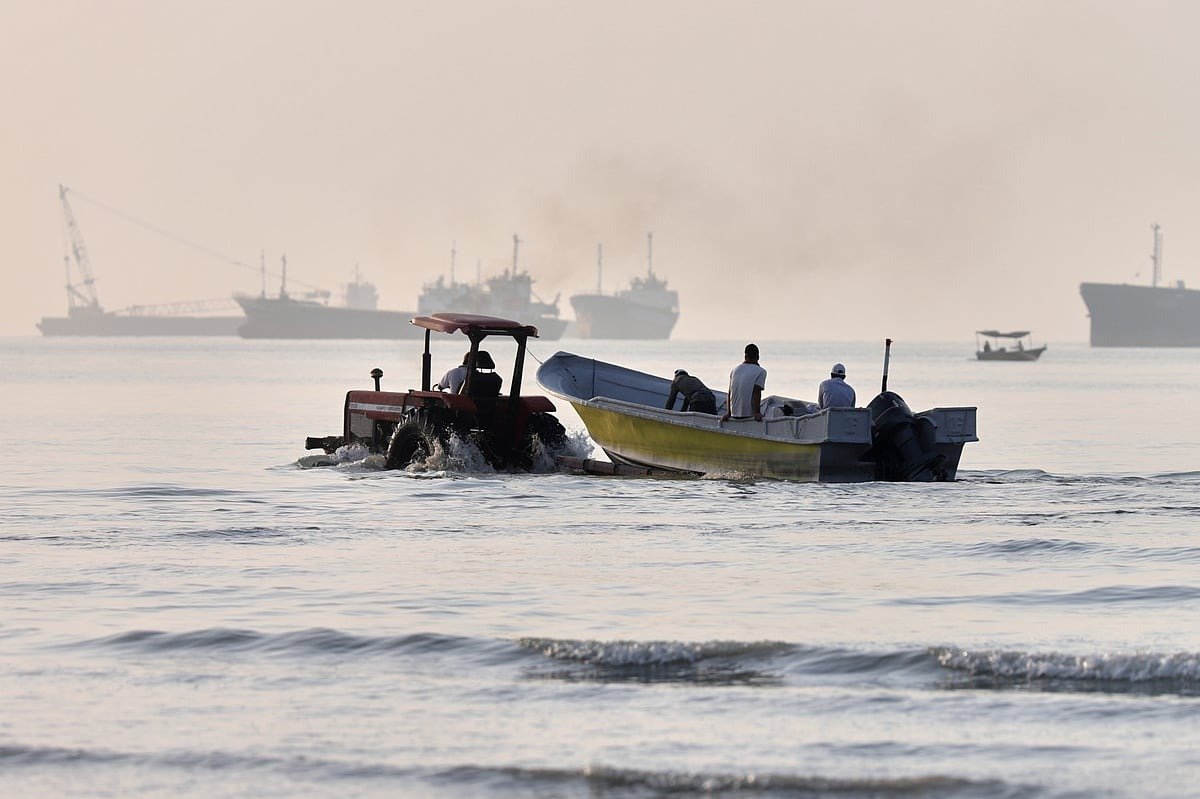
(Credit - Gulf News)
Strait of Hormuz Has Been a Ghost Route for Three Months, and Carriers Still Won’t Come Back
The Strait of Hormuz, the narrow waterway that typically channels roughly 20% of the world’s oil supply, has remained effectively inactive for approximately three months following a conflict, and despite ongoing discussions about reopening, major shipping companies are showing no urgency to resume normal transits.
Why the Route Isn’t Just “Closed”, It’s Structurally Frozen
The distinction is important. The Strait of Hormuz isn’t sealed by a formal blockade. It is paralysed by a calculation that every shipowner, charterer, and insurer is making independently, and arriving at the same answer. When war-risk insurance premiums spike sharply, when crews face legitimate safety concerns, and when charterers refuse to expose vessels to incident risk, traffic collapses even if the water is technically navigable. That is the condition the Strait has been in since approximately early March 2026.
This is the mechanics of a “soft closure”, arguably more durable than a hard one, because no single authority can reopen it with a declaration. Normalisation requires a convergence of signals: reduced incident reports, falling war-risk premiums, formal security guarantees, and public confirmation from major carriers that they are resuming scheduled transits. As of June 4, 2026, none of those signals have consolidated.
The Systemic Drivers Behind Three Months of Paralysis
Economic Driver: Insurance and Freight Cost SpiralWar-risk insurance is the invisible gatekeeper of maritime trade. When premiums rise sharply on a specific corridor, the economics of routing a laden tanker through that corridor deteriorate fast. Shipowners face a binary: absorb the premium and risk the vessel, or reroute at higher operational cost. For three months, the industry has overwhelmingly chosen the latter. The result is elevated tanker rates on alternative routes, delayed cargo schedules, and pressure on strategic stockpiles held by importers who had calibrated their buffer stocks to normal Hormuz transit times.Geopolitical Driver: The Chokepoint PremiumThe Strait of Hormuz sits at coordinates that make it irreplaceable in the short term. There is no quick substitute route for the volume of crude, LNG, and refined products that typically transit it. Rerouting around the Arabian Peninsula adds significant time and cost. The geopolitical reality is that any state or non-state actor that can credibly threaten this corridor holds disproportionate leverage over global energy logistics, and that leverage has been exercised, whether intentionally or as a byproduct of conflict, for the past three months.Operational Driver: Crew Safety and Charterer Risk AppetiteBeyond insurance, there is a human variable that doesn’t appear in freight indices. Seafarers and their unions have leverage over routing decisions. Charterers, the companies that hire vessels to move cargo, have their own risk committees. Even if a shipowner were willing to transit, a charterer refusing exposure can ground the commercial arrangement entirely. This layered reluctance, across multiple decision-makers in a single voyage chain, is why traffic has stayed minimal even as diplomatic conversations about reopening have continued.The Ripple Effect: Three Groups Feeling the Pressure
Gulf Energy Exporters are absorbing the most direct commercial impact. Crude and LNG cargoes that would normally move efficiently through the Strait are either delayed, rerouted at higher cost, or sitting in storage awaiting a viable transit window. The longer the disruption persists, the greater the strain on export scheduling and contract performance obligations.UAE-Based Importers and Logistics Operators face a second-order squeeze. The UAE’s position as a regional trade and re-export hub means that elevated freight costs and rerouting delays feed into the cost of imported goods, components, and energy inputs. Businesses relying on predictable cargo scheduling, from petrochemical traders to consumer goods importers, are operating with compressed lead times and inflated logistics budgets.Global Refiners and Energy Buyers are watching their supply-chain assumptions unravel. Refineries calibrated to receive Gulf crude on specific schedules are either drawing down strategic reserves or sourcing from alternative, typically more expensive, origins. The downstream effect is inflationary pressure on refined fuels and petrochemicals, a cost that eventually reaches end consumers.The Contrarian View
The strongest counter-argument is that the Strait of Hormuz has faced serious threat cycles before and recovered relatively quickly once the immediate security trigger subsided. Shipping is commercially adaptive: when premiums fall and incident reports drop, carriers return fast because the route is simply too economically efficient to abandon permanently. Critics of the “structural freeze” framing would argue that the current paralysis is being prolonged by risk aversion that has outrun the actual threat level, and that a single credible security signal could unlock a rapid return to near-normal traffic. That argument deserves weight. But it also assumes the security signal arrives cleanly and soon, which, three months in, remains unverified.- Duration of disruption: Approximately three months, from early March to June 4, 2026
- Share of global oil flows at risk: Roughly 20% typically transits the Strait of Hormuz
- Carrier posture: Major shipping companies remain reluctant to resume normal transits despite reopening discussions
- Reopening threshold: Requires convergence of lower war-risk premiums, reduced incidents, formal security guarantees, and carrier confirmation, none yet consolidated
The Strait of Hormuz has been a ghost route for three months, not because it is physically blocked, but because the commercial and human risk calculus has not shifted enough to bring carriers back. With roughly a fifth of global oil flows tied to this corridor, the longer the standoff persists, the deeper the freight, insurance, and supply-chain stress becomes. The route will reopen when the risk signals converge, not before.


UAE WPS Update June 2026: New Salary Deadline
UAE WPS Update June 2026 Forces Private-Sector Employers to Pay Salaries by the First of Every Month
The UAE WPS update June 2026 draws a hard line for private-sector employers: salaries must be processed and received by employees on the first day of each calendar month, effective June 1, 2026, with escalating penalties for anyone who misses that mark.
Who Does This Rule Apply To?
If your company is registered under the Wage Protection System and employs staff in the UAE private sector, this rule applies to you, regardless of company size, industry, or the nationality of your workforce. That covers everyone from a five-person trading firm in Deira to a multinational with offices across Dubai and Abu Dhabi.
The rule has a sharper edge for larger organisations. Companies with 50 or more employees face the steepest exposure: repeated non-compliance can escalate beyond fines and work permit suspensions into potential criminal prosecution, turning a payroll admin lapse into a legal and reputational crisis. HR managers, PRO officers, and finance controllers at these firms carry direct accountability.
Employees whose wages flow through WPS-compliant channels, which covers the vast majority of private-sector workers in the UAE, are the direct beneficiaries. If your salary has historically arrived on the 5th, 7th, or 10th of the month, your employer now has a legal obligation to move that date forward.
What You Need to Do Right Now
For employers:1. Audit your payroll cycle today. Log in to the MoHRE (Ministry of Human Resources and Emiratisation) employer portal and confirm your WPS file submission schedule. If your current cycle targets mid-month or end-of-month payment, it must be restructured immediately. 2. Coordinate with your bank. WPS salary transfers require bank processing time. Speak to your corporate banking relationship manager to establish a cut-off date that guarantees funds clear employee accounts by the 1st, not just that the transfer is initiated. 3. Update your payroll calendar. Finance and HR teams should rebuild the monthly payroll timeline backwards from the 1st, accounting for data collection, approvals, WPS file generation, and bank processing windows. 4. Flag high-risk months. Months where the 1st falls on a Friday, Saturday, or public holiday require advance planning. Confirm with your bank whether transfers need to be initiated a day or two earlier to meet the deadline. 5. Document everything. Keep records of WPS file submission timestamps and bank transfer confirmations. In any enforcement review by MoHRE, timestamped evidence of timely submission is your primary defence.For employees:If your salary does not arrive by the 1st of any month from June 2026 onwards, you have grounds to raise a formal complaint through the MoHRE smart app or the MOHRE website (mohre.gov.ae). You do not need to approach your employer first, the complaint can be filed directly.Penalties for Non-Compliance
The enforcement framework under the updated WPS rules is structured to escalate with each violation. The source confirms the following consequence tiers, though specific fine amounts in dirhams were not disclosed in the available information:- First-tier consequence: Financial fines imposed on the employer for delayed salary payments.
- Second-tier consequence: Work permit suspensions, blocking the employer from hiring new staff until compliance is restored.
- Third-tier consequence (50+ employee firms): Repeated violations can trigger potential prosecution, moving the matter from an administrative penalty into the criminal enforcement domain.
- Enforcement authority: MoHRE is the named regulator overseeing WPS compliance and initiating penalty proceedings.
The June 1, 2026 WPS update compresses payroll timelines in a way that leaves no room for the informal delays that many private-sector employees have quietly absorbed for years. For employers, the first of the month is no longer a target, it is a deadline with teeth. Getting your payroll infrastructure aligned now, before MoHRE begins active enforcement, is the only sensible move.

Idris Elba Knighted by King Charles at Windsor
Idris Elba Knighted by King Charles III at Windsor Castle for Services to Young People
Idris Elba was knighted by King Charles III at Windsor Castle on June 2, 2026, formally receiving the title Sir Idris Elba. The honour recognises his sustained work in youth-focused public service, placing his contribution in a category distinct from his film career.
What the Windsor Castle Investiture Means Beyond the Title
The investiture ceremony at Windsor Castle is the moment a knighthood is formally conferred, separate from the public announcement of the honours list. King Charles III conducted the ceremony, touching a sword to Elba's shoulders in the traditional ritual. The citation "services to young people" signals that the recognition is rooted in social impact and community work rather than entertainment achievement alone.
Under the UK honours system, a knighthood grants the recipient the right to use "Sir" before their given name. For women, the equivalent title is "Dame." The honour carries no statutory powers but significantly raises a recipient's public profile and, in practice, can expand their ability to convene institutional partnerships, attract philanthropic funding, and access policy-level conversations around the causes they champion.
Recognition That Carries Real-World Weight in Youth Philanthropy
For organisations working in youth development, education, or social mobility, Elba's elevation to knighthood is likely to sharpen interest in any programmes he is publicly associated with. Charities and foundations operating in this space may find that a figure now formally recognised by the Crown carries greater leverage in fundraising and government engagement, though that influence also invites closer scrutiny of measurable outcomes.
- Recipient: Idris Elba, now Sir Idris Elba
- Conferred by: King Charles III
- Location: Windsor Castle, England, United Kingdom
- Date of investiture: June 2, 2026
- Citation: Services to young people
Idris Elba's knighthood, conferred by King Charles III at Windsor Castle on June 2, 2026, formally ties his public identity to youth service rather than screen performance. The title Sir Idris Elba places him among a cohort of public figures whose community contributions have been recognised at the highest level of the British honours system. For youth-sector organisations, the development signals a potentially more prominent advocate with enhanced institutional reach.*Source: Gulf News / Windsor Castle official investiture, June 2, 2026.*

Five Greatest FIFA World Cup Players of All Time
Five Greatest FIFA World Cup Players of All Time, and Why Each One Earned the Spot
The five greatest FIFA World Cup players of all time have been named, Maradona, Messi, Pelé, Ronaldo, and Cruyff, and the list is already splitting opinion across football fans worldwide. These are not just the biggest names in the sport; they are the figures whose performances on the World Cup stage specifically defined what tournament football can look like at its absolute peak. One of them never even lifted the trophy, which tells you everything about how complex this debate really is.
How "Greatest" Gets Decided, and Why It's Never Simple
Rankings like this typically weigh three things: tournament impact (goals, assists, match-winning moments), performance across multiple editions, and the kind of iconic individual moments that lodge permanently in football memory. No single metric settles it, a player can dominate one tournament so completely that it outweighs a longer but quieter career, while another can accumulate across four editions and still be questioned.
That subjectivity is exactly why lists like this generate heat. Depending on whether you prioritise trophies, individual awards, or tactical influence on the game itself, the five names could shift significantly, and plenty of legends sit just outside this group with legitimate claims of their own.
1. Diego Maradona, The One-Tournament Standard No One Has Matched
Maradona's case rests almost entirely on Mexico 1986, and it is still enough. He scored five goals and provided five assists across seven matches, dragging Argentina to the title with performances that remain the benchmark for individual World Cup dominance. The "Hand of God" goal and the "Goal of the Century", both scored against England in the quarter-final, happened in the same game, which captures the contradictory brilliance that made him impossible to ignore.Why it changes how you watch the tournament: When you understand that Maradona essentially carried a functional-but-not-exceptional Argentina squad to a World Cup title on individual will, every "best player at a World Cup" conversation starts and ends with 1986.2. Lionel Messi, The Long Game That Finally Paid Off
Messi's World Cup story is one of sustained elite output across five tournaments (2006, 2022), culminating in Argentina's triumph in Qatar in December 2022. He finished that tournament with seven goals and three assists, winning the Golden Ball for best player, his second such award at a World Cup, having also claimed it in 2014 despite Argentina losing the final. No other player has won the Golden Ball twice.Why it reshapes the GOAT argument: The 2022 title removed the one credible counterargument to Messi's inclusion on any all-time list. He now holds both the individual accolades and the winner's medal.3. Pelé, Three Tournaments, Two Titles, One Unbroken Record
Pelé remains the only player in history to win three FIFA World Cup titles (1958, 1962, 1970), and he scored in all three winning campaigns. He was 17 years old when he won his first, making him the youngest World Cup winner ever, a record that still stands as of June 2026. His 1970 Brazil side is routinely described as the finest national team ever assembled, and Pelé was its centrepiece.Why the numbers still hold up: Three titles across three different decades of football is a volume of success no other player has come close to replicating at international tournament level.4. Ronaldo (Brazil), A Comeback Story Built Around Goals When They Counted
Brazil's Ronaldo Nazário, not Cristiano Ronaldo, is the player referenced here, and his World Cup record is straightforward: 15 goals across three tournaments (1994, 1998, 2002), which remains the all-time record for goals scored at FIFA World Cups. His 2002 campaign in South Korea and Japan was particularly decisive: eight goals in seven matches, including a brace in the final against Germany, after a career-threatening knee injury had kept him out of the game for nearly two years.Why the comeback element is relevant: Ronaldo's 2002 performance carries extra weight precisely because it came after a period when many assumed his career was effectively over. Scoring eight goals in a winning World Cup campaign under that kind of pressure is a different kind of achievement.5. Johan Cruyff, The Greatest Player Who Never Won It
Cruyff led the Netherlands to the 1974 World Cup final in West Germany, where they lost 2, 1 to the host nation. He never played in another World Cup, he boycotted the 1978 tournament in Argentina for reasons he only publicly confirmed years later. Despite that, his influence on how the game is played, through the "Total Football" system he embodied, reshaped football tactics globally in ways that are still visible today.Why a runner-up belongs on this list: Cruyff's inclusion is the most debated of the five, but it reflects a broader point: World Cup greatness is not exclusively measured in trophies. His tactical and cultural impact on the tournament, and on football itself, is an argument that has held up for more than 50 years.The Five at a Glance
| Player | Country | World Cup Titles | Key Tournament | Notable Stat |
|---|---|---|---|---|
| Diego Maradona | Argentina | 1 (1986) | Mexico 1986 | 5 goals, 5 assists in one tournament |
| Lionel Messi | Argentina | 1 (2022) | Qatar 2022 | 2× Golden Ball winner |
| Pelé | Brazil | 3 (1958, 1962, 1970) | Mexico 1970 | Youngest-ever World Cup winner (age 17) |
| Ronaldo Nazário | Brazil | 2 (1994, 2002) | South Korea/Japan 2002 | All-time record: 15 World Cup goals |
| Johan Cruyff | Netherlands | 0 | West Germany 1974 | Finalist; never played 1978 tournament |
The Verdict
If forced to pick one name whose World Cup record is simply beyond challenge on every metric, titles, individual performance, and longevity, Pelé's three-tournament, three-title run is the hardest to argue against. Maradona's 1986 peak is the most spectacular single-tournament performance in the sport's history, and Messi's 2022 triumph finally gave him the complete résumé. But Pelé did it three times, starting at 17. That is the number that keeps coming back.Rankings of this kind are always editorial judgements, not official FIFA classifications, and reasonable cases exist for players outside this five. What makes this particular list durable is that each name on it changed something, a tournament, a tactical era, or the sport's understanding of what one player can do. The debate over who was left out is, in many ways, the point.

Saadiyat Beach Ranks 19th Best in World
Saadiyat Beach Enters the World's Top 20, and It's the Only Middle Eastern Beach to Do So
Saadiyat Beach on Abu Dhabi's Saadiyat Island has been ranked 19th on The World's 50 Best Beaches list for 2026, confirmed on June 4, 2026, making it the sole representative from the entire Middle East on this year's global ranking.
Why This Ranking Carries Real Weight for UAE Travellers
The World's 50 Best Beaches cited Saadiyat Beach's natural beauty and sustainability efforts as the basis for its placement. The beach sits within a stretch of coastline on Saadiyat Island that has long been managed with conservation in mind, nesting hawksbill turtles are a well-documented feature of the shoreline, and access protocols have historically been shaped around protecting that habitat.
A top-20 global placement on a list of 50 is not a minor footnote. It positions Abu Dhabi ahead of hundreds of widely visited coastal destinations worldwide, and it does so on criteria, environmental stewardship alongside aesthetic appeal, that are increasingly driving where discerning travellers choose to spend their money.
What This Means If You're Planning a Visit
Abu Dhabi's Department of Culture and Tourism has been building the Saadiyat Island proposition for years, and a ranking of this profile will sharpen demand during the cooler peak travel window running from October through March. Visitors planning beach stays on Saadiyat Island should expect tighter hotel inventory and earlier booking lead times as international interest follows the ranking's publication.
- Global Rank: 19th on The World's 50 Best Beaches 2026
- Regional Status: Only Middle Eastern beach included in the 2026 list
- Recognition Criteria: Natural beauty and sustainability efforts
- Location: Saadiyat Island, Abu Dhabi, UAE (24.5333°N, 54.4333°E)
Saadiyat Beach's entry at No. 19 is the strongest signal yet that Abu Dhabi's conservation-led approach to coastal tourism is being recognised at the highest global level. For UAE residents, it's a reminder that one of the world's best beaches is a short drive, or a 90-minute trip from Dubai, away. If you haven't locked in a stay on Saadiyat Island for the coming winter season, now is the time to look.

UAE condemns Iranian attacks on Kuwait, Bahrain
UAE Condemns Iranian Attacks on Kuwait and Bahrain, Calls for Unified Gulf Response
The UAE condemned Iranian attacks on Kuwait and Bahrain on Thursday, June 4, describing the strikes as a serious escalation that demands a coordinated Gulf response. Residents and travellers across the region are directly affected, with Kuwait International Airport suspending operations after being targeted and injuries reported on the ground.
Kuwait Airport Suspended, Bahrain Reports Successful Interceptions
Kuwait halted all operations at Kuwait International Airport following the attack, triggering immediate flight disruptions, rerouting, and passenger backlogs that will ripple across regional carriers and cargo schedules. The suspension is not a precautionary measure, the airport was directly targeted, and injuries have been confirmed, though specific casualty figures were not provided in official statements at the time of publication.
Bahrain separately confirmed that it intercepted incoming missiles and drones, indicating that Gulf air-defence systems were activated across more than one country simultaneously. The scale of the incident, targeting critical civilian infrastructure in two GCC states within the same episode, marks a qualitative shift from previous patterns of regional tension.
What This Means for UAE Residents and Gulf Travellers Right Now
Anyone with flights connecting through Kuwait International Airport should contact their airline immediately, as the operational suspension will affect departures, arrivals, and transit connections without a confirmed timeline for resumption. Travellers on routes that transit Bahrain should also monitor updates closely given the active interception activity reported there. The UAE Ministry of Foreign Affairs has not issued a separate travel advisory as of publication, but the situation is developing rapidly.
- Kuwait Airport Status: Operations suspended after the airport was directly targeted; injuries reported
- Bahrain Defence: Missiles and drones intercepted; air-defence systems activated
- UAE Position: Strongly condemned the attacks; called for a unified Gulf Cooperation Council stance
- Aviation Risk: Regional flight rerouting, cargo delays, and insurance risk reassessments now underway
The UAE's call for a unified Gulf stance signals a push for collective political messaging through GCC channels, a response framework that Gulf states have previously used to consolidate diplomatic pressure during periods of heightened regional tension.
Iranian attacks struck Kuwait and Bahrain on June 4, with Kuwait International Airport suspended after being targeted and Bahrain confirming missile and drone interceptions. The UAE issued a strong condemnation, framing the strikes as a serious escalation and urging Gulf states to respond with a unified position. Travellers with connections through Kuwait or Bahrain should verify their flight status directly with their carrier as the situation continues to develop.*Source: Dubai Eye 103.8 / UAE Ministry of Foreign Affairs statement. Reported June 4, 2026.*