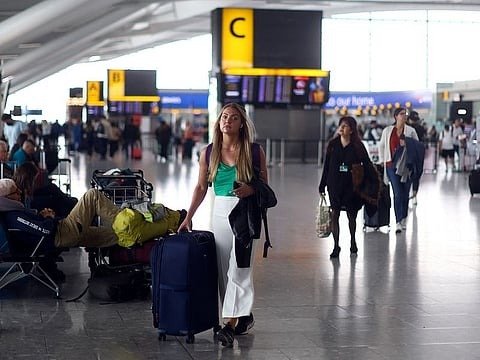
(Credit - Gulf News)
Schengen Internal Border Checks Are Still Running in 10 Countries, Here’s What That Means for Your Next Trip
If you’re planning a cross-border trip inside Europe this summer, Schengen internal border checks are still very much in force, and the EU’s review of whether to phase them out is far from settled.
What’s Actually Happening at Europe’s Internal Borders Right Now
The Schengen Area was built on one core promise: once you’re in, you move freely. No passport queues at the French-German motorway crossing, no ID checks boarding a train from Amsterdam to Brussels. But as of June 3, 2026, that promise has a significant asterisk. Ten member states, Austria, Denmark, France, Germany, Italy, the Netherlands, Norway, Poland, Slovenia, and Sweden, are operating temporary internal border controls, citing migration pressures and security concerns.
EU law does allow this, but only under strict conditions. Internal controls are supposed to be exceptional, time-limited, and proportionate to a genuine threat to public policy or internal security. The European Commission is now reviewing whether the current wave of checks, many of which have been renewed repeatedly, still meets that bar, and whether tighter renewal criteria, clearer end-dates, and stronger coordination between member states are needed to protect freedom of movement.
Before and After: What the EU Review Could Change
| Factor | Current Situation (June 2026) | If EU Tightens Rules |
|---|---|---|
| Countries with active checks | 10 (Austria, Denmark, France, Germany, Italy, Netherlands, Norway, Poland, Slovenia, Sweden) | Reduced, stricter renewal criteria could force rollbacks |
| Duration of controls | Renewable under existing EU rules; some have persisted for extended periods | Mandatory end-dates and proportionality tests enforced more rigorously |
| Traveler experience | Possible ID checks on roads, rail, and at land crossings | Smoother, more predictable cross-border movement |
| Cross-border commuters | Unpredictable delays; ID required even on routine routes | Greater certainty; reduced compliance friction |
| Freight and logistics | Longer transit times; variable delivery schedules | More predictable routing and staffing |
How This Affects You, Depending on How You Travel
If you’re a leisure traveller planning a multi-country European itinerary this summer, budget extra time at land crossings and on international rail routes passing through any of the ten countries listed above. Carry your passport or national ID even for short hops, checks can appear on motorways and at train stations without advance notice.If you’re a cross-border commuter working across a Schengen internal border, say, living in one country and working in another, the day-to-day friction is real. ID inspections on routine commutes, unpredictable queue times, and the possibility of controls shifting location or intensity mean you should keep valid ID on your person at all times and monitor official government travel advisories from the relevant national authorities.If you work in logistics or freight forwarding, the ten active check zones create variable transit times that complicate delivery scheduling. Until the European Commission’s review produces binding changes, contingency planning for both a continued-checks scenario and a rapid rollback remains prudent.The Key Facts at a Glance
- Claim status: The assertion that the EU is moving to “phase out” internal Schengen checks is currently unverified, the European Commission is reviewing governance, but no binding phase-out decision has been confirmed.
- Active check countries: Austria, Denmark, France, Germany, Italy, the Netherlands, Norway, Poland, Slovenia, and Sweden as of June 2026.
- Legal basis: EU rules permit internal controls only in exceptional circumstances; extensions require justification on public policy or internal security grounds.
- What to watch: Any formal EU move would likely introduce stricter renewal criteria, mandatory end-dates, and enhanced coordination requirements, none of which are yet in force.
What You Should Do Right Now
1. Check your route against the ten active-check countries before travel. National government travel pages and the European Commission’s Schengen governance portal publish current notifications. 2. Carry valid ID at all times, passport or national identity card, on any cross-border journey within the Schengen Area, regardless of how routine the route feels. 3. Monitor the European Commission’s Schengen notifications page for updates on renewal decisions or new policy guidance as the review progresses. 4. If you’re a UAE resident travelling to Europe, check the latest entry and transit requirements via the ICP (Federal Authority for Identity, Citizenship, Customs and Port Security) portal before departure, as Schengen entry conditions for UAE passport holders remain separate from internal check rules but can be affected by border operational changes.Schengen’s internal border checks were designed as a short-term emergency tool, but ten countries are still using them in June 2026, and the EU’s review has yet to produce a binding phase-out. Until the European Commission sets firmer limits, travellers and logistics operators should plan for checks to remain in place on key land and rail corridors. Watch the Commission’s formal notifications, that’s where any real change will first appear.

Spain World Cup final showdown
Spain Reaches World Cup Final with Historic Defense
Spain's national football team, La Roja, has reached the FIFA World Cup final, driven by a remarkable balance of attacking flair and defensive resilience. Luis de la Fuente's side will face defending champions Argentina at MetLife Stadium on Monday, seeking to add a second World Cup crown to their achievements. La Roja's journey to the final has been marked by an unbeaten run, with the team conceding just one goal in seven matches, the best defensive record in the tournament.
This impressive defensive performance has been complemented by the team's attacking quality, with Mikel Oyarzabal emerging as the leading scorer with five goals. Teenage sensation Lamine Yamal has also made a significant impact, dazzling on the wings, while captain Rodri has controlled the midfield. The team's campaign began with a surprise goalless draw against Cabo Verde but quickly gained momentum with a 4-0 win over Saudi Arabia, where Yamal scored his first World Cup goal.
The knockout rounds have showcased Spain's growing confidence, with comfortable wins over Austria in the Round of 32. La Roja sealed top spot in Group H with a hard-fought 1-0 win over Uruguay, demonstrating their ability to perform under pressure. As they prepare to face Argentina, Spain's balanced team approach, combining attacking flair with exceptional defensive resilience and discipline, will be crucial in determining the outcome of the final.
The final match against Argentina will be played at MetLife Stadium, marking a significant moment in the tournament. Spain's success in reaching the final reflects their dedication and teamwork, and they will look to capitalize on this momentum to secure a historic win.

World Cup Final Pitch Debate
World Cup Final Pitch Sparks Debate
The pitch at MetLife Stadium in East Rutherford, New Jersey, is under scrutiny as Argentina and Spain prepare for the World Cup final. FIFA insists the hybrid grass surface meets top standards despite criticism from players and coaches. Several players and coaches have offered contrasting views on the surface, with some, like Brazil's Vinicius Junior, expressing dissatisfaction, while others, such as Norway's Ståle Solbakken, found it better than expected, especially when wet.
France coach Didier Deschamps called the pitch "special" - and not in a good way. The surface, a grass field with synthetic fibers stitched in to reduce the risk of divots and tears, has drawn mixed reviews through the first seven games of the tournament at the stadium. After a nearly two-week break for staff to get it in the best condition possible, the most important game takes place there on Sunday when Argentina and Spain meet in the final. Neither team has played at the Meadowlands stadium yet, adding another element of uncertainty to the matchup.
The pitch's condition is expected to be influenced by rain, with players and coaches saying it plays faster and better when wet. Before Norway faced Senegal in New Jersey, Solbakken compared the Meadowlands pitch to AstroTurf, saying the short, firm grass could be good for teams who like to possess the ball. Torrential rain fell before and during the game on June 22, changing the complexion of how it played. Solbakken noted that the rain made the pitch better, allowing the ball to move faster and smoother.
This debate comes ahead of the highly anticipated World Cup final between Argentina and Spain, with the pitch's condition potentially impacting the teams' strategies and performance. The final is scheduled to take place on Sunday, and fans are eagerly awaiting the outcome.
The controversy surrounding the pitch is reminiscent of previous discussions about the quality of playing surfaces in major tournaments. As the world watches the World Cup final, the condition of the pitch will be under close scrutiny, with many wondering how it will affect the game.

Dubai explosions probe expanded
UAE Expands Probe into False Dubai Explosions Report
The Public Prosecution has expanded its investigation into the publication and circulation of a false report claiming explosions had been heard in central Dubai. Counsellor Dr Hamad Saif Al Shamsi, Attorney-General of the UAE, stated that the Public Prosecution is continuing its investigation, which includes questioning the reporter and summoning those responsible for preparing, approving, and publishing the report at the news agency. Local journalists and news agencies are affected as the Public Prosecution examines their respective roles and the procedures followed in preparing, approving, and publishing the report.
The investigation aims to determine responsibility and take necessary legal action based on its findings. The Attorney-General affirmed that the agency's decision to withdraw the report and publish an apology does not preclude the continuation of the investigation. The Public Prosecution is taking these measures to ensure compliance with legal and professional standards governing the verification of information before publication.
The Dubai Media Office had previously denied a Reuters report on explosions in Downtown Dubai. This incident highlights the importance of verifying information before publication to maintain media standards and avoid spreading false news.
The Public Prosecution's investigation into the false report is ongoing, following the report's publication on July 18, 2026. This probe is part of the UAE's efforts to ensure that media outlets adhere to professional standards and verify information before publication.

Kuwait Airways Reschedules Flights Due to Airport Suspension
Kuwait Airways Reschedules Flights Amid Airport Suspension
Kuwait Airways announced the rescheduling of the majority of its commercial flights following a temporary suspension of take-off and landing operations at Kuwait International Airport due to the ongoing Iranian aggression on the country. Passengers are urged to closely monitor their flight status as automated updates and text messages are being sent to inform travelers of timely changes.
The airline's decision affects the majority of its commercial flights, with passengers advised to keep a close eye on their flight status. The temporary suspension of operations at Kuwait International Airport has prompted the national carrier to take this measure to ensure the safety of its passengers.
The suspension of operations at Kuwait International Airport is a result of the ongoing Iranian aggression on the country. Kuwait Airways has assured its passengers that it is taking all necessary measures to minimize the impact of the suspension on its flight schedule.
This development comes as the Iranian aggression on Kuwait continues, prompting the country to take necessary measures to ensure the safety of its citizens and visitors. The rescheduling of flights by Kuwait Airways is a precautionary measure to ensure the safe operation of its flights.
Kuwait Airways has not specified when the normal flight schedule will resume, but it has assured its passengers that it will keep them informed of any changes to their flight status. The airline has also advised passengers to check their flight status regularly for updates.
As the situation at Kuwait International Airport continues to evolve, passengers are advised to stay informed and follow the instructions of the airline and the airport authorities. The safety of passengers is the top priority, and all necessary measures are being taken to ensure their safe travel.

Emirates ID Renewal Rejected?
Fix Emirates ID Renewal Issues
If your Emirates ID renewal application has been rejected, you're not alone. The Federal Authority for Identity, Citizenship, Customs and Port Security (ICP) has identified eight common reasons why this happens. Here's what you need to know to get your application back on track.
- Photograph Issues: A non-compliant photograph can cause your application to be rejected. The ICP has specific guidelines for photographs, including that they must be no more than six months old, 35mm in width, and 45mm in height, with a resolution of at least 600dpi. Ensure your photograph meets these requirements to avoid rejection.
- Passport Mismatches: If your passport details don't match those in your Emirates ID application, your application may be rejected. Double-check your passport details before submitting your application to avoid this issue.
- Unrenewed Residence Visas: An unrenewed residence visa can also cause your Emirates ID renewal application to be rejected. Make sure your residence visa is up to date before applying for Emirates ID renewal.
- Missed Biometric Appointments: Missing a biometric appointment can lead to application rejection. If you've missed an appointment, reschedule it as soon as possible to avoid further delays.
- Incorrect Passport Details: Incorrect passport details, such as an incorrect passport number or expiry date, can cause your application to be rejected. Verify your passport details carefully before submitting your application.
- Incomplete Information: Incomplete information in your application can also lead to rejection. Ensure you fill out all required fields and provide all necessary documents to avoid this issue.
- Unaddressed Modification Requests: If you've requested modifications to your Emirates ID, such as a name change, and haven't completed the necessary steps, your application may be rejected. Follow up on any modification requests to ensure your application is processed smoothly.
- Incorrect Contact Details: Incorrect contact details, such as an invalid email address or phone number, can prevent you from receiving important updates on your application status. Make sure your contact details are up to date and accurate.