(Credit - Dubai Roads and Transport Authority (RTA))
RTA Digital Revenue 2025 Crosses AED 5.3 Billion as Dubai Residents Ditch the Counter for Good
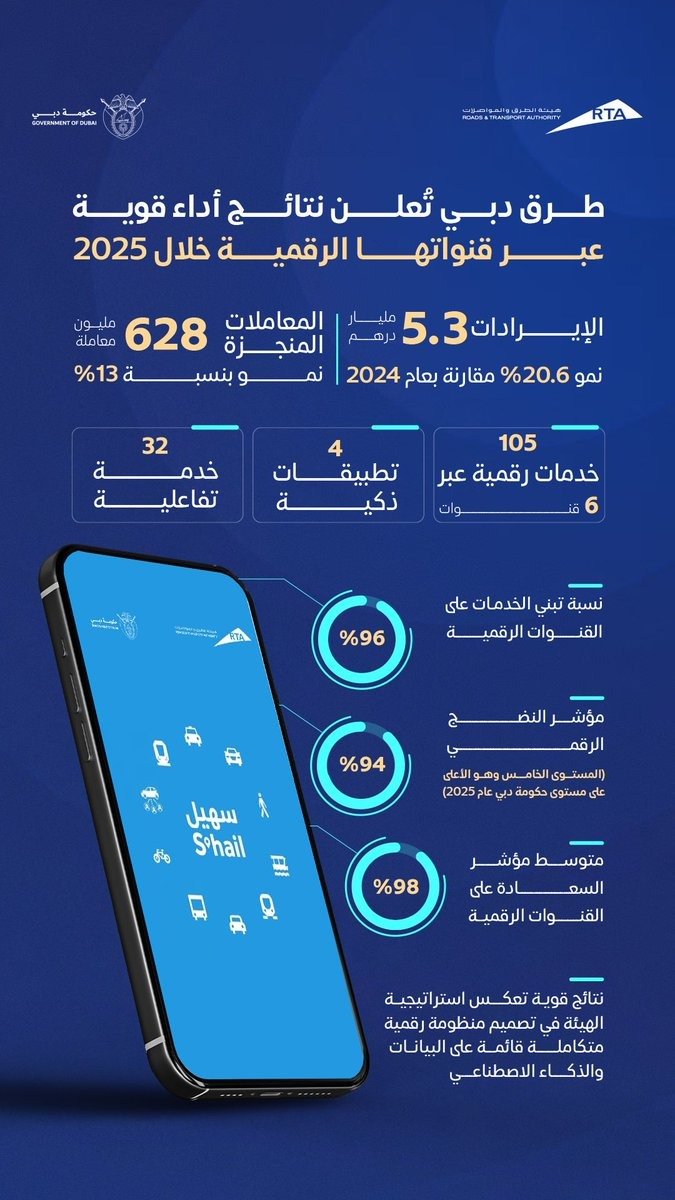
AED 5.3 billion, that is how much Dubai’s Roads and Transport Authority (RTA) collected through digital channels in 2025, a 20.6% jump from 2024, according to the authority’s official figures posted on its verified X account. The number lands alongside a record 628 million-plus digital transactions, confirming that the shift away from service counters is no longer a trend, it is the operating reality for the vast majority of Dubai residents.
Why Dubai’s Biggest Transport Bill Is Now Paid on Your Phone
RTA‘s digital ecosystem now spans 105 services across six channels, covering everything from Nol card top-ups and parking payments to vehicle licensing renewals, driver licence applications, permit processing, and fine settlements. When more than six hundred million transactions clear through apps, websites, kiosks, and integrated government payment rails in a single year, the infrastructure behind those taps and clicks is effectively running a mid-sized bank’s payment volume.
Digital adoption reached 96% in 2025, meaning only a small fraction of RTA customers are still walking into a physical service centre for routine transactions. The authority also reported an average customer happiness index of 98%, a core government performance KPI in Dubai, suggesting that the migration to digital has not come at the cost of service quality. For most residents, that translates directly into shorter queues, 24/7 access, and faster confirmation of payments and renewals.
What the Numbers Mean for Your Daily Commute and Monthly Budget
At city scale, routing hundreds of millions of payments through digital rails accelerates cash collection, reduces administrative overhead, and creates a unified audit trail that supports Dubai’s broader smart-city governance model. For private-sector operators, fleet managers, logistics firms, ride-hailing platforms, reliable digital processing of renewals and compliance payments reduces the operational downtime that physical counter dependency used to create. The 13% year-on-year rise in transaction volume also signals that more service categories are being added to the digital stack, not just existing ones growing in usage.
| Metric | 2024 Baseline | 2025 Figure | Change | Resident Impact |
|---|---|---|---|---|
| Digital channel revenue | ~AED 4.4bn (implied) | AED 5.3bn | +20.6% | More services funded without counter infrastructure costs passed on |
| Digital transactions | ~556m (implied) | 628m+ | +13% | Faster processing; less time waiting for confirmation |
| Digital services available | Not disclosed | 105 | , | Broader range of tasks completable without an in-person visit |
| Digital channels | Not disclosed | 6 | , | App, web, kiosk, and integrated payment options available |
| Digital adoption rate | Not disclosed | 96% | , | 96 in 100 customers already transacting digitally |
| Customer happiness index | Not disclosed | 98% avg | , | High satisfaction signals reliable uptime and user experience |
Three Wallet Scenarios: Renter, Job-Seeker, Business Owner
If you rent in Dubai and rely on public transport: The 96% adoption rate means RTA’s digital channels, including the RTA app for Nol top-ups, trip planning, and parking, are effectively the primary service window. You no longer need to budget time for a service centre visit for most routine tasks; renewals and payments can be handled outside office hours, reducing the indirect cost of lost working time.If you are actively job-seeking and need a driving licence or vehicle-related document: With 105 digital services available, licence applications, status checks, and fee payments can be tracked and completed online. The 98% happiness index suggests processing reliability is high, meaning fewer failed transactions or unexplained delays that could stall a job start date tied to a vehicle permit.If you run a business with a fleet or logistics operation: The 13% rise in transaction volume reflects growing use of digital channels for high-frequency compliance payments, renewals, permits, fines. Integrating your accounts payable workflow with RTA’s digital payment rails now is a practical step: manual fallbacks carry increasing friction as physical counter capacity shrinks relative to digital-first demand.Dubai RTA’s AED 5.3 billion digital revenue figure for 2025 is not just a government milestone, it is a signal that routine transport costs, compliance payments, and service renewals have permanently moved online for nearly all Dubai residents. For anyone still managing RTA transactions manually, the gap between digital and counter-based processing times will only widen as the authority continues expanding its 105-service digital catalog. The 98% customer happiness index suggests the infrastructure is stable enough to rely on, making now the right moment to consolidate transport payments into a single digital workflow.

New Zealand earthquake hits South Island
Powerful Earthquake Hits New Zealand's South Island, Tsunami Warning Issued
A magnitude 6.3 earthquake struck near the town of Te Anau in New Zealand's South Island on July 16, 2026, prompting authorities to issue a tsunami warning for parts of the west coast. Residents in affected coastal areas were urged to evacuate immediately and move to higher ground as emergency officials warned that damaging tsunami waves and coastal flooding were possible. The National Emergency Management Agency advised people in the affected area to make their way to the nearest high ground out of the tsunami evacuation zones or as far inland as possible.
The epicenter of the earthquake was reportedly located approximately 40 km north of Te Anau, which is the gateway to the tourist hotspot of Fiordland. The earthquake's depth was estimated to be around 50 km. The United States Geological Survey and the German Research Center for Geosciences initially pegged the earthquake at 5.9 on the Richter scale, although it was later reported as a 6.3-magnitude quake.
The tsunami warning was later downgraded to an advisory after no tsunami signals were detected, and it was eventually lifted. There were no immediate reports of injuries or damage. The New Zealand National Emergency Management Agency, along with other agencies such as GeoNet, monitored the situation and provided updates to the public.
This earthquake is the latest to affect New Zealand's South Island, which is prone to seismic activity. The region's unique geology makes it susceptible to powerful earthquakes, and authorities are always on alert for potential disasters. In this case, the swift response and evacuation warnings likely helped prevent any major damage or loss of life.
The National Emergency Management Agency's quick response and evacuation warnings were crucial in preventing any major damage or loss of life. The agency's advice to move to higher ground or as far inland as possible helped residents in the affected areas to stay safe.

Iraq Jordan Oil Pipeline Revival
Iraq and Jordan Revive Oil Pipeline Plan
The strategic intent behind Iraq and Jordan's decision to revisit their long-discussed oil pipeline plan is to diversify their export options and reduce reliance on the Strait of Hormuz, a chokepoint vulnerable to conflict or disruption. This move is driven by the need to ensure energy security and stability in the region, particularly in the face of heightened risks associated with the Strait of Hormuz crisis.
The drivers behind this renewed focus on the oil pipeline plan are largely economic and geopolitical. The Strait of Hormuz crisis has raised concerns about the reliability of Gulf shipping routes, prompting Iraq and Jordan to explore alternative export options. By developing a pipeline to Jordan's Red Sea outlet, Iraq can reduce its dependence on the Strait of Hormuz and mitigate the risks associated with shipping oil through this volatile region.
The stakeholders most affected by this development are the governments and energy stakeholders of Iraq and Jordan. The pipeline project has the potential to enhance energy security and stability in the region, providing a more reliable and efficient export route for Iraqi oil. Additionally, the project could also have a positive impact on the local economies of Iraq and Jordan, creating jobs and stimulating economic growth.
The business community, particularly those involved in the energy sector, will also be impacted by this development. The pipeline project could provide new opportunities for investment and trade, as well as create new jobs and stimulate economic growth. Furthermore, the project could also have a positive impact on the environment, as it could reduce the reliance on shipping oil through the Strait of Hormuz, which is a vulnerable and sensitive ecosystem.
On the other hand, some may argue that the pipeline project is not a viable solution to the region's energy security challenges. They may point out that the project is costly and complex, and that it may not be able to provide a significant increase in oil exports. Additionally, they may also argue that the project could have negative environmental impacts, particularly if it is not designed and implemented with adequate safeguards.
In conclusion, the revival of the Iraq-Jordan oil pipeline plan is a strategic move to enhance energy security and stability in the region. The project has the potential to provide a more reliable and efficient export route for Iraqi oil, reducing the risks associated with shipping oil through the Strait of Hormuz. While there may be challenges and uncertainties associated with the project, it is an important step towards diversifying export options and reducing reliance on vulnerable chokepoints.

Venezuela Twin Earthquakes Death Toll Rises
Venezuela Earthquakes: Death Toll Surpasses 4,800
The death toll from the twin earthquakes that struck Venezuela on June 24 has risen to 4,833, according to National Assembly President Jorge Rodriguez. Thousands more were injured and left homeless by the temblors, with 16,740 people reported injured and thousands still displaced. The earthquakes, which measured 7.2 and 7.5 in magnitude, caused widespread destruction in La Guaira state, prompting a large-scale national and international humanitarian response.
Rescue operations continue in the affected areas, with 6,462 people rescued and 94 temporary camps established to house 18,437 people. Authorities have distributed 9,766 metric tons of food and more than 16.6 million liters of water, while 31,193 patients have received medical treatment. The government has also deployed 31,837 personnel and 30,197 volunteers for relief efforts, supported by 2,422 international rescue workers.
The Venezuelan government has declared a disaster zone in La Guaira state and placed the region under military control. The United Nations has estimated that up to 68,000 people may be missing, making the disaster one of the deadliest in recent history. The earthquakes have had a devastating impact on the local population, with many families left without permanent housing or access to basic necessities.
The disaster has prompted an outpouring of international support, with countries such as Russia delivering humanitarian aid to the affected areas. The Venezuelan government has also declared seven days of national mourning for the victims of the earthquakes.
In the aftermath of the disaster, the Venezuelan authorities have been working to provide assistance to those affected, with 86,794 families receiving aid. The government has also established a relief fund to support the reconstruction efforts in the affected areas.
The twin earthquakes that struck Venezuela on June 24 have had a profound impact on the country, causing widespread destruction and loss of life. As the rescue operations continue, the international community remains committed to providing support and assistance to those affected by the disaster.
UAE weather alert: Rain in Al Ain, dust storms
Rain Alert in Al Ain and Eastern UAE: NCM Warns of Dust Storms and Rough Seas
The UAE's National Centre of Meteorology (NCM) has issued a weather alert for Al Ain and the eastern parts of the country, warning of convective clouds that may bring light to moderate rain, turning heavy at times. Motorists and beachgoers are advised to take extra precautions due to the possibility of blowing dust and reduced visibility.
The NCM's weather alert, which is in effect until 9pm today, also warns of rough seas in the Arabian Gulf and Oman Sea. However, sea conditions are expected to ease later tonight and remain mild for most of Friday. Temperatures are expected to remain high, with maximum levels reaching 48°C in some internal areas, while humidity is expected to ease slightly, dropping to around 80% from 95% over the past two days.
For tomorrow, Friday, July 17, the NCM has forecast partly cloudy conditions for most of the country, with a chance of convective cloud formation over eastern and southern areas, accompanied by rainfall. The maximum and minimum temperatures for various areas are as follows: Abu Dhabi (43-32°C), Dubai (44-31°C), Sharjah (44-31°C), Ajman (41-31°C), Umm Al Quwain (41-30°C), Ras Al Khaimah (43-32°C), Al Fujairah (36-33°C), Al Ain (46-33°C), Liwa (48-30°C), Al Ruwais (40-30°C), Sila (42-29°C), Dalma (38-31°C), and Abu Musa (37-32°C).
The weather pattern is expected to continue over the coming days, with convective clouds, gusty winds, and blowing dust expected in several eastern areas. Residents are advised to stay updated with the latest weather forecasts and take necessary precautions to ensure their safety.
The NCM has also issued a convective cloud alert covering parts of eastern Abu Dhabi from 2pm until 7:30pm, warning of cloud development that could bring rainfall. Light to moderate southeasterly to northeasterly winds are forecast to freshen at times, reaching speeds of up to 40km/h and causing blowing dust in exposed areas.
Residents can stay updated with the latest weather forecasts through the NCM's website or mobile app. It is essential to take necessary precautions and follow the instructions of local authorities to ensure safety during this period.
The National Centre of Meteorology (NCM) is the primary authority for weather forecasts and warnings in the UAE. The NCM's warnings and forecasts are based on the latest data and models, and residents are advised to follow their instructions to ensure their safety.
In conclusion, the UAE's National Centre of Meteorology (NCM) has issued a weather alert for Al Ain and the eastern parts of the country, warning of convective clouds, dust storms, and rough seas. Residents are advised to take necessary precautions and stay updated with the latest weather forecasts to ensure their safety.
Dubai RTA Auctions 150 Premium Licence Plates
RTA to Auction Premium Licence Plates in Dubai
The Roads and Transport Authority (RTA) in Dubai is set to auction 150 premium licence plates, including three-, four-, and five-digit plates, starting July 27, 2026. This online auction, the 83rd of its kind, provides an opportunity for motorists to secure distinctive vehicle registration numbers. Registration for the auction will open on July 20, 2026.
Auction Details
The auction will run for five days, and to participate, bidders must have a Dubai traffic file, a security cheque of Dh5,000, and pay a non-refundable fee of Dh120. Additionally, a 5% VAT will be applied to winning bids. These requirements are essential for anyone looking to take part in the auction and potentially drive away with a unique licence plate.Participation and Payment
For those interested in participating, the RTA has outlined clear requirements. Beyond the initial registration and fees, bidders must also consider the 5% VAT on their winning bids. The RTA's Customer Happiness Centers, located in Umm Ramool, Al Barsha, and Deira, will be available for registration and payment processes, making it convenient for potential bidders to complete the necessary steps.Auction Significance
This auction is part of the RTA's efforts to provide motorists with the opportunity to own unique and premium licence plates. The variety of plates on offer, including three-, four-, and five-digit numbers, caters to different preferences and vehicle types, including private, classic, and motorcycle vehicles. The online platform ensures accessibility and transparency throughout the bidding process.The RTA's initiative aligns with its mission to offer innovative services that meet the needs of Dubai's residents and visitors. By providing a regulated and fair auction process, the RTA ensures that the allocation of these premium licence plates is both exciting and equitable.
As the auction approaches, those interested in securing a premium licence plate should prepare by ensuring they have the necessary documents and funds. The RTA's online auction platform will be the go-to place for registration and bidding, offering a user-friendly experience for participants.
In conclusion, the upcoming RTA auction presents a unique opportunity for car enthusiasts and collectors in Dubai to acquire distinctive licence plates. With clear guidelines and a straightforward participation process, the RTA aims to make this experience as smooth and enjoyable as possible for all involved.