New Lane on Sheikh Zayed Road to Ease Morning Congestion
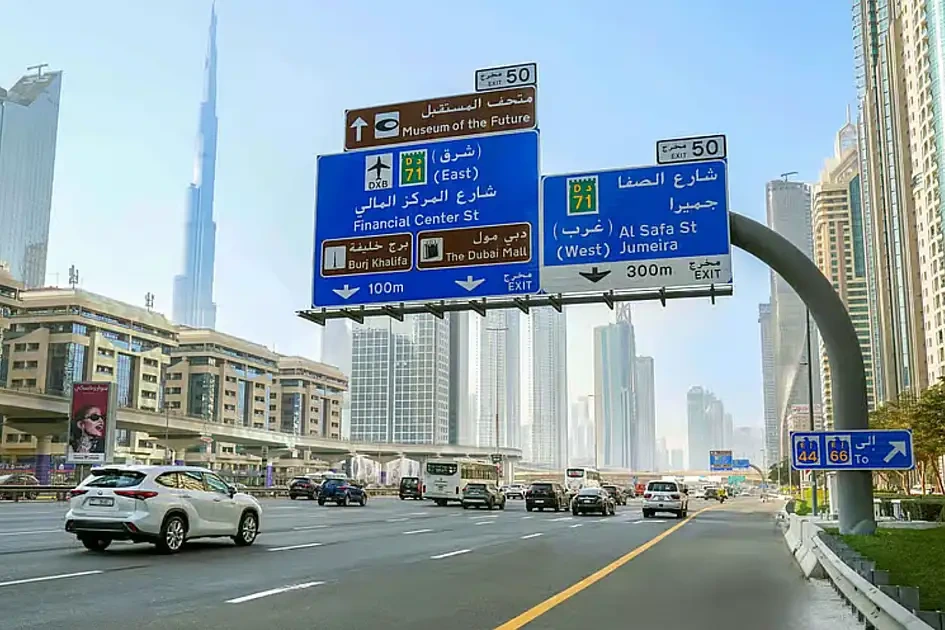
Dubai’s Road and Transport Authority (RTA) has expanded Sheikh Zayed Road over a 2-kilometre stretch to improve flow in high traffic areas. As part of the expansion, a new lane was added in the direction coming from Abu Dhabi and heading towards the World Trade Centre Intersection, near Burj Khalifa/Dubai Mall Metro Station. Local commuters are affected by this change, as the new lane aims to reduce morning and evening congestion on one of Dubai’s busiest highways.
The RTA is implementing a wider package of traffic improvement projects along Sheikh Zayed Road to improve traffic flow and keep up with the growing population’s demands. This comes after a new lane and two U-turns were opened on Latifa bint Hamdan Street, cutting traffic by up to 30 per cent. The expansion of Sheikh Zayed Road is part of the RTA’s ongoing efforts to enhance the city’s transportation infrastructure.
The new lane on Sheikh Zayed Road is located near the Burj Khalifa/Dubai Mall Metro Station, a key area with high traffic volume. This expansion is expected to have a positive impact on commuters who travel from Abu Dhabi to Dubai for work or other purposes.
This development is connected to previous RTA projects, such as the opening of new lanes on Ras Al Khor and Al Khail roads, which have also aimed to reduce traffic congestion in Dubai.

Abu Dhabi autonomous patrol boat trial nears success
Abu Dhabi Makes Waves with Autonomous Patrol Boat Trial
Abu Dhabi has successfully completed a second field trial of a 23-foot autonomous patrol boat near Al Saadiyat Ferry Terminal. The vessel, developed by Blue Gulf Group, underwent tests for navigation, vessel detection, collision avoidance, and its ability to operate safely without an onboard operator. Local maritime authorities, including Abu Dhabi Maritime and the Abu Dhabi Investment Office, collaborated on the trial, which aimed to develop autonomous patrol capabilities to support monitoring operations across public waterways in Abu Dhabi.
The successful trials highlight Abu Dhabi's commitment to embracing innovative technologies to enhance maritime monitoring, strengthen safety, and improve operational efficiency across its waterways. The development of autonomous maritime systems also reflects the UAE's broader vision of using advanced technology and artificial intelligence to build safer, smarter, and more sustainable transportation and security solutions.
The 23-foot autonomous patrol boat was tested for compliance with international rules of the sea (COLREGS) from a shore-based control room. The vessel's ability to navigate, detect other boats, avoid collisions, stop on command, and safely return to the control room was evaluated. These trials followed initial field tests with Blue Gulf Group in May 2026 and support next-generation maritime mobility in Abu Dhabi.
The trial is part of Abu Dhabi's efforts to develop smarter and safer maritime operations, under the supervision of the Smart and Autonomous Systems Council. The emirate's growing role as a hub for innovation and advanced maritime solutions is demonstrated through initiatives such as this autonomous patrol boat trial.
The autonomous patrol boat trial is connected to Abu Dhabi's previous initiatives in developing smart mobility frameworks, including the integration of autonomous vehicles and advanced transportation systems. This trial marks another step forward in the emirate's efforts to enhance maritime security and surveillance capabilities.

TDRA telecom licence renewal until 2046
UAE Telecoms Get 20-Year Licence Renewal
The Telecommunications and Digital Government Regulatory Authority (TDRA) has renewed the public telecommunications licences of Emirates Telecommunications Group (e&) and Emirates Integrated Telecommunications Company (du) for a further 20 years. The renewed licences will take effect from 9th August 2026 until 8th August 2046, replacing the licences originally issued in 2006. Local telecom operators are expected to benefit from the long-term regulatory framework, which supports continued investment in digital infrastructure and future technologies.
The renewal provides stability for the telecommunications sector, enabling the UAE to advance its AI-driven networks, digital infrastructure, and economy-wide transformation. The TDRA will continue monitoring compliance with licence conditions, protecting subscriber rights, and ensuring a fair and competitive telecommunications environment. The licences include enhanced obligations relating to network resilience, international connectivity, quality of service, and subscriber protection.
The UAE has ranked first globally in fibre-to-the-home penetration for the tenth consecutive year, reaching 99.7%. The sector has evolved from providing traditional telecommunications services to becoming a key enabler of digital transformation, smart cities, and government services. The TDRA's decision is expected to foster investments in AI-driven networks, digital infrastructure, and national connectivity, supporting the UAE's next phase of digital growth.
The renewal of the licences is based on the Federal Decree-Law on the Regulation of the Telecommunications Sector, as amended. The TDRA's Board of Directors announced the renewal, which will provide the sector with the stability required to sustain investment in digital infrastructure and future technologies.

UAE weather: Summer heat to ease after Suhail star rise
UAE Summer Heat to Gradually Ease After Suhail Star Appearance
The UAE has just passed through the peak of its traditional summer heat period, known as Ayam Al Ghayth, which usually lasts for about six weeks from early July to around August 10. Temperatures in the UAE have soared, crossing 51°C on August 5, with night-time lows reaching as high as 35°C. However, with the appearance of the Suhail star expected on August 24, residents can expect a gradual change in the weather.
The rise of the Suhail star has long been regarded as a seasonal marker across the region, and according to Ibrahim Al Jarwan, chairman of the Emirates Astronomy Society, the days following its rise should bring a steady, rather than dramatic, easing in temperatures. While actual temperatures are likely to begin declining, the increased humidity could make conditions feel uncomfortable at times.
As temperatures begin to fall, humidity levels are expected to increase, which means residents may still experience a strong sensation of heat, even when thermometer readings are lower than they were during the height of summer. September and October are typically among the UAE's most humid months, and the rising moisture may also bring early-morning fog and dew, with the first signs possible from late August and becoming more common through September.
Residents should also not rule out short-lived returns of intense heat, known as Zafarat Al Qayth, which can occur after the peak season has passed. Such spells do not alter the overall seasonal trend but can bring temporary increases in temperatures before conditions become more stable around the autumn equinox on September 23. After that, evenings are expected to become progressively more pleasant, with cooler daytime conditions taking longer to arrive, likely in November, and a broader seasonal cooling trend continuing into mid-December.
The appearance of the Suhail star does not cause changes in the weather but serves as a reliable marker in the traditional Arabian calendar, coinciding with the gradual transition away from peak summer conditions. As the UAE transitions into a new season, residents can expect a gradual easing of the summer heat, but patience will be needed as humidity, fog, and occasional hot spells remain part of the weather environment.

Fujairah property market to rise 20%
Etihad Rail to Boost Fujairah Property Market
The launch of Etihad Rail's passenger network is expected to transform Fujairah's real estate market, with property values near stations predicted to rise by 20 to 30 per cent between 2029 and 2031. According to Nasar Tajalli, general manager of Fujairah Real Estate Agency, demand is likely to emerge first around the Fujairah and Sakamkam station areas, with healthy interest in residential plots and villas, followed by retail and mixed-use developments.
| Category | Amount |
|---|---|
| Searches for property sales in Fujairah | 8,337 |
| Rent leads | 1,306 |
| Sale leads | 92 |
The improved connectivity provided by Etihad Rail is expected to make Fujairah a more viable place to live, work, and invest, with shorter commutes, better amenities, and increased employment opportunities. Fibha Ahmed, vice-president of Sales at Bayut and dubizzle Property, notes that the launch of Etihad Rail's passenger services could be a major turning point for Fujairah's real estate market, making previously overlooked markets more attractive to residents and investors.
Fujairah already offers relatively affordable homes, larger properties, and a distinct lifestyle, with rail connectivity strengthening that proposition for buyers who want better value while remaining connected to the country's major employment centres. The impact of Etihad Rail is expected to extend beyond residential demand, supporting tourism, attracting business activity, and encouraging investment in infrastructure and mixed-use developments.
One potential risk to consider is that the predicted growth in property values may not materialize if the demand for housing in Fujairah does not increase as expected. However, with search activity and rent leads already surging across the emirate, it seems likely that the improved connectivity provided by Etihad Rail will have a positive impact on the local real estate market.

Dubai traffic: 10 to 2 minutes
New Bridge Cuts Dubai World Trade Centre Exit Time
On Al Mustaqbal Street, a new 500-metre bridge is set to open, significantly reducing travel time for motorists leaving Dubai World Trade Centre from 10 minutes to just 2 minutes. This bridge, part of the Dh633-million Al Mustaqbal Street Development Project, aims to increase road capacity by 33 per cent. The project, undertaken by the Roads and Transport Authority (RTA), will eventually enable Al Mustaqbal Street to handle 8,800 vehicles per hour in both directions, up from the current 6,600, and reduce journey time along the corridor from 13 minutes to six minutes.
The new bridge will provide a direct connection from Dubai World Trade Centre and One Central towards Al Mustaqbal Street and Za’abeel Palace Street, greatly improving traffic movement around the area, especially during major events. The Al Mustaqbal Street project stretches 3.5km from Financial Centre Street to Za’abeel Palace Street and includes widening the road from three to four lanes in each direction, as well as constructing around 2km of bridges and tunnels. This development is expected to benefit around half a million residents and visitors, enhancing access to key areas such as Dubai World Trade Centre, Dubai International Financial Centre (DIFC), Za’abeel, Downtown Dubai, and Business Bay.
Further improvements are planned, with three tunnels spanning a combined 1,500 metres scheduled to open in February 2027 at the intersection of Al Mustaqbal Street and Trade Centre Street. The largest tunnel will be a three-lane tunnel on Al Mustaqbal Street towards Deira, with a capacity for 4,500 vehicles per hour. Additionally, a new pedestrian bridge on Al Sukook Street, upgraded pedestrian walkways, a cycling track, and improvements to existing intersections are part of the project. RTA also plans to open another bridge by the end of August for traffic travelling from Sheikh Rashid Road towards 2nd December Street, and the final bridge under the World Trade Centre Roundabout project is scheduled to open in October.
The ongoing development of Dubai's infrastructure, particularly the Al Mustaqbal Street project, aligns with the emirate's strategic plans to enhance its transportation network and reduce congestion. By investing in such projects, Dubai aims to improve the quality of life for its residents and visitors, making it an attractive destination for business and tourism.