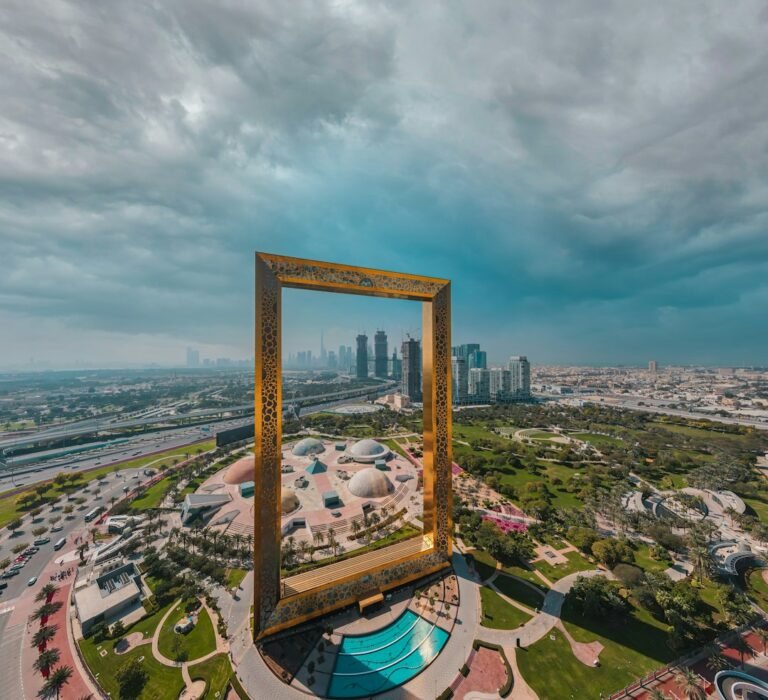
Step into a Dubai Metro station and you’ll see smart gates scanning Nol cards, AI-powered cameras monitoring passenger flow, and mobile apps updating train schedules in real time. Beyond the station, autonomous shuttles are on trial, drones monitor construction, and paperless services run from the palm of your hand. This is not science fiction—it’s the Smart Dubai vision in action.
What Makes Dubai a Smart City
Dubai launched its Smart City strategy to digitize government, modernize services, and enhance quality of life. Through the DubaiNow app, residents can access over 130 services—from paying utility bills to renewing car registrations—without paperwork. The government’s decision to go 100% paperless by 2021 has saved billions of dirhams and millions of labor hours (u.ae).
The city’s smart transformation isn’t only about convenience—it’s also about competitiveness. By embedding AI, blockchain, and IoT across systems, Dubai aims to attract investors, create jobs, and position itself as a global digital hub.
Key Sectors Driving the Transformation
• Digital Governance: Blockchain-based land registries under the Dubai Land Department and AI-powered customer service bots in public portals.
• *Mobility: Self-driving taxis under trial by the *Roads and Transport Authority (RTA) and plans to make 25% of journeys autonomous by 2030.
• *Healthcare: AI-driven diagnostics, telemedicine expansion, and blockchain-secured patient records via the *Dubai Health Authority.
• *Energy and Sustainability: Smart meters, solar grid integration, and smart irrigation supporting the *Net Zero 2050 strategy.
• Safety: Predictive policing and AI surveillance led by Dubai Police to maintain one of the world’s safest city rankings.
Evidence on the Ground
• DubaiNow transactions exceeded millions annually, proving adoption of paperless governance.
• Smart grids and the Mohammed bin Rashid Solar Park supply clean power, making communities more sustainable.
• DIFC has become a fintech hub using blockchain to streamline trade finance and regulatory compliance.
• RTA pilots of autonomous vehicles and drone taxis are already underway, signaling a future of driverless mobility.
Federal and Global Context
Dubai’s smart push aligns with UAE-wide strategies like the UAE National Digital Economy Strategy and Artificial Intelligence Strategy 2031. Internationally, the emirate benchmarks itself against Singapore, Seoul, and London, positioning its urban model as a case study for smart governance and economic diversification.
Challenges and Adaptations
The rapid rollout of new technologies brings challenges: cybersecurity, cost of adoption for SMEs, and data privacy. However, proactive regulations, public-private partnerships, and investments in digital literacy are addressing these gaps. The city’s model is iterative—testing, refining, and scaling.
Where the Momentum is Heading
• Autonomous transport integration with metro, buses, and last-mile solutions.
• Blockchain adoption in trade, real estate, and healthcare.
• AI copilots in education and city planning.
• Green smart housing with IoT energy optimization.
SEO and AI SEO Keywords and Phrases
• Dubai smart city initiatives
• Smart Dubai strategy
• DubaiNow government services
• Dubai blockchain projects
• Dubai AI adoption
• RTA autonomous transport Dubai
• Dubai smart healthcare
• Dubai Net Zero smart grids
• DIFC fintech blockchain Dubai
• Dubai smart policing AI
Meta Title
Dubai Smart City Initiatives | AI, Blockchain, and Paperless Governance
Meta Description
Explore Dubai’s smart city transformation. From AI and blockchain to autonomous transport and paperless governance, see how technology shapes daily life.

6 Months Outside UAE Residence Visa: What Happens Next
6 Months Outside UAE on a Residence Visa? Here's Exactly What Changes When You Try to Return
If you've been outside the UAE for more than six months on a residence visa, this changes everything about how you plan your return flight. Your visa may be treated as inactive by immigration systems, meaning you can't simply land at Dubai International and walk through on your existing residency status, you'll need an additional step before you board. The authority overseeing this is ICP (the Federal Authority for Identity, Citizenship, Customs and Port Security), and the mechanism available to you is a re-entry permit.
What Actually Happens to Your Residence Visa After Six Months Abroad
UAE residence visas are built on the assumption that you maintain a continuing, active connection to the country. When you remain outside the UAE beyond six months, immigration systems can flag your residency as no longer active for re-entry purposes, not necessarily cancelled outright, but effectively blocked at the border until you regularise your status. This applies whether you're on a company-sponsored employment visa or a family-sponsored dependent visa.
The re-entry permit is the bridge back. Once approved, it gives you a one-month window to physically return to the UAE. After you're back on UAE soil, you can then proceed with the standard residence visa renewal process, which typically involves medical screening, Emirates ID renewal, and sponsor confirmation through the relevant channels.
Before vs. After: How the Six-Month Rule Changes Your Return Plan
| Situation | Before 6 Months Abroad | After 6 Months Abroad |
|---|---|---|
| Re-entry method | Existing residence visa | Re-entry permit required first |
| Border clearance | Standard immigration lane | May be blocked without permit |
| Time window to return | Visa validity period | 1 month from permit approval |
| Visa renewal timing | Anytime before expiry | After physical return to UAE |
| Who is affected | All resident visa holders | Employees, dependants, family sponsors |
| Key authority | ICP / GDRFA Dubai | ICP / GDRFA Dubai |
Who Feels This Most, and What It Costs You in Real Terms
If you're an employee on company sponsorship, your HR team needs to know your travel duration before you hit the six-month mark. Missing the return window doesn't just create a visa problem, it can interrupt your employment continuity, delay onboarding back into your role, and trigger rebooking costs if you've already purchased a return flight that can't be used until the permit is in place. Employers and PRO teams should be tracking time-outside-UAE as a compliance control, not an afterthought.
If you're a dependent on a family visa, a spouse, child, or parent sponsored by a UAE resident, the same rule applies to you. An inactive visa status can cascade into disrupted school enrolment, frozen bank account access, and complications with tenancy renewals, since many landlords and utility providers verify residency status. The one-month re-entry permit window is tight, so the application should be initiated well before you intend to travel back.
If you're a UAE resident who travelled for medical treatment, a long-term family care situation, or an overseas work assignment, the six-month threshold can arrive faster than expected. GDRFA Dubai handles re-entry matters for Dubai-based residents, while ICP covers the broader federal process, knowing which authority applies to your emirate of residency is the first practical step.
Key Facts at a Glance
- Absence threshold: More than six months outside the UAE can trigger inactive residency status
- Re-entry permit validity: Typically one month from approval, you must enter within this window
- Who it affects: All UAE residence visa holders, including employment and family-sponsored dependants
- After return: Normal residence visa renewal steps apply once you're back in the UAE
- Governing authorities: ICP (federal) and GDRFA Dubai (Dubai-specific residents)
Your Next Steps Before You Book That Return Flight
1. Check your absence duration, Count the days from your last UAE departure stamp. If you're approaching or past six months, do not assume your residence visa will clear immigration automatically.2. Apply for a re-entry permit via ICP, Visit the ICP smart services portal (icp.gov.ae) to apply for the return/re-entry permit. Dubai residents can also approach GDRFA Dubai through their smart app or service centres.3. Book your return flight within the permit window, The permit is valid for one month. Confirm your travel dates align with that window before purchasing tickets.4. Prepare for visa renewal on arrival, Once back in the UAE, initiate your residence visa renewal through your sponsor (employer via MoHRE, or family sponsor via ICP/GDRFA Dubai). This will include medical fitness testing and Emirates ID renewal at a Federal Authority for Identity, Citizenship, Customs and Port Security-approved centre.5. Notify your sponsor in advance, Whether it's your employer's HR/PRO team or your family sponsor, give them lead time. Residence visa renewals require sponsor-side action and cannot be completed by the resident alone.Six months outside the UAE is the line between a straightforward return and a multi-step re-entry process, and the one-month re-entry permit window leaves little room for delays. Apply through ICP or GDRFA Dubai before you book your flight back, not after. Once you're on UAE soil, the standard renewal process picks up from there.

Islamic New Year 2026 UAE Public Holiday: June 16 or 17?
Islamic New Year 2026 UAE Public Holiday Could Land on June 16 or 17, Here's How to Plan Around the Uncertainty
If you're trying to lock in leave, rosters, or a quick getaway, the Islamic New Year 2026 UAE public holiday is your next day off after Eid Al Adha, and right now, it sits on a knife-edge between June 16 and June 17, 2026.
Why the Date Is Still a Two-Day Window
Islamic New Year marks 1 Muharram 1448 AH, the first day of the new Hijri year. Because the Hijri calendar is lunar and runs roughly 10 to 11 days shorter than the Gregorian calendar each year, the exact start of Muharram can only be confirmed once the new crescent moon is officially sighted. In the UAE, that determination goes through a formal moon-sighting process, after which the UAE Cabinet or relevant federal authority issues the official confirmation.
That is why every credible projection right now gives you two possible dates. Astronomical calculations point to June 16 or June 17, 2026 as the most likely candidates, but neither is locked in until the official announcement drops, typically within 24 to 48 hours of the expected sighting window. Until then, treat both dates as live.
What This Means for Your Week, Sector by Sector
The holiday applies nationwide across both public and private sectors. Government service counters, licensing offices, and court registries will be closed on the confirmed date. For residents with pending transactions at the Dubai Land Department (DLD), the Identity and Citizenship Authority (ICP), or the Ministry of Human Resources and Emiratisation (MoHRE), factor this into any mid-June deadlines you're working toward.
If you're an employee planning annual leave, June 16 falls on a Tuesday and June 17 on a Wednesday. Neither creates an automatic long weekend on its own, but a Tuesday holiday makes Monday a natural bridge day for a four-day break if your employer approves. A Wednesday holiday splits the week differently. Submit your leave request now with a note that the exact date is pending official confirmation, so HR can adjust without a last-minute scramble.If you're an employer or HR manager, the one-day variance directly affects shift rosters, payroll attendance records, delivery cut-off windows, and any SLA commitments to clients. Sectors running continuous operations, aviation, hospitality, retail, logistics, and healthcare, should prepare two roster versions and communicate clearly with staff that the final call depends on the moon-sighting announcement. MoHRE's standard guidance on public holiday pay applies on the confirmed date.If you're a parent or school administrator, school calendars for the week of June 15, 19 should be treated as provisional until the Ministry of Education or individual school management issues a confirmed circular following the official announcement.June 2026 Holiday Snapshot
| Detail | Current Status |
|---|---|
| Holiday name | Islamic New Year (1 Muharram 1448 AH) |
| Projected date | June 16 or June 17, 2026 |
| Confirmation method | Official UAE moon-sighting announcement |
| Applies to | Public and private sector (nationwide) |
| Day of week (June 16) | Tuesday |
| Day of week (June 17) | Wednesday |
| Long-weekend potential | Yes, if June 16 (bridge to weekend via Monday leave) |
| Status as of June 1, 2026 | Unconfirmed, UAE Cabinet announcement pending |
Next Steps Before the Announcement
1. Watch for the official UAE Cabinet announcement via the UAE Government's official channels and UAE Pass notifications, this is where the confirmed date will first appear. 2. Submit provisional leave requests now through your company's HR portal, flagging June 16/17 as the target window pending confirmation. 3. Check ICP (icp.gov.ae) if you have a visa renewal, Emirates ID, or residency transaction due in mid-June, plan to complete it before June 14 or after the holiday to avoid a missed deadline. 4. Check DLD (dubailand.gov.ae) if you have a property registration or NOC deadline falling that week, DLD counters will be closed on the confirmed holiday date. 5. Check MoHRE (mohre.gov.ae) for the latest circular on public holiday compensation rules if you operate in a sector where staff work on official holidays.The UAE's next public holiday after Eid Al Adha 2026 is Islamic New Year, expected on either June 16 or June 17, the final call rests with the official moon-sighting outcome. Whether you're planning a short break or managing a business roster, prepare for both dates now rather than waiting for the announcement. Once the UAE Cabinet confirms the sighting, update your plans immediately, the window between confirmation and the holiday itself can be less than 24 hours.

UAE Golden Visa for Content Creators: 5 or 10 Years
UAE Golden Visa for Content Creators Now Offers 5 or 10-Year Residency, Here's Exactly Who Qualifies
If you're a content creator, influencer, filmmaker, or artist building a career in the UAE, the UAE Golden Visa for content creators could be the most consequential residency move you make this year. Long-term residency, typically issued for either five or ten years, is now a realistic pathway for creatives who can demonstrate proven impact, credible recognition, or strong potential to contribute to the UAE's creative economy.
What Changed, and What It Means for Your Residency Status
Previously, most creators in the UAE operated on short-cycle employment or freelance visas, which meant renewals every one to three years, dependency on sponsor structures, and limited ability to plan multi-year projects or investments. The Golden Visa framework removes that ceiling. Once approved, you hold long-term residency independently, no employer sponsor required, which changes how you negotiate contracts, invest in equipment, and structure your business.
The Federal Authority for Identity, Citizenship, Customs and Port Security (ICP) oversees the Golden Visa programme at the federal level. Applications follow a two-stage process: first, an eligibility or nomination review where your profile and supporting evidence are assessed; then, if approved, the standard residency formalities, medical fitness test, biometrics, Emirates ID processing, and visa stamping. Whether you apply from inside the UAE or from abroad affects the exact sequence and attestation requirements, so confirm your route with ICP before submitting.
Before vs. After: How the Golden Visa Shifts a Creator's Situation
| Factor | Standard Short-Term Visa | UAE Golden Visa (Creator Route) |
|---|---|---|
| Residency duration | 1, 3 years (renewable) | 5 or 10 years |
| Sponsor dependency | Employer or sponsor required | Independent residency |
| Career planning horizon | Short-cycle, renewal pressure | Multi-year projects viable |
| Business structuring | Limited flexibility | Trade licence / freelance permit can align with long-term status |
| Eligibility trigger | Employment contract | Proven track record, recognition, or strong potential |
If You're a Digital Creator or Influencer
Your eligibility case rests on demonstrable professional standing. That means a portfolio showing consistent output, channel links, published campaigns, verified audience reach, major brand collaborations, or press coverage. Contracts and reference letters from agencies or brands strengthen the application. A UAE-issued freelance permit or trade licence showing you operate lawfully in the country is also standard supporting documentation. Financial stability evidence (proof of income) is commonly expected alongside the portfolio.
If you're a filmmaker or artist, the same logic applies but the evidence shifts toward film credits, awards, festival selections, exhibition records, or institutional recognition. The core question the reviewing authority is asking is: does this person generate economic and cultural value for the UAE's creative community? Your documentation needs to answer that directly.
What You Actually Need to Prepare
- Valid passport: Current, with sufficient validity for residency processing.
- Professional portfolio: Links to channels, published work, campaigns, film credits, or press coverage demonstrating track record or recognition.
- Supporting evidence: Contracts, reference letters, awards, certifications, or verified audience/reach data.
- Financial documentation: Proof of income or financial stability as applicable to your route.
- Operating documentation: Trade licence, freelance permit, or company ownership documents showing lawful UAE activity.
- Medical fitness and health insurance: Standard components of UAE residency processing.
Next Steps: How to Move Forward
1. Check your eligibility category on ICP's portal (icp.gov.ae), confirm whether you fall under the creative talent or specialist professional pathway and which visa duration (5 or 10 years) applies to your profile. 2. Compile your portfolio and supporting documents before initiating any application, gaps in evidence are the most common reason for delays. Include contracts, brand collaboration records, awards, and income proof. 3. Ensure your UAE operating structure is in order, if you don't yet hold a freelance permit or trade licence, resolve this before applying. The relevant licensing authority in Dubai is typically the Department of Economy and Tourism (DET) or a free zone authority depending on your activity. 4. Submit your nomination/eligibility application through ICP and track status via the ICP smart services portal or the UAEICP app. 5. Complete residency formalities once approved, medical test, biometrics, and Emirates ID steps are processed through ICP-linked service centres. Visa stamping follows upon clearance.The UAE Golden Visa for content creators is a genuine long-term residency option, not a shortcut, and the strength of your application depends entirely on the quality of evidence you bring to it. Treat your portfolio, contracts, and operating documents as your application, not an afterthought. If your professional record is solid, the pathway is open; if it isn't documented, even a strong career won't carry the case.
FAQ

UAE Football Association Sacks Coach Cosmin Olaroiu
UAE Football Association Terminates Cosmin Olaroiu's Contract After Just Over a Year in Charge
The UAE Football Association (UAEFA) has terminated the contract of national team head coach Cosmin Olaroiu and his entire technical staff, effective June 1, 2026. Every UAE football supporter, club operator, and player in the national-team pool is now waiting on the federation's next move.
UAEFA Confirms Full Technical Staff Exit, Replacement Announcement Pending
The UAEFA confirmed the departure covers not just Olaroiu but his full technical unit, a standard outcome when a national program is built around a single integrated methodology. The Romanian coach had been in the role for just over a year. No reason for the termination was provided in the federation's statement.
The UAEFA said it will announce the new technical staff soon. That timeline carries weight: national-team programs require continuity in sports-science protocols, scouting criteria, and match-preparation routines, all of which reset when a coaching group exits. The next FIFA international window will be the first real test of how quickly the incoming staff can establish a working identity.
What Changes Now for Players, Clubs, and Fans
The most immediate practical shift is squad selection. A new technical staff typically revises call-up criteria from the first camp it runs, which can alter the balance between UAE Pro League performers and overseas-based players. UAE clubs will also need to factor in potential changes to player workload management and camp scheduling once the UAEFA confirms its replacement appointment.
- Coaching exit scope: Olaroiu and the full technical staff, assistants, analysts, and support roles, have all had their contracts terminated.
- Tenure length: Olaroiu served just over one year as UAE national team head coach.
- Reason given: None stated publicly by the UAEFA.
- Next step: UAEFA has confirmed a new technical staff announcement is forthcoming, with no date specified.
The UAEFA's decision ends Cosmin Olaroiu's tenure after roughly a year, with the full technical unit also departing. The federation has committed to naming a replacement staff shortly, leaving the national team program in a brief but consequential transition. How quickly the UAEFA moves will signal whether the priority is immediate qualification results, longer-term squad development, or a combination of both.*Source: UAE Football Association official channels via Khaleej Times / MSN, June 1, 2026.*

Cancel UAE Residence Visa: Step-by-Step Guide
Last Updated: June 1, 2026, Review quarterly. Process guides become unreliable fast.How to Cancel a UAE Residence Visa: The Sponsor-Led Process Employees and Families Must Follow
If you need to cancel a UAE residence visa, whether you're leaving a job, relocating, or restructuring family sponsorship, the process starts with your sponsor, not you, and getting the sequence wrong creates real delays. This guide is for UAE residents in Dubai (employees and their dependents) who want to complete the cancellation cleanly through GDRFA, either online or in person, without leaving loose ends on their immigration file.
Who This Guide Is For
This guide is for two groups: employees whose residence visa is tied to an employer-sponsor, and family members (spouses, children, parents) whose visa is held under a family sponsor. It covers the full cancellation workflow as administered by the General Directorate of Residency and Foreigners Affairs (GDRFA) in Dubai, including the correct order of cancellation, what documents you'll need to have ready, and where to submit.If you're in Abu Dhabi or another emirate, the authority changes, Abu Dhabi uses the Federal Authority for Identity, Citizenship, Customs and Port Security (ICP), but the sponsor-led logic and dependent-first sequencing broadly applies across the UAE.The One Rule That Trips Up Most Families: Cancel Dependents First
UAE immigration practice requires that dependents' residence visas are cancelled before the primary sponsor's visa is cancelled. If a family sponsor cancels their own visa first, dependent family members are left linked to an inactive sponsorship file, and that creates a compliance problem that takes additional steps to untangle.For employees, the employer's PRO (Public Relations Officer) or authorised signatory handles the submission on behalf of the company. The employee does not initiate this independently. For family files, the sponsoring spouse or parent drives the process, cancelling each dependent's visa in sequence before addressing their own.This sequencing is not optional. Build it into your offboarding or relocation timeline from day one.Exact Costs: What GDRFA Charges for Visa Cancellation
The source data for this guide does not include specific government fee figures verified at the time of publication. Providing invented numbers here would be worse than useless, fees vary by emirate, service channel (online vs. Amer Centre vs. typing centre), and resident category.What is confirmed:- Government processing fees apply: There is a core GDRFA fee for residence visa cancellation. The exact amount should be confirmed directly via the GDRFA Dubai website or the ICP smart services portal before you submit.
- Typing/service centre fees are additional: If you submit through an Amer Centre or approved typing centre rather than online, expect a separate service charge on top of the government fee.
- Channel affects total cost: Online self-service is generally the lowest-cost route. In-person counter service at an Amer Centre adds a service fee. Third-party typing centres add their own margin.
- Keep all receipts and reference numbers: You will need these if the cancellation doesn't reflect in the system within the expected processing window, or if a linked record (Emirates ID, labour file) needs to be updated separately.
Required Documents for UAE Residence Visa Cancellation
Document requirements can vary by category and emirate. The following are the standard documents that GDRFA and immigration processing channels typically require to locate and action a residency file. Confirm the exact checklist with GDRFA or your Amer Centre before visiting.For Employees (Employer-Sponsored): - Original passport of the visa holder - Emirates ID of the visa holder - Visa/residency file number (from the existing visa stamp or residency permit) - Employer's trade licence copy (submitted by the PRO/authorised signatory) - Authorisation letter from the employer (if applicable) - Completed cancellation application form (available via GDRFA portal or at the service centre)For Family-Sponsored Dependents: - Original passport of the dependent - Emirates ID of the dependent - Visa/residency file number of the dependent - Passport and Emirates ID of the sponsoring family member - Completed cancellation application formImportant: If there are outstanding fines, immigration holds, or mismatched identity records on the file, these must be resolved before cancellation can proceed. GDRFA will flag these at the point of submission. Check your file status in advance through the GDRFA smart app or ICP portal to avoid a wasted trip.Step-by-Step: How to Cancel a UAE Residence Visa Through GDRFA Dubai
For Families, Complete These Steps in Order1. Identify all dependents on the sponsorship file. Log into the GDRFA Dubai smart app or visit [gdrfad.gov.ae](https://www.gdrfad.gov.ae) to view all visas linked to your sponsorship number. Confirm which dependents need to be cancelled first.2. Resolve any outstanding fines or holds. Check each dependent's file for unpaid fines or immigration holds via the GDRFA app or ICP smart services portal. Pay or dispute any outstanding amounts before proceeding, unresolved issues will block cancellation.3. Submit each dependent's cancellation request, one at a time, in sequence. Do this via the GDRFA Dubai smart app (online route) or in person at an Amer Centre. You will need the dependent's passport, Emirates ID, and residency file number for each submission. Pay the applicable fee and collect the reference number.4. Confirm each dependent cancellation is reflected in the system. Do not proceed to the next step until the previous dependent's cancellation is confirmed. Check status via the GDRFA app using the reference number provided.5. Submit the primary sponsor's cancellation request. Once all dependents are cancelled, the sponsor (or employer PRO, for work visas) submits the primary visa cancellation through the same channel, GDRFA smart app online, or in person at an Amer Centre.6. Collect the cancellation confirmation. GDRFA issues a cancellation confirmation document. Keep this. You will need it to close linked accounts (utilities, bank accounts, tenancy agreements) and to confirm your status if you re-enter the UAE or apply for a new visa.7. Surrender or update the Emirates ID. Emirates ID linked to a cancelled residence visa must be handled through the Federal Authority for Identity, Citizenship, Customs and Port Security (ICP). The ID becomes invalid upon visa cancellation. ICP manages Emirates ID deactivation, this is a separate step from the GDRFA visa cancellation itself.For Employees, Employer-Led Process1. Employer PRO initiates the cancellation. The employer's authorised signatory or PRO submits the cancellation request through the GDRFA business portal or at an Amer Centre. The employee does not submit this independently.2. Employee provides required documents to the PRO. Hand over your original passport and Emirates ID to the PRO for submission. Confirm with your HR department exactly what the company requires from you and the timeline they are working to.3. Check for outstanding fines on your file. The PRO should flag any holds, but verify independently via the GDRFA app using your residency file number. Unresolved fines delay cancellation and can affect your ability to exit the UAE cleanly.4. PRO submits the application and pays the fee. The employer bears the cost of the cancellation fee in most standard employment exit scenarios, but confirm this with your HR or finance team, arrangements vary.5. Collect your cancellation confirmation from the employer. Once GDRFA processes the cancellation, the employer receives the confirmation. Request a copy for your own records immediately. Do not leave without it.6. Update Emirates ID with ICP. As with family cancellations, your Emirates ID is deactivated upon visa cancellation. ICP handles this separately from GDRFA.Where to Submit: Your GDRFA Dubai Service Options
- Online (lowest cost, fastest for straightforward files): GDRFA Dubai Smart App or gdrfad.gov.ae, available 24/7 for most standard cancellation cases.
- Amer Centres (in-person, Dubai): Multiple locations across Dubai. Bring originals and copies of all required documents. Service fees apply on top of government fees.
- Approved typing centres: Can assist with form preparation and submission. Additional service charges apply. Use only GDRFA-approved centres.
What Happens If You Don't Cancel Properly
A residence visa that is not formally cancelled does not simply expire quietly. Overstaying a visa, or leaving the UAE without completing the cancellation, generates fines that accumulate daily and are recorded against your passport. These fines must be settled before you can re-enter the UAE or apply for a new visa under any category.For employees, an uncancelled work visa can also block the employer from issuing new work permits under their quota, creating a problem that lands on HR and PRO capacity long after the employee has left. For family sponsors, dependents left on an inactive file create a compliance gap that GDRFA will require to be resolved before any new sponsorship activity is approved.The administrative cost of fixing a poorly handled cancellation is always higher than doing it correctly the first time.Cancelling a UAE residence visa is a sponsor-led process, the resident cannot do it alone, and for families, the sequence of cancellation is fixed: dependents first, primary sponsor last. GDRFA in Dubai handles the process online via the smart app or in person at Amer Centres, with fees that vary by channel and category. Get the confirmation document, update your Emirates ID with ICP, and resolve any outstanding fines before you start, those three steps prevent the majority of delays.