(Credit - What's On)
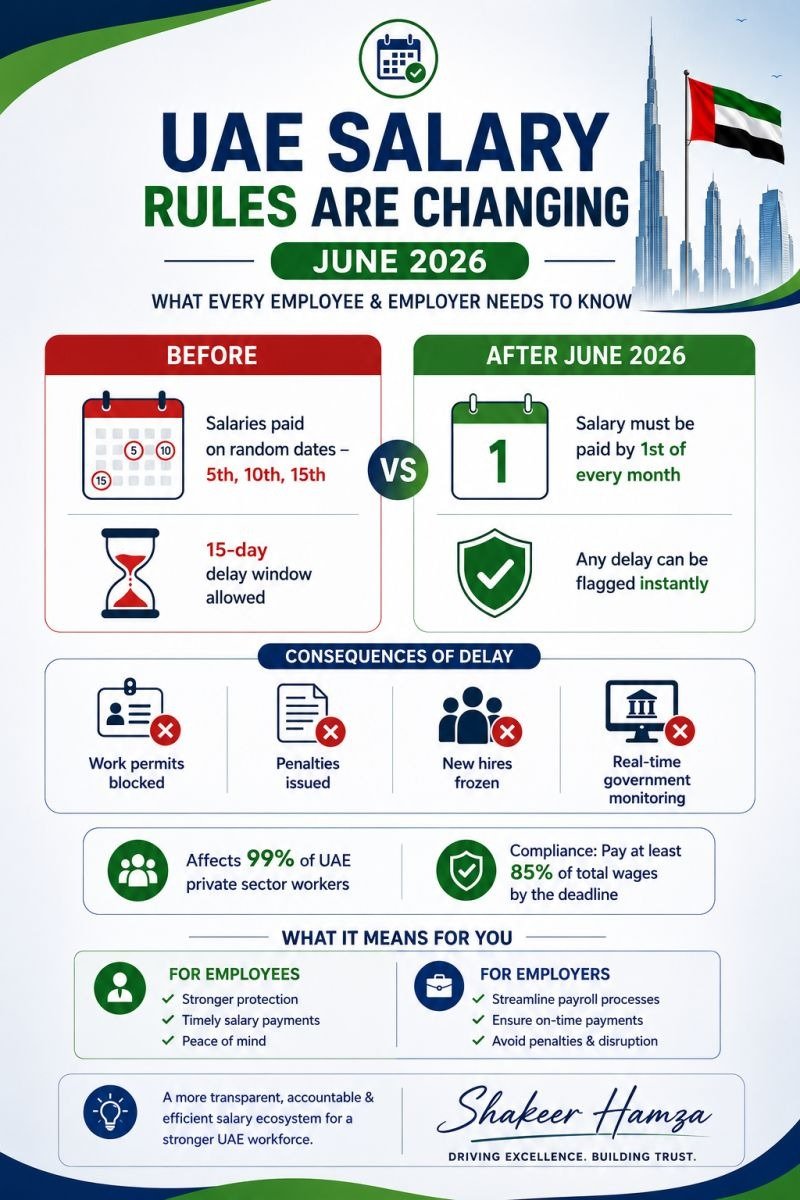
What is the MOHRE salary rule from 1 June 2026?
Under Ministerial Resolution No. 0340 of 2026, issued by the Ministry of Human Resources and Emiratisation on 12 May 2026 and in force from 1 June 2026, private-sector employers must pay wages no later than the first day of each month for the previous month’s work. Payment must go through the Wage Protection System (WPS) or another MOHRE-approved system. The resolution replaces Ministerial Resolution No. 598 of 2022.
What does the 85% threshold mean?
An employer is treated as compliant if it pays at least 85% of the total wages due by the deadline, after any deductions the labour law allows. If an employee is owed AED 10,000, at least AED 8,500 must reach them by the 1st. The rest, such as overtime or variable allowances that need more time to calculate, can follow, but a token payment on the 1st does not meet the rule. Employers can delegate payment, but they remain responsible for compliance, and proof of payment must be submitted to MOHRE.
What happens if an employer pays late?
| Day after deadline | Action reported |
|---|---|
| Day 2 | Electronic monitoring flags the company and sends alerts and notifications |
| Day 5 | New work permits are suspended |
| Day 11 | Administrative fines apply under Cabinet Resolution No. 21 of 2020, and repeat offenders within six months are downgraded to the Third Category |
| Day 16 | Labour disputes are registered automatically, with wider permit suspension where 25 or more workers are affected |
| Day 21 | Legal escalation, which can include asset attachment, travel bans and referral to public prosecution |
The exact fine amounts are set under the Cabinet resolution, so employers should confirm them with MOHRE.
Who is excluded?
The rule applies to private-sector employers registered with MOHRE, but some workers and sectors are excluded. Reported exclusions include workers in ongoing wage disputes, absconding cases, detainees and those on approved unpaid leave, as well as foreign employees paid abroad, short-term mission workers, and sectors such as banks, financial institutions and places of worship. Employers in a grey area should confirm their status with MOHRE.
What should employers do now?
- Move the payroll cut-off so wages are processed before the end of the month.
- Check WPS registration on the MOHRE website or app and confirm your bank or exchange house is an approved channel.
- Pay at least 85% by the 1st and treat it as a hard deadline.
- Pay variable components such as overtime as a follow-up transfer, not by holding back the main run.
- Keep proof of payment ready to submit.
Employees can read what to do if wages are late in our guide: what workers can do if salary is not paid on time.